Construction Direct Mail Marketing: Strategy & Examples

Construction direct mail marketing sends printed pieces like postcards, letters, and brochures to targeted homeowners, builders, and property managers to win construction jobs. It works best as one channel inside a wider plan, aimed at named prospects and past customers rather than a whole zip code. Done well, a physical mailer lands in a hand while your competitors fight for the same crowded inbox.
Why builders trust our direct mail guidance:
We’ve run more than 180 campaigns across 14 industries. That track record shows us which mailers pull real leads and which ones just waste budget. Across our recent construction campaigns, qualified leads climb sharply within the first 90 days.
Need help with construction direct mail marketing?
Reach out and we’ll map your list, offer, and mailing schedule around your service area. Our integrated marketing services tie that mail to your online follow-up so no lead slips through.
What Is Construction Direct Mail Marketing?
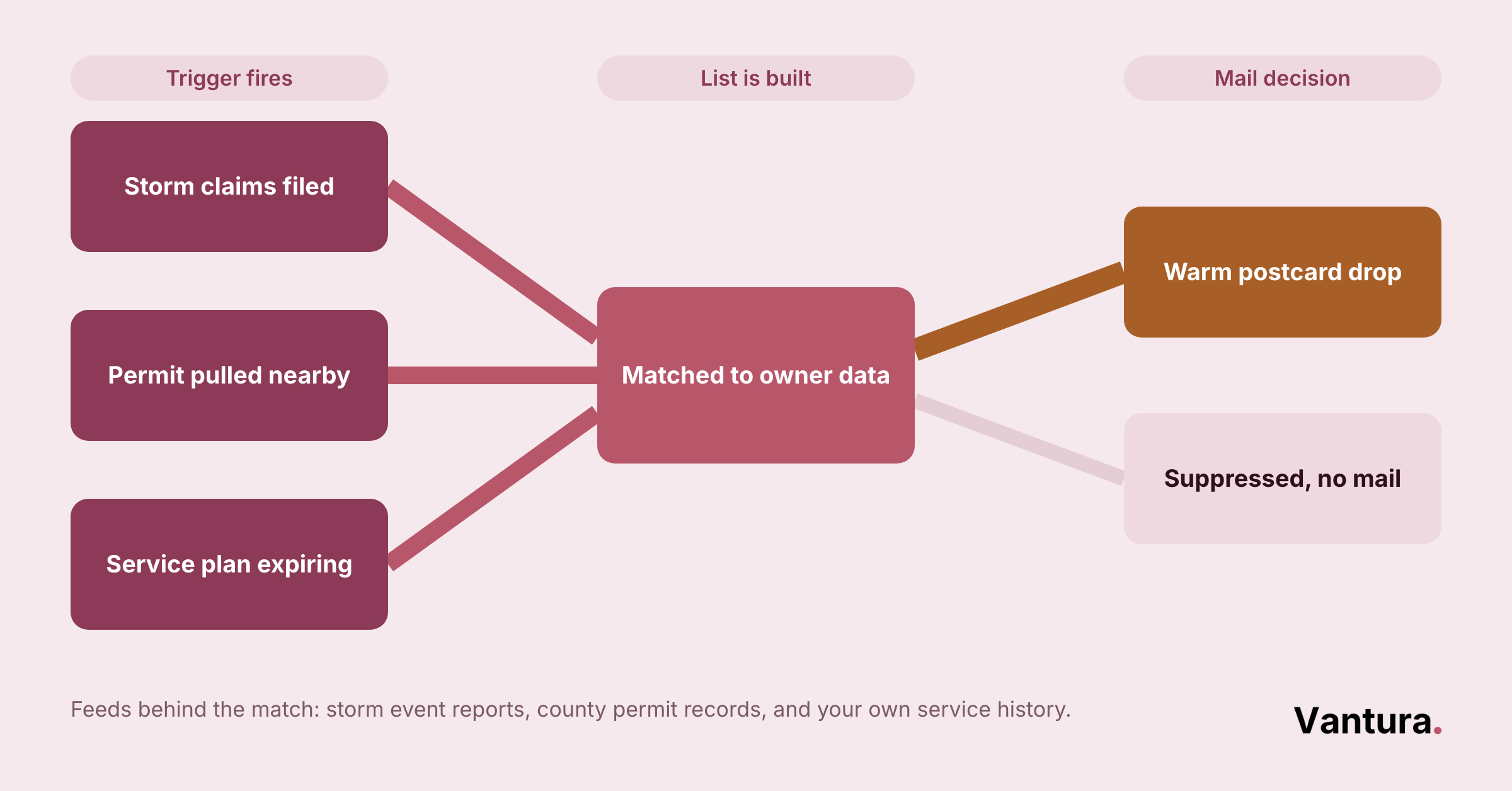
Construction direct mail marketing is the practice of sending printed offers, letters, and postcards to a chosen list of homeowners, developers, and facility managers to generate construction leads. It covers the whole cycle, from building the list to tracking the calls a mailer brings in.
Most contractors picture a generic flyer blasted to a whole neighborhood. The version that works is tighter, aimed at people with a real reason to hire you.
That reason might be a recent storm, a permit filed nearby, or a maintenance contract about to lapse. The more specific the trigger, the warmer the response.
Smaller trades and remodelers with lean small business marketing budgets lean on it because a good list beats a big one every time.
Worth knowing: direct mail is not the opposite of digital. The contractors who win treat a postcard as the first touch, then let their website, calls, and emails carry the rest of the conversation.
How Does Direct Mail Fit Into a Construction Digital Marketing Strategy?
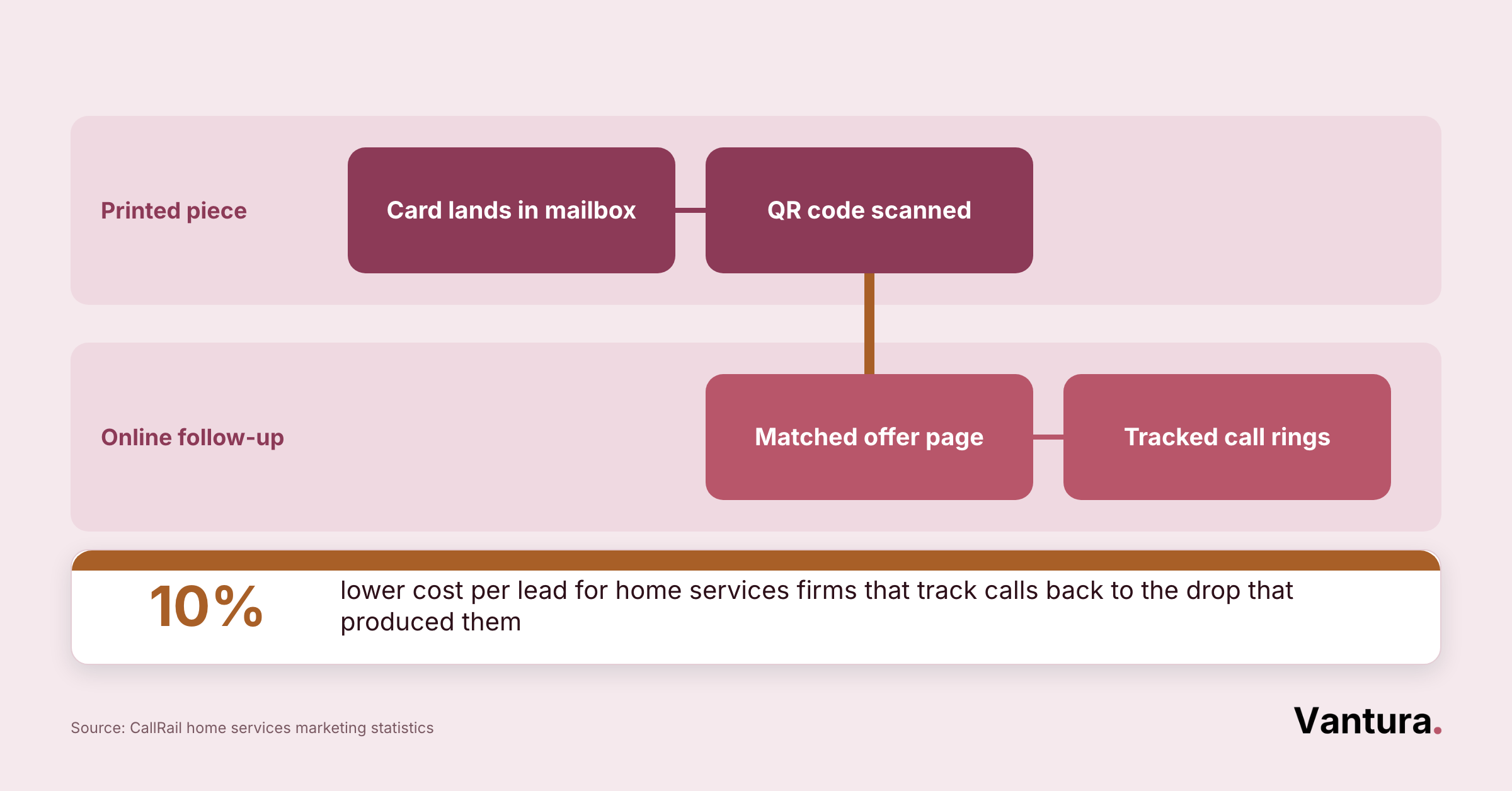
Direct mail fits into a construction digital marketing strategy as the offline touch that starts or reinforces an online one. It drives prospects to a landing page, a phone number, or a review profile, then digital channels carry the lead to a signed job.
On its own, a mailer is a one-way message. Paired with your online presence, it becomes a loop you can measure.
We usually line the two up inside a single digital marketing strategy. That way the mail date, the ad schedule, and the sales follow-up all point at the same week. When a homeowner gets a postcard on Tuesday and sees your ad on Thursday, both feel more legitimate.
A few common ways construction teams connect the two:
- Landing pages built for one offer, linked from the mailer.
- Retargeting ads that follow anyone who scans a code.
- Review requests mailed to finished jobs.
- Call tracking numbers unique to each drop.
Pairing Direct Mail With Digital Retargeting
Retargeting is where mail and digital stop competing. A prospect who scans your QR code or visits the URL on your postcard can join an online audience within minutes.
From there, your display and social ads keep showing up while they compare bids. In our experience, that combined touch lifts response on the second pass by a rough 15 to 25 percent over mail alone.
Direct Mail vs Email for Construction Marketing
Direct mail and email both reach construction prospects directly, but they win at different jobs. Mail gets opened and held, which suits high-value bids and cold lists. Email costs almost nothing and suits fast follow-up with people who already know you.
You don’t have to choose. Most of our best construction campaigns run both, with mail opening the door and email keeping it open.
Most commercial construction sales run through a buying committee. The same rules that guide our B2B marketing programs apply to the mail you send them.
Email also performs unusually well in this space. Campaign Monitor’s email benchmarks put the Real Estate, Design and Construction category at a 21.7 percent open rate. It also has the highest click-to-open rate of any industry, at 17.2 percent.
Best for cold prospecting, high-ticket bids, and audiences that ignore email. It costs more per piece, but it gets physically handled, so a strong offer stands out.
Best for nurturing known leads, sending quotes, and quick reminders. It’s cheap and instant, though inboxes stay crowded and cold sends often get filtered out.
The takeaway is simple. Lead with mail when you need attention, then switch to email once the conversation starts.
Types of Construction Direct Mail Campaigns
Construction direct mail comes in a handful of common formats. The right one depends on your offer, your budget, and how much you need to stand out in the mailbox.
A roofing marketing push after a hailstorm needs speed and volume. A design-build firm pitching a large remodel needs something that feels premium.
| Format | Best for | Typical piece |
|---|---|---|
| Postcards | Fast, high-volume offers | Compact card, about 6 by 9 inches |
| Self-mailers | Detailed offers without an envelope | Folded brochure |
| Dimensional mail | High-value bids that must get opened | Box or lumpy package |
| Every Door Direct Mail | Saturating a service area cheaply | Route-based postcard |
| Letters | Personal, permit-triggered outreach | Printed letter in an envelope |
| Newsletters | Staying top of mind with past clients | Multi-page mailer |
How Do You Design Construction Direct Mail That Gets a Response?
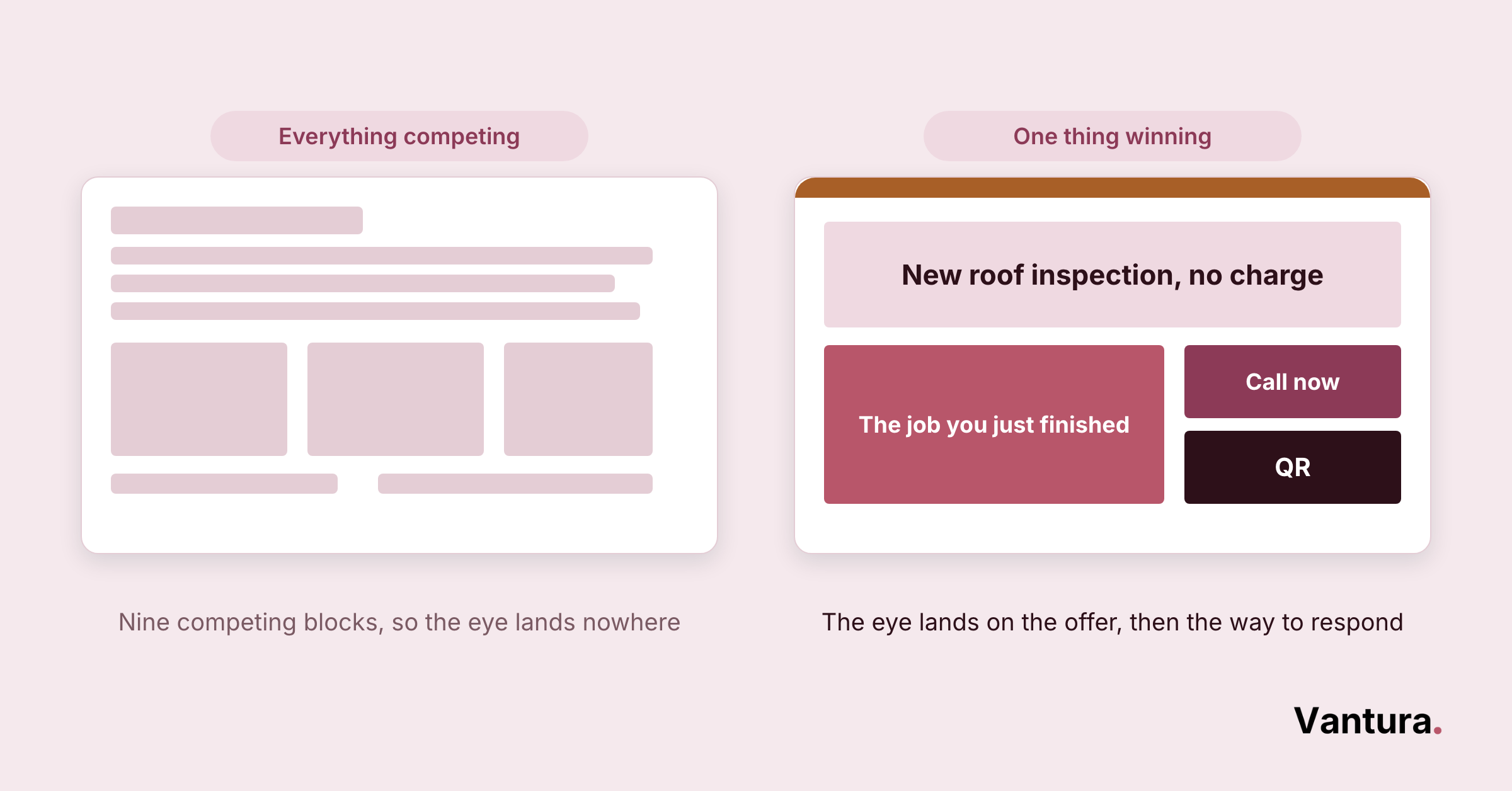
Good construction direct mail design leads with a single clear offer, uses a photo of real work, and makes the next step obvious. The goal is one message a busy homeowner grasps in three seconds, not a brochure that lists every service you own.
We’ve watched beautiful mailers flop because they buried the offer under a logo and a mission statement. The plainest postcard with a bold number usually wins.
Firms mailing property developers borrow cues from real estate marketing, where the photo does most of the selling.
Four design rules hold up campaign after campaign:
- Lead with the offer. Put the discount, guarantee, or free inspection where the eye lands first.
- Show real work. A photo of your crew or a finished roof beats stock art every time.
- Make one call to action. One number, one URL, one QR code, nothing competing.
- Leave white space. A cluttered card reads as junk and gets tossed.
Building and Targeting a Construction Direct Mail List
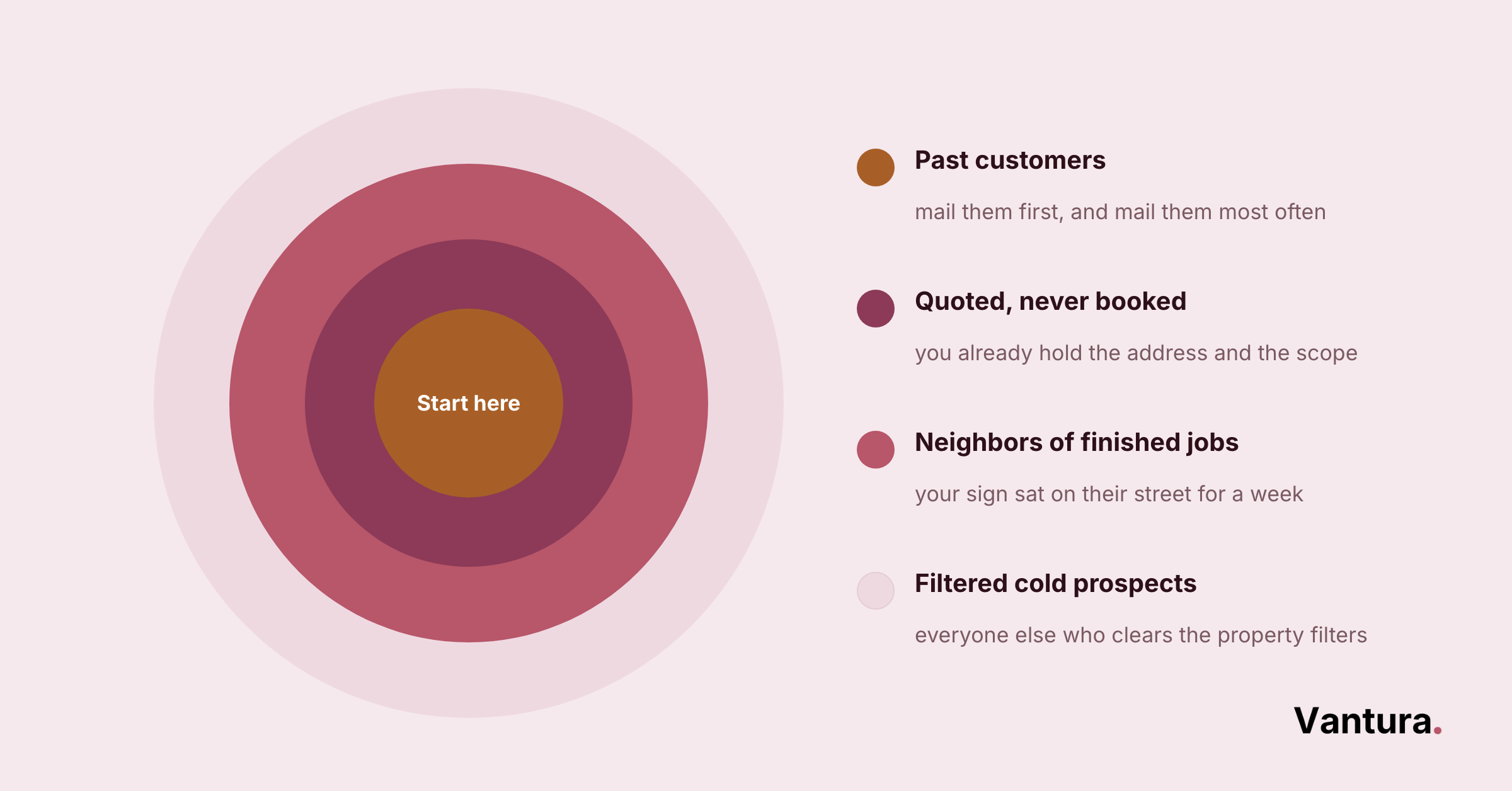
A construction direct mail list is only as good as its targeting. The strongest results come from your own past customers. From there, tightly filtered prospect lists built on property age, permit activity, storm data, or ownership records add reach.
This is where most budget gets wasted or saved. According to the ANA, mail sent to a company’s own house list of past customers returns a 15.6 percent response rate. Cold prospect lists return 10.8 percent.
So we start every construction list with the people who already paid you. Then we widen to lookalikes filtered by the traits that predict a real job.
For commercial and industrial mailers, we pull supplier and facility records the way our manufacturing marketing team builds account lists.
Field note: a list you rent goes stale fast. We re-pull permit and ownership data before every drop, because addresses from six months ago quietly send a chunk of your budget to empty houses.
Personalizing Construction Direct Mail
Personalization goes past printing a first name. The mailers that convert reference the property itself, the neighborhood, or the exact service that address is likely to need.
A postcard noting that a home’s roof is near the end of its typical lifespan lands harder than a generic discount. We’ve seen personalized variable-data mail lift response by a rough 50 to 70 percent over a one-size card across our projects.
How Do You Track and Measure Construction Direct Mail?
You track construction direct mail with unique phone numbers, QR codes, personalized URLs, and match-back reports that tie new customers to the addresses you mailed. Each method connects an offline drop to a measurable action, so you learn which list and offer paid off.
The old complaint about mail is that you can’t measure it. That stopped being true once every piece could carry its own trackable code.
A simple way to set tracking up:
- Step 1. Assign a unique phone number and URL to each mailing.
- Step 2. Add a QR code that lands on a matching page.
- Step 3. Match your new customer list back to the mailed addresses every month.
If your numbers never line up, a marketing audit usually finds the tracking gap before you spend another dollar.
Using QR Codes and PURLs in Construction Direct Mail
QR codes and personalized URLs turn a printed card into a clickable one. A homeowner scans, lands on a page built for that offer, and you capture the visit even if they don’t call yet.
PURLs go a step further by greeting each prospect by name and pre-filling a quote form. That small bit of ease pulls more responses from the same list.
Track Codes on Every Piece
Give each mailing version its own code so you can tell the storm postcard from the maintenance letter. Without that, scans blur into one number you can’t act on.
Connect Scans to Your CRM
Every scan should drop into your CRM as a lead with its source attached. That’s how a Tuesday drop becomes a Friday estimate you can trace.
What Does Construction Direct Mail Cost, and What ROI Does It Deliver?
Construction direct mail usually costs between 40 cents and 2 dollars per piece, all in, depending on format, list, and volume. Postcards sit at the low end, while dimensional mail runs highest. Return depends far more on the list than the postage.
Three things move the price. It comes down to how many pieces you print, how fancy the format is, and how clean your list is.
Bad addresses cost you twice, once to print and once in lost response. Cleaning the list first is the cheapest upgrade you can make.
On return, we stay honest with clients. Across our construction campaigns, a well-targeted mailer tends to return three to four dollars for every dollar spent. Weak lists can lose money outright.
The bigger lever is job value. When one won project is worth twenty thousand dollars, the math changes fast. An HVAC marketing mailer or a remodel offer clears its cost several times over on a single response.
Keep in mind: the cheapest mailer is rarely the most profitable. We’d rather send five hundred well-targeted pieces than five thousand random ones, because response, not postage, decides whether the campaign pays.
Printing and Fulfillment for Construction Direct Mail
Printing and fulfillment cover everything between your artwork and the mailbox. That means print quality, folding, addressing, postal sorting, and the drop date you hit.
Most contractors hand this to a mail house rather than manage postage themselves. The trade-off is a per-piece fee for speed and postal discounts you can’t get alone.
| Format | What’s included | Typical cost per piece |
|---|---|---|
| Postcard | Print, addressing, standard postage | 40 to 75 cents |
| Self-mailer | Print, fold, postage | 60 cents to 1.20 dollars |
| Letter package | Print, envelope, insert, postage | 75 cents to 1.50 dollars |
| Dimensional mail | Box, assembly, priority postage | 3 to 12 dollars |
| Every Door Direct Mail | Print, route-based postage | 30 to 55 cents |
Timing, Frequency, and Automating Construction Direct Mail
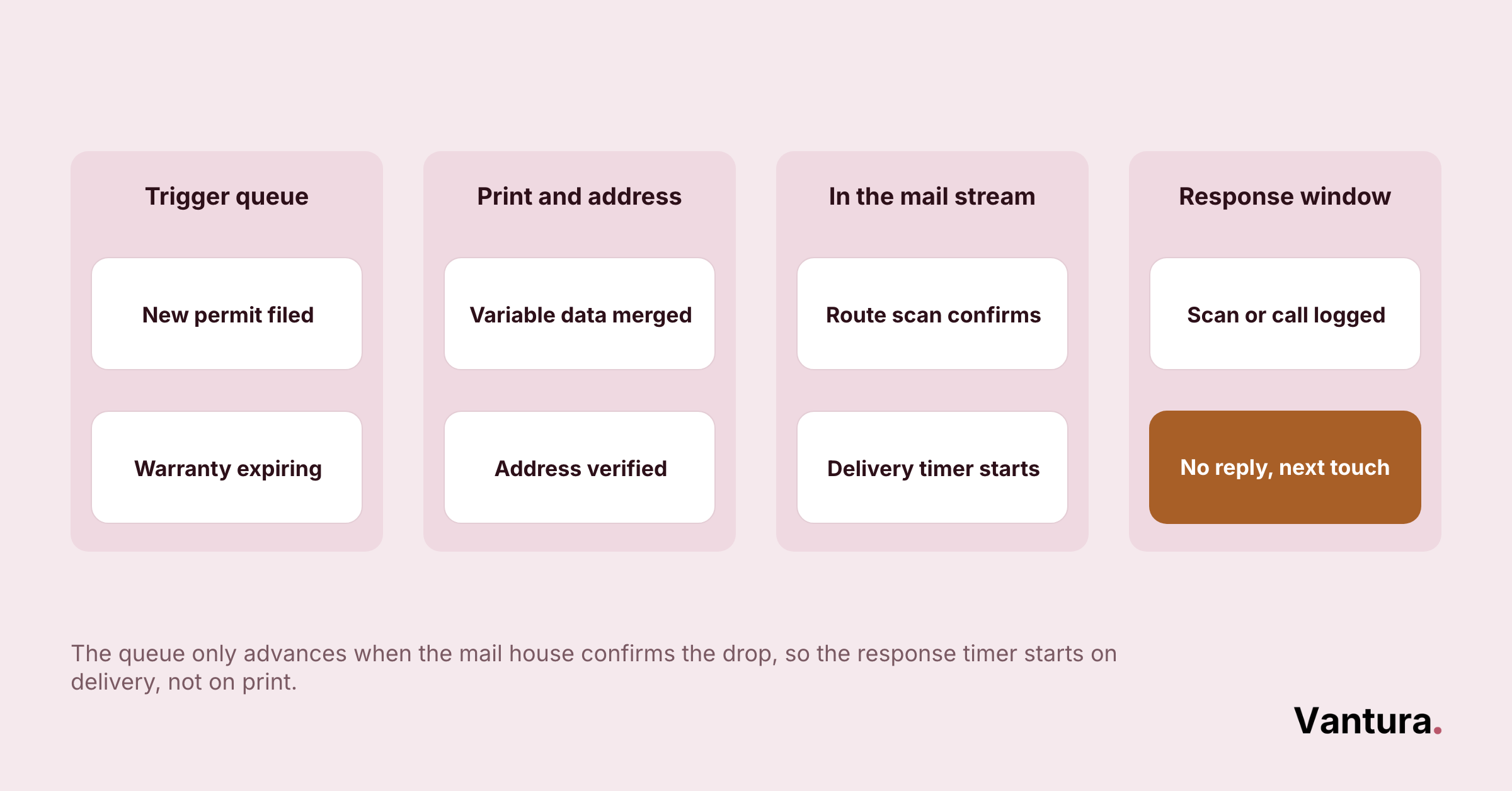
Timing and frequency decide whether construction direct mail sticks. One postcard rarely converts. The best programs mail the same list several times, spaced a few weeks apart. They also trigger drops around events like storms, permits, or seasonal demand.
We learned the hard way that a single send is wasted money. Response climbs with repetition, then flattens, usually around the third or fourth touch.
A cadence that holds up for most trades:
- Touch #1. The core offer, mailed to the full list.
- Touch #2. A reminder two to three weeks later.
- Touch #3. A deadline or seasonal hook.
- Touch #4. A last-chance card to non-responders only.
Automation keeps this running without a spreadsheet. Trigger-based platforms can mail a new homeowner, a lapsed customer, or a fresh permit automatically, the same way an email workflow fires.
For teams that don’t want to manage a calendar by hand, handing the whole cycle to an outsourced marketing team is often worth it. It usually costs less than a missed drop.
Using Direct Mail for Construction Customer Retention
Retention is the cheapest win in direct mail. Mailing past customers costs less and converts better than chasing strangers, yet most contractors forget the people who already trust them.
A maintenance reminder, a seasonal check-up offer, or a simple thank-you card keeps your name in the drawer when the next project comes up. Campaign after campaign, our repeat-customer drops out-earn cold ones by a wide margin.
Common Construction Direct Mail Mistakes to Avoid
The most common construction direct mail mistakes are easy to avoid once you’ve seen them sink a campaign. Nearly all trace back to a weak list, a buried offer, or quitting after one send. A quick marketing consulting review catches most of these before the print order goes out.
Construction Direct Mail Compliance and the Tools to Run It
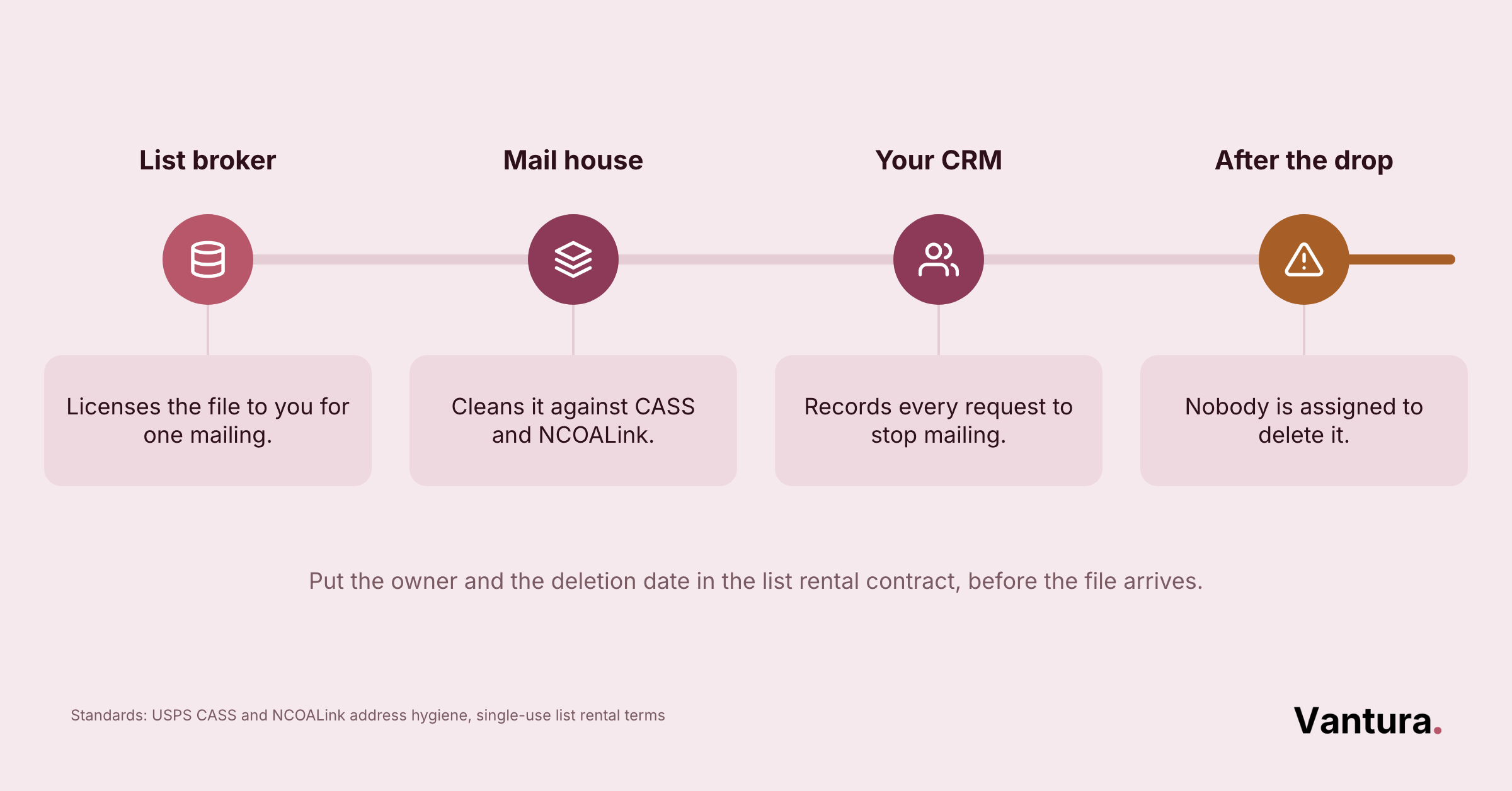
Construction direct mail compliance is lighter than email, but it still has rules. You must honor mailing opt-outs, follow postal addressing and content standards, and protect any customer data you use to build lists. Most trades stay clear simply by mailing clean, sourced records.
Direct mail avoids the strict consent rules that govern email and texts. Still, if you buy or store homeowner data, the privacy laws about how you collect and keep it apply.
Licensed trades like electrician marketing clients also watch state advertising rules on license numbers and claims.
Quick compliance checks before a drop:
- Honor every do-not-mail request.
- Use accurate return addresses and clear offers.
- Store list data securely and delete what you don’t need.
Tools and Providers for Construction Direct Mail
You don’t need enterprise software to run construction direct mail. Most trades combine a print-and-mail house with a CRM and a tracking layer, adding automation only when volume justifies it.
Leading options include national mail houses, print-on-demand platforms, and niche direct mail apps that plug straight into a CRM. We stay independent on tools, so our picks follow what fits your list and volume, not any vendor relationship.
Bottom line: the tools matter less than the list and the follow-up. Start with your past customers, mail them more than once, track every piece, and let your digital channels finish the job.
Disclaimer: This article is for general informational purposes only and does not constitute legal, financial, or professional marketing advice. Vantura Marketing makes no guarantee of specific results, since outcomes vary by market, list, and execution. Confirm all compliance requirements with a qualified professional before you mail.