Construction SWOT Analysis: Template & Examples (2026)

A construction SWOT analysis maps the strengths, weaknesses, opportunities, and threats shaping how a contractor markets its work, from a small remodeling crew to a regional builder. Builders, remodelers, and specialty trades use it to decide where the next marketing dollar should go before committing budget. Done well, it turns a vague sense of what’s working into a clear, ranked plan the whole team can act on.
Why Our Construction SWOT Work Stands Up:
Our 28 specialists have run campaigns for firms across 14 industries, backed by 190 plus combined years of hands-on work. That depth lets us fill an honest grid for any construction niche, not a recycled one.
Want a SWOT Built Around Your Firm?
Get in touch and we’ll weigh your priorities against real bid data through construction marketing consulting, not a template. We turn the four quadrants into a plan your crews can act on this quarter.
What Is a Construction SWOT Analysis in Marketing?
A construction SWOT analysis in marketing is a simple grid that sorts your strengths, weaknesses, opportunities, and threats. It gives a contractor one page showing where the marketing stands and what to fix first.
The four letters split into two pairs. Strengths and weaknesses sit inside your business, while opportunities and threats come from the market around it.
Most firms we work with have never written one down. The picture lives in a few people’s heads, which makes it easy to argue about and hard to act on.
Running one next to a proper digital marketing audit turns those gut feelings into something the whole team can see. That’s the point where a SWOT stops being an exercise and starts steering budget.
| Quadrant | What it looks at | Construction marketing example |
|---|---|---|
| Strengths | What you do well inside | Strong Google reviews and a full project gallery |
| Weaknesses | Internal gaps to fix | No one owns marketing, slow quote follow-up |
| Opportunities | Outside openings to seize | Rivals ignoring paid search, video walkthroughs |
| Threats | Outside risks to plan for | Rising ad costs, a new franchised competitor |
Quick definition: a SWOT isn’t a report you file away. It’s a working grid you pin above the marketing plan and check every quarter, so strengths get used and threats never catch the crew off guard.
How Do You Run a Construction Marketing SWOT, Step by Step?
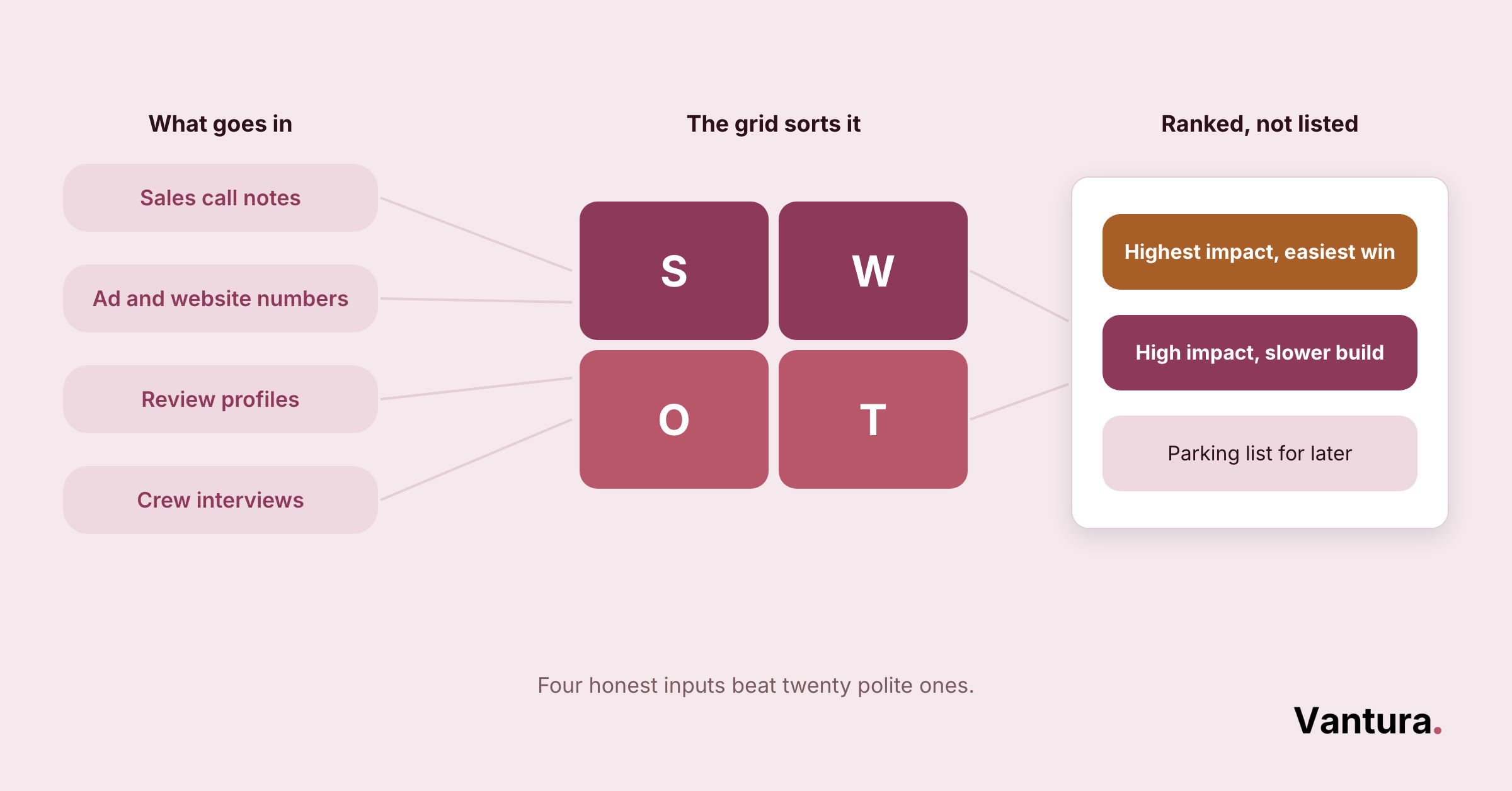
You run a construction marketing SWOT by gathering honest input, filling each quadrant with real examples, then ranking what matters. The whole exercise takes an afternoon, not a month.
The order matters more than the tool itself. Skip the prep and you end up with a grid full of vague, feel-good bullets.
We use the same sequence on every construction marketing strategy engagement, from a solo remodeler to a regional builder. It keeps a big firm and a two-truck crew working off the same simple frame.
Step #1: Gather Stakeholder Input
Pull your sales notes, review profiles, ad reports, and website numbers into one place. Then ask the people who talk to clients what they really hear.
Stakeholder input keeps the grid honest. Estimators, the office manager, and even a longtime subcontractor often spot gaps the owner has stopped noticing, so loop them in before you write a single bullet.
Step #2: Fill the Four Quadrants
Work through strengths, weaknesses, opportunities, and threats in that order. Give every bullet a concrete example, never a one-word label.
- Write each entry as a full phrase, not a single word
- Back it with a number or a real project
- Keep the list to the top five per box
Step #3: Score and Rank Each Item
Not every bullet deserves equal weight. Score each one on impact and on how easy it is to act on.
In our experience, a quick one-to-five score on both cuts a messy grid down to the six items worth real budget. Everything else can wait for a calmer quarter.
Step #4: Turn It Into Priorities
Close by picking two strengths to push and two weaknesses to fix this quarter. Anything left over goes on a parking list for the next review.
What Goes in Each Quadrant of a Construction Marketing SWOT?
Each quadrant of a construction marketing SWOT holds a different kind of insight. Strengths and weaknesses look inward at your team and tools, while opportunities and threats look outward at the market.
Identifying Construction Marketing Strengths
Strengths are the assets that already win you work online. Most contractors underrate them because they feel ordinary from the inside.
- Reviews: a stack of five-star ratings rivals can’t fake
- Portfolio: real before-and-after project photos
- Local name: years of word-of-mouth in one service area
- Repeat clients: an email list of past customers
Identifying Construction Marketing Weaknesses
Weaknesses are the internal gaps that quietly cost you bids. They’re the hardest box to fill honestly, since no one enjoys listing them.
A common one is having no in-house marketer, so the website and reviews drift. Bringing in an outsourced marketing team is often the fastest way to close it.
- No system: leads tracked on paper or from memory
- Thin content: a website untouched in years
- Slow follow-up: quotes that go out days late
- One channel: everything riding on referrals
Construction Digital Marketing Opportunities to Explore
Opportunities are outside shifts you can ride before rivals do. Right now, most of them sit in digital channels contractors still treat as optional.
Across our construction accounts, digital adoption keeps climbing even among firms that used to lean entirely on referrals. That wave pulls buyer habits along with it, and it rewards the contractors who show up first.
The same developers and homeowners now research trades online first, which opens room for firms that show up well. It’s why we push industrial marketing programs for clients chasing commercial and civil work.
- AI search tools surfacing local contractors
- Video walkthroughs of finished projects
- Underused paid search in many trades
- Referral ties with architects and suppliers
Construction Marketing Threats and How to Mitigate Them
Threats are external risks that can shrink your pipeline fast. You can’t stop them, but you can plan around each one.
Rising ad costs, a big franchised competitor, and swings in permit volume top most lists. The fix is rarely one move, it’s spreading risk across more than a single channel.
Competition itself keeps intensifying industry-wide. Crayon reports that 57.5% of competitive intelligence and sales leaders now see more of their deals turn competitive than a year ago, against just 16% who say it eased, which is exactly why the Threats box deserves a fresh look each quarter, not a one-time write-up.
| Threat | Why it bites | How to mitigate it |
|---|---|---|
| Rising ad costs | Cost per lead climbs | Build organic and email so you’re not renting every lead |
| New competitor | Splits local demand | Sharpen your niche and keep reviews coming |
| Seasonal swings | Bid volume drops off | Bank content and leads before the busy season |
| Algorithm shifts | Traffic dips overnight | Spread across search, social, and referrals |
Watch for: the biggest threat we see isn’t a competitor, it’s standing still. Firms that skip digital while rivals invest lose ground slowly, then all at once when a slow season hits.
Construction Internal vs External SWOT Factors
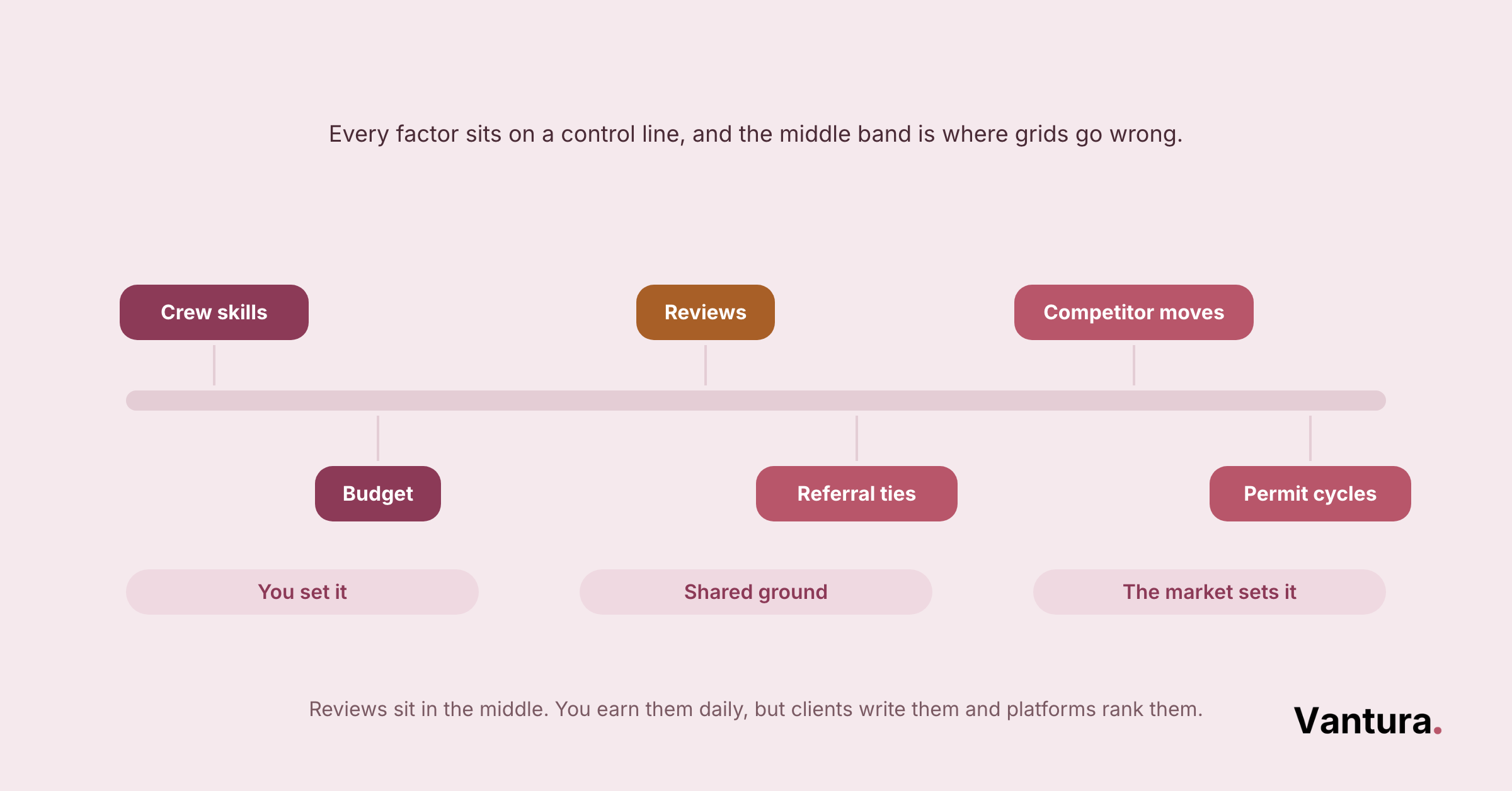
Two of the four quadrants sit inside your business, and two sit outside it. Sorting them this way stops the classic mix-up of listing a market trend as a strength.
Internal factors are the ones you own and can change. They cover the team, the tools, and the day-to-day process behind your marketing.
- Team skills and who owns marketing
- Website, CRM, and review tools
- Budget and how fast you follow up
External factors come from the market, and no single firm controls them. You track them so nothing catches the business off guard.
- Competitors and what they publish
- Local demand, rates, and permit cycles
- Rules on advertising and customer data
For a smaller crew, marketing help for small contractors usually starts by fixing the internal column first. The external threats matter far less until the basics at home are solid.
Construction SWOT vs PESTLE: Which Planning Tool Fits?
A construction SWOT and a PESTLE analysis answer different questions. SWOT weighs your firm against the market, while PESTLE scans the wider forces that shape the whole industry.
Most contractors only need a SWOT. PESTLE earns its place when you plan a big move, like opening in a new region or chasing public contracts.
| What it covers | SWOT | PESTLE |
|---|---|---|
| Focus | Your firm against the market | Big-picture industry forces |
| Boxes | Strengths, weaknesses, opportunities, threats | Political, economic, social, tech, legal, environmental |
| Best for | Quarterly marketing planning | Major expansion or new market entry |
| Effort | An afternoon | A deeper research project |
In practice, we run PESTLE once a year at most, then feed its findings into the opportunities and threats side of the SWOT. That keeps the SWOT grounded without turning it into a research report.
How Do You Use a Construction SWOT to Prioritize Marketing Channels?
You use a construction SWOT to prioritize channels by matching each strength and opportunity to the channel that plays to it. The grid tells you where to spend first and what to leave for later.
A firm with a strong review profile should lean into local search. One sitting on great project photos belongs on visual channels.
Pulling those signals into a single integrated marketing program keeps the channels reinforcing each other instead of competing for budget. That’s usually where scattered spending starts to pay off.
| Channel | SWOT signal that favors it | Priority |
|---|---|---|
| Local SEO | Strong reviews, fixed service area | High for most trades |
| Paid search | Weak organic, urgent demand | High when leads are needed fast |
| Project galleries | Strong photos, weak website | Medium, high visual payoff |
| Big past-client list | Low cost, steady return |
Rank the channels, don’t run them all at once. Two done well beat five done halfway, especially on a contractor’s budget.
Applying a Construction SWOT to Each Marketing Channel
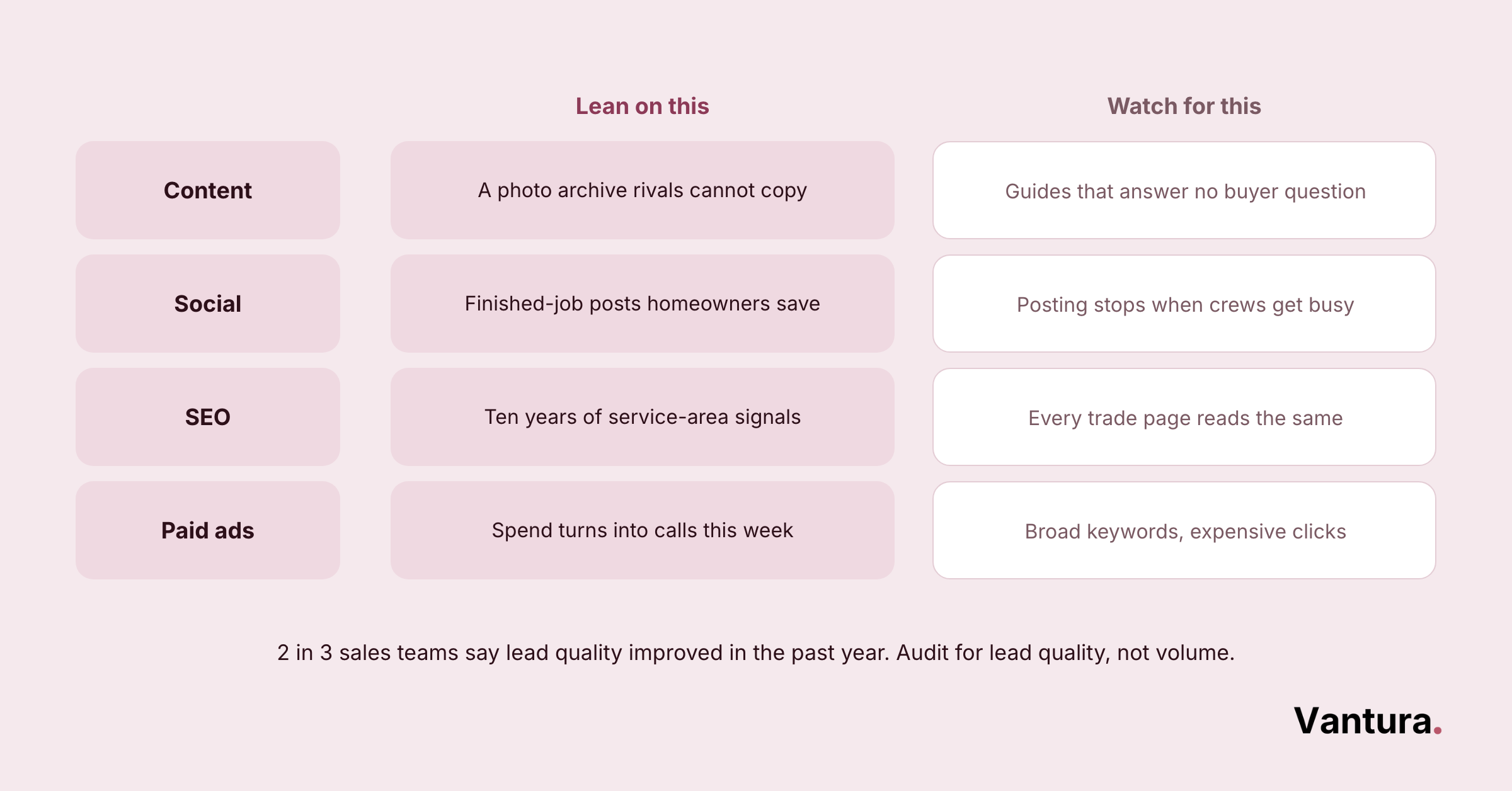
You apply the SWOT channel by channel by running a mini version for each one. The same four boxes reveal where content, social, SEO, and paid ads each stand.
Construction SWOT for Content Marketing
Content is often a hidden strength for trades that document their work. The weakness shows up as a blog nobody has touched in a year.
For firms chasing commercial jobs, B2B construction marketing content like spec guides and safety records tends to win the most trust. It answers the exact questions a procurement team asks before a bid.
Construction SWOT for Social Media Marketing
Social media rewards firms with strong visuals and a steady posting habit. The threat is spreading thin across platforms that never send a single lead.
Residential remodelers in particular see real traffic from Pinterest ad campaigns, since homeowners save project ideas there for months. That long shelf life is rare on faster-moving feeds.
Construction SWOT for SEO Performance
SEO strengths usually hide in local reviews and years of service-area history. Weaknesses tend to surface as slow pages and thin service descriptions.
Contractors selling big, considered projects can borrow landing-page ideas from real estate marketing tactics, where the buying decision is just as slow. Both fields need proof and patience on the page.
Construction SWOT for Paid Advertising
Paid ads turn a budget strength into fast leads, but rising costs are the standing threat. The opportunity is bidding on terms bigger rivals ignore.
In our experience, narrow service-plus-city keywords beat broad ones for most trades. They cost less and pull people who are ready to request a quote.
Landing pages carry as much weight as the ad itself. Unbounce found a median landing page conversion rate of 6.6 percent across industries, a useful benchmark for judging whether your quote-request page is pulling its weight before you blame the keywords.
How Do You Turn Construction SWOT Insights Into an Action Plan?
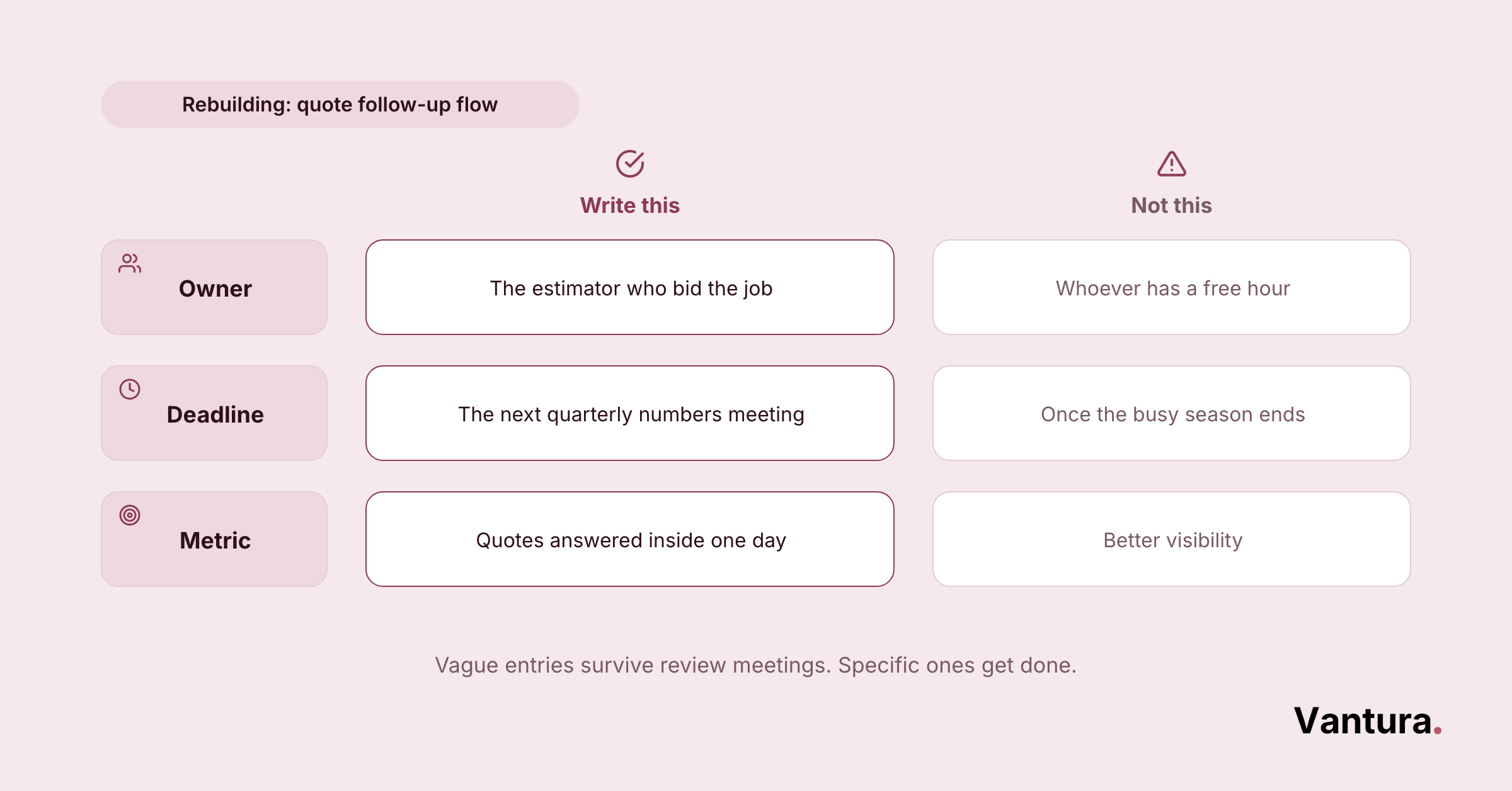
You turn SWOT insights into an action plan by giving each priority an owner, a deadline, and one number to hit. Without those three, a SWOT stays a wall of sticky notes.
Alignment is the whole point. The plan only works when every marketing task traces straight back to a strength or threat the grid surfaced.
Building the Action Plan
From Grid to Goals
Take your top two strengths and top two fixes, then write one action for each. Keep the quarter’s list to four items, not fourteen.
- Owner: one named person per action
- Deadline: a date inside this quarter
- Metric: the single number that proves it worked
Larger builders running several regions often fold this into wider enterprise marketing support so each branch works from the same grid. It stops one strong office from drifting away from the plan.
Bottom line: a SWOT with no owners is just a list. The firms that get results assign every priority to a person and review it on a fixed date, so nothing quietly slips off the plan.
SWOT Findings and Strategic Alignment
A SWOT only earns its keep when its findings truly shape the marketing plan sitting next to it. If the grid says content is a strength but the budget still favors paid ads alone, the two documents are quietly working against each other.
From Findings to Strategy
Walk each finding into the annual plan before you leave the review meeting. A strength earns more budget, a weakness earns a fix, and a threat earns a line in the risk column, not just a mention nobody wrote down.
We’ve watched construction marketing plans drift from their own SWOT within a single quarter, simply because no one connected the two documents on paper. Naming the link keeps both honest.
How Often Should You Update a Construction Marketing SWOT?
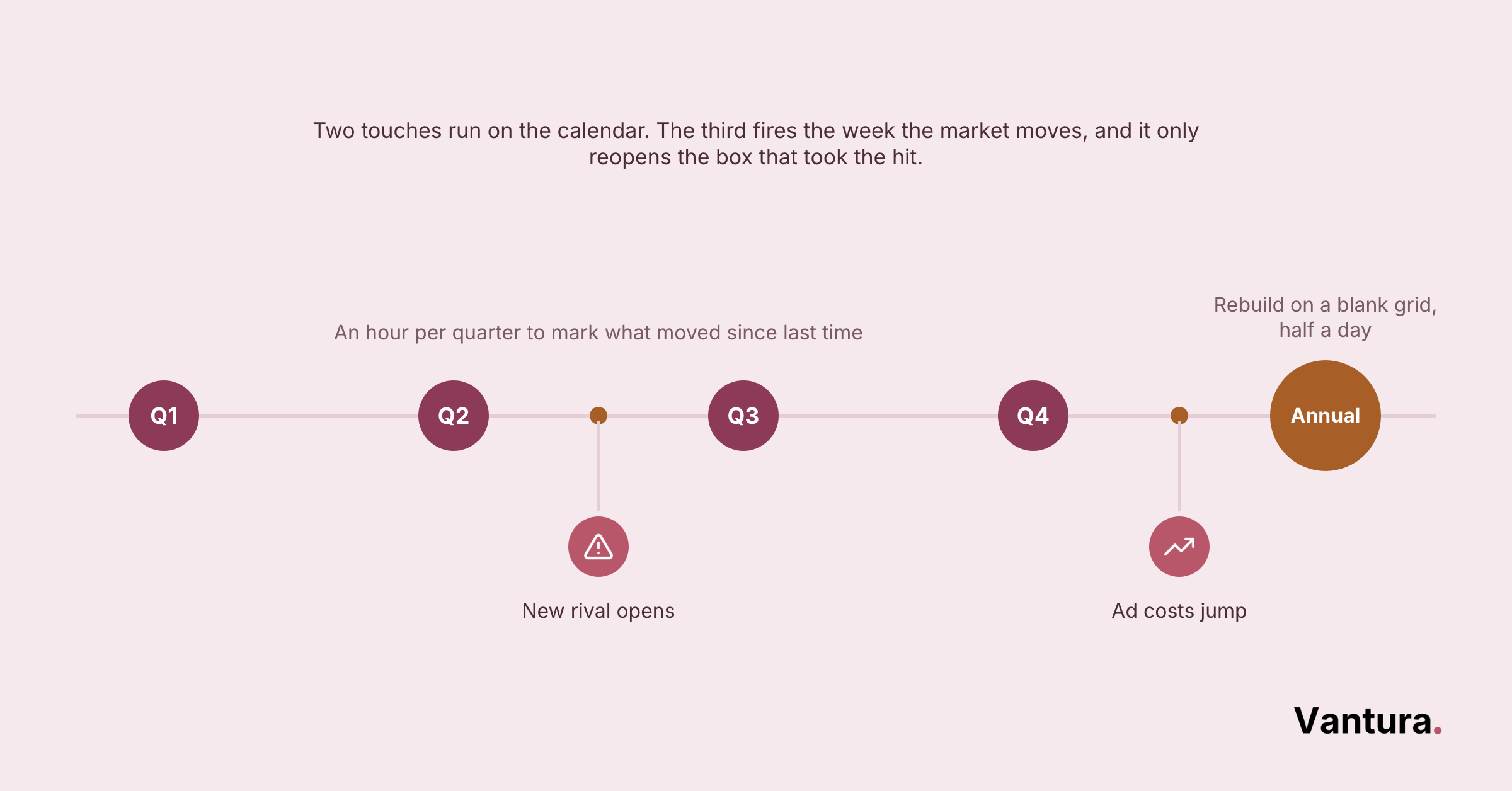
Update a construction marketing SWOT once a quarter, with a deeper review each year. Marketing conditions and permit cycles shift too fast for a once-a-year grid to keep up.
Tie the review to something already on the calendar, like a quarterly numbers meeting. That way it happens without another standing invite to ignore.
Bring the same mix of people each time. The owner, whoever handles marketing, and a client-facing estimator will together catch far more than any one of them alone.
- Each quarter, a quick refresh of all four boxes
- Each year, a deeper look with sales and finance
- After any big shift, a new competitor or rate change
Common Construction Marketing SWOT Mistakes
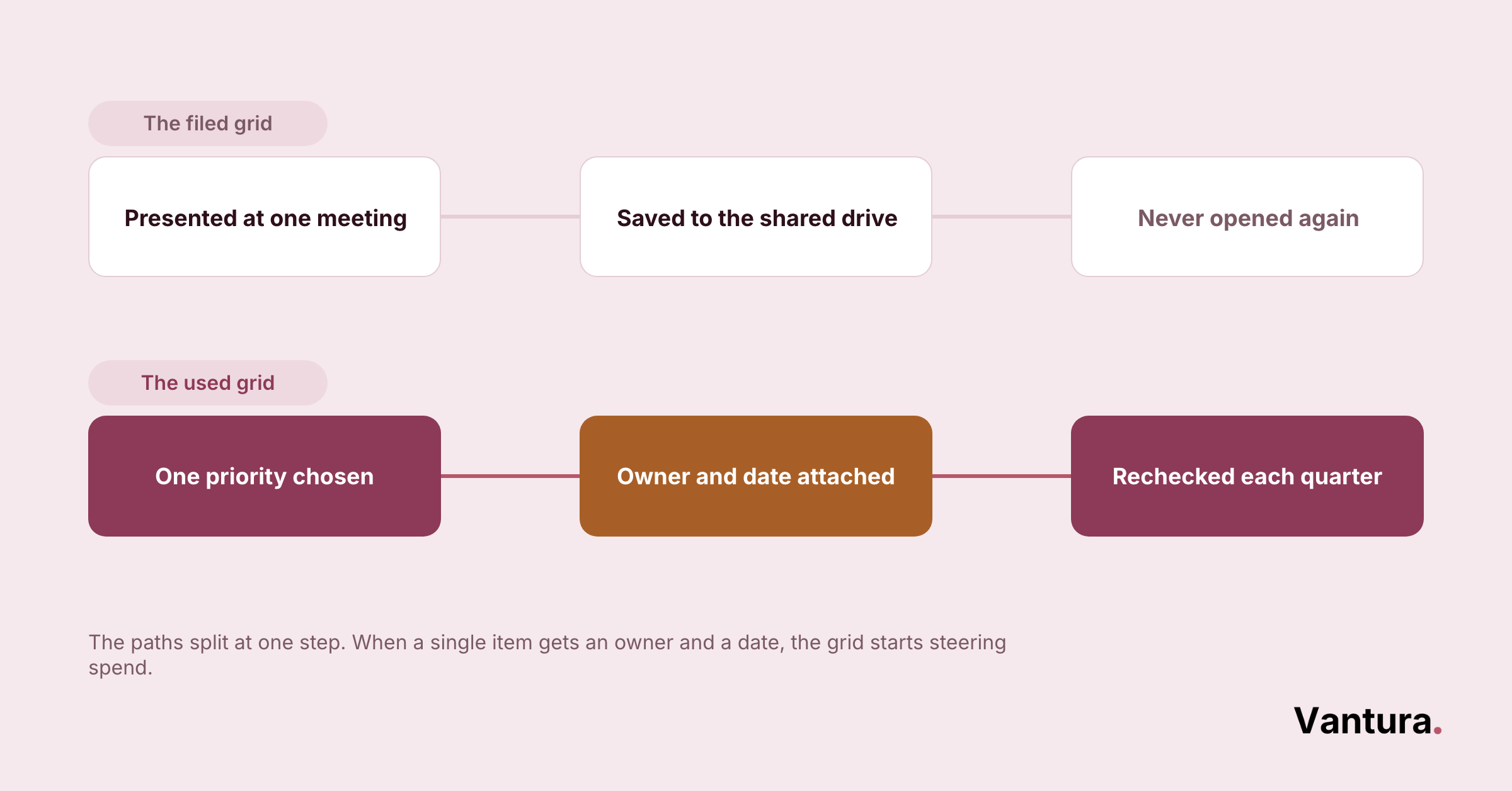
Most construction SWOT analyses fail in the same few ways. Knowing them ahead of time keeps your grid from turning into a feel-good exercise.
- Vague bullets: one-word entries with no example
- All strengths: a grid too flattering to be useful
- No ranking: every item treated as equally urgent
- Filed away: built once, then never opened again
- Wrong box: a market trend listed as a strength
The biggest miss is treating the SWOT as a document instead of a decision tool. We’ve watched sharp grids gather dust because no one turned them into a single next step.
Keep in mind: a rough SWOT you actually use beats a polished one you file. Aim for five honest bullets per box and one clear action, then sharpen it at the next review.
Disclaimer: This SWOT template and the examples above are shared for general informational purposes only and are not a substitute for tailored marketing, financial, or legal advice. Results depend on your firm’s own market, resources, and follow-through, so we cannot guarantee a specific outcome. Vantura Marketing has no ownership stake or vendor tie to any platform or brand referenced above, and each remains the property of its own owner.