Construction Brand Positioning: Framework & Examples

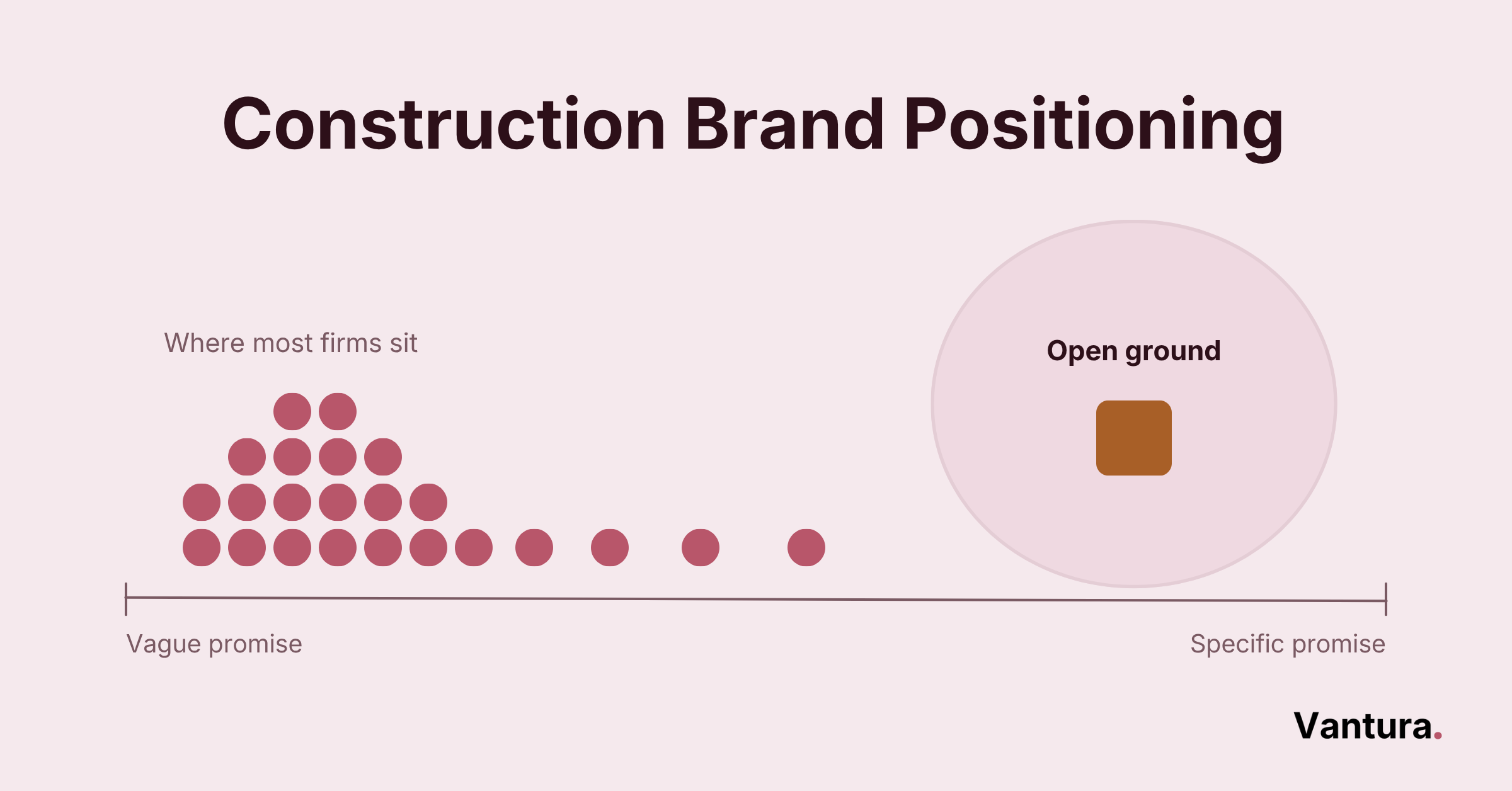
Construction brand positioning is the specific place your company owns in a buyer’s mind, the reason clients pick you over the next contractor. It shapes how general contractors, developers, and homeowners judge your reliability and price before they ever call. Get the position right and every bid, ad, and referral starts pulling the same direction.
Why Builders Trust Our Positioning Work
We’ve logged 190+ combined years shaping marketing that has to win real bids, not just look sharp. Across 180+ campaigns in 14 industries, we’ve learned what makes a construction brand stick in a buyer’s memory.
Ready to Sharpen Your Position?
Not sure where your brand stands today? Reach out and we’ll map your position, your rivals, and the gap worth owning, then build a digital marketing strategy around it.
What Is Construction Brand Positioning?
Construction brand positioning is the clear, defendable place your firm holds in the market, built on one main promise buyers remember. It answers a plain question in the client’s head, why you and not the next contractor on the list.
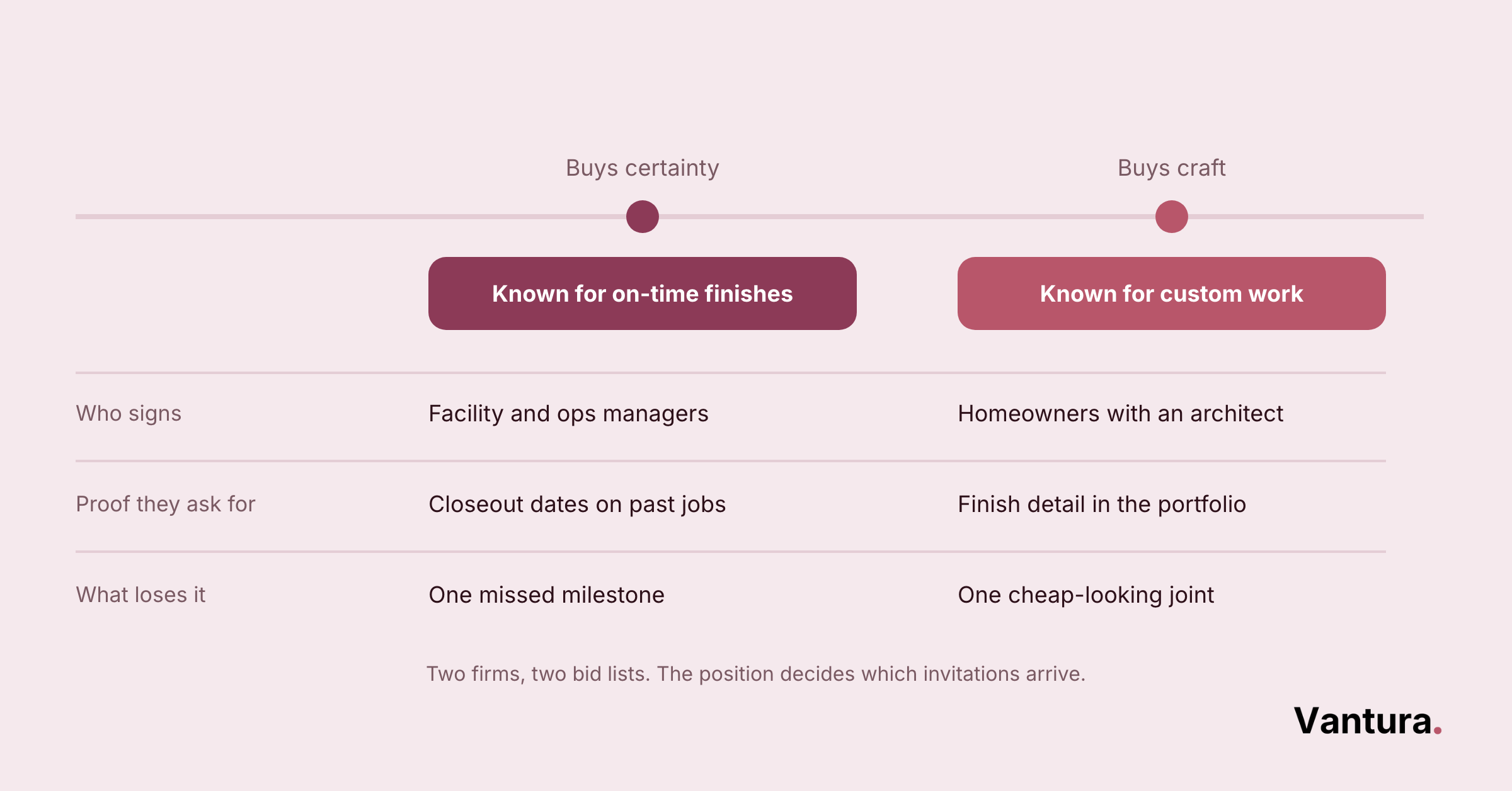
Think of it as the short version of your reputation, the line people repeat when they refer you. A remodeler known for on-time finishes owns a different spot than one known for high-end custom work.
Both firms can win, but they win different jobs, and strong positioning makes that choice on purpose. Construction sits inside the wider world of industrial marketing, where proof carries more weight than a clever slogan.
What it comes down to: Positioning is not your tagline or your logo. It’s the single idea you want a client to hold about your firm. It only works if your crews, your bids, and your reviews all say the same thing.
Construction Brand Positioning vs Brand Identity
People mix these up, so let’s keep them apart. Positioning is the idea you want to own, identity is how that idea looks and sounds, and reputation is what people already believe.
Your logo, colors, and truck wraps are identity. The promise behind them is positioning, and the two should never fight each other.
| Aspect | Brand positioning | Brand identity | Brand reputation |
|---|---|---|---|
| What it is | The idea you want to own | How that idea looks and sounds | What people already believe |
| Who controls it | Your leadership and strategy | Your design and content team | Your past clients and crews |
| Where it lives | Your messaging and bids | Logo, site, signage, wraps | Reviews, referrals, word of mouth |
| Builder example | “The safest choice for schools” | Navy and safety-orange brand kit | “They finish on time” |
Get identity right and you look consistent. Get positioning right and you get chosen.
How Do You Write a Construction Positioning Statement?
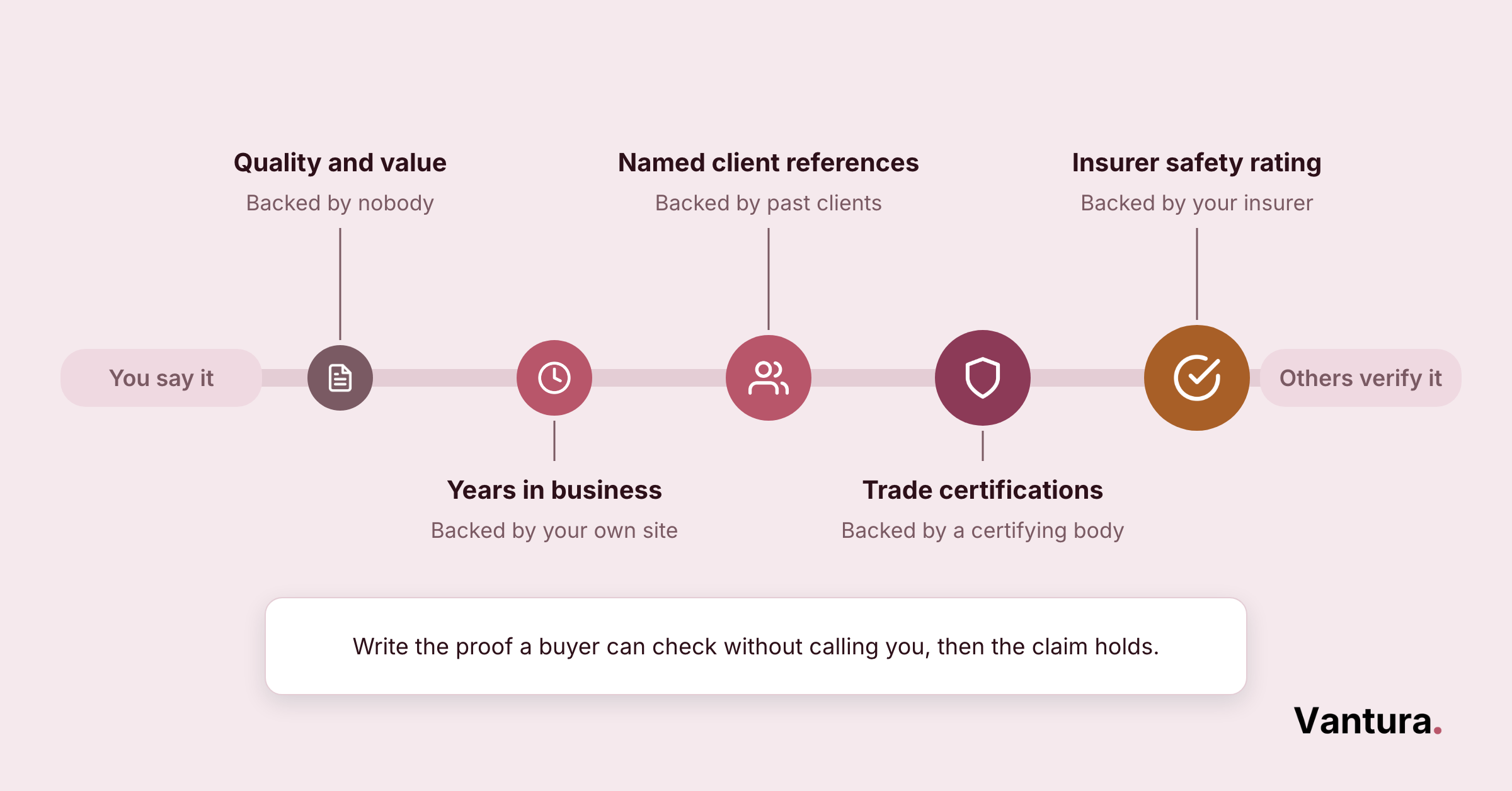
A construction positioning statement names who you serve, the category you play in, the one benefit you own, and the proof behind it. Keep it to a sentence or two, written for your team, not for your website.
The four-part positioning statement
Fill these four parts in order and you’ve got a working draft. Say it out loud, and cut anything you’d feel silly claiming to a real client.
Step 1: Name the buyer
Pick the client you most want more of, like commercial developers or high-end homeowners. A statement built for everyone lands with no one.
Step 2: Set the category
Say what kind of firm you are in plain words, such as design-build or tenant improvement. This is the shelf buyers file you on.
Step 3: Own one benefit
Choose the single thing you beat rivals on, like schedule certainty or clean punch lists. One sharp benefit beats a list of five soft ones.
Step 4: Back it with proof
Attach the reason to believe you, like a safety record or a repeat-client rate. Proof is what turns a claim into a position.
Building your messaging framework
Your framework is one core message plus three supporting pillars. The core message carries your main promise, and each pillar backs it with a different kind of proof.
- Core message: the one promise you lead with
- Pillar one: results, like on-time or on-budget delivery
- Pillar two: people, like tenured crews and clear communication
- Pillar three: process, like safety and quality controls
Sharpening your value proposition for digital
Online, your promise has about five seconds to register. A visitor should read your homepage or profile and know exactly what you do and who you do it for.
Cut the vague lines about quality and passion, since every rival claims them. Put the specific benefit and the proof right at the top, where nobody has to scroll.
If the message still feels muddy, a short round of digital marketing consulting can pressure-test it before it goes live. A second set of eyes catches what you can’t see anymore.
Field note: Homepages that name a specific buyer and a single benefit tend to book more qualified calls than ones leading with “quality craftsmanship.” Specific almost always beats impressive.
Who Should Your Construction Brand Positioning Target?
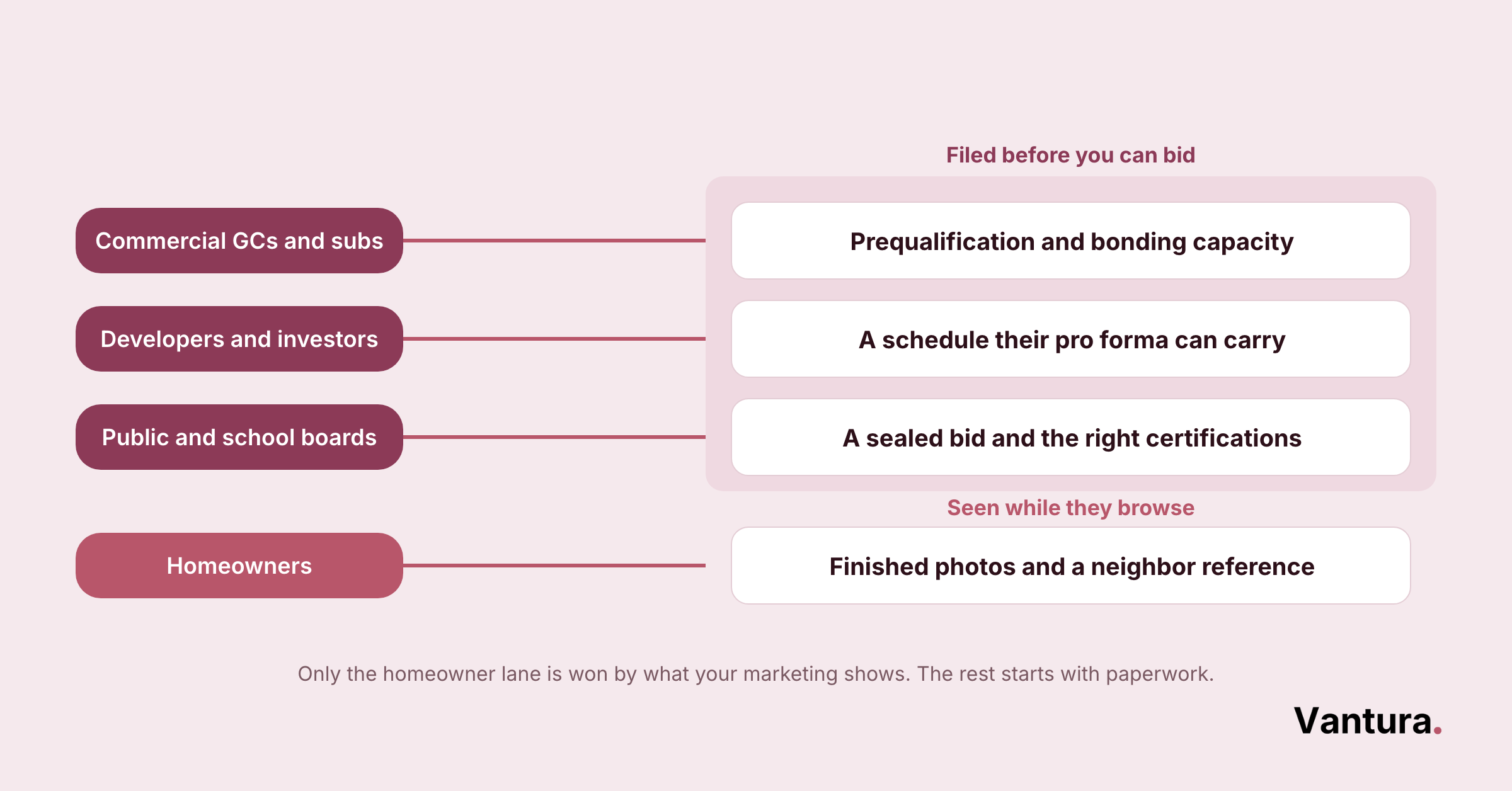
Your positioning should target the one buyer group that drives most of your profit, not every client you could technically serve. Most construction firms sit in one of a few lanes, so pick the lane you already win in.
- Commercial general contractors and their subs
- Property developers and investors
- Homeowners for custom builds or remodels
- Public and institutional buyers, like schools and municipalities
Commercial work leans on the same trust signals that drive B2B marketing, like references and a track record. The buying group is bigger and slower, so proof does the heavy lifting.
Homeowner-focused builders lean toward look, feel, and the stress of living through a job. Firms chasing developers instead borrow habits from real estate marketing, where timelines and returns rule the conversation.
How Do You Stand Out in a Crowded Construction Market?
You stand out by owning one angle rivals can’t easily copy, then proving it everywhere buyers look. In a market where everyone claims quality and value, the specific and the provable win.
Differentiation isn’t about being better at everything. It’s about being the obvious choice for one kind of job.
| Positioning angle | What it says to buyers | Where it wins |
|---|---|---|
| Schedule certainty | “We finish when we say we will” | Tenant improvement, retail rollouts |
| Complex builds | “We handle the jobs others pass on” | Healthcare, labs, phased work |
| Design-build under one roof | “One team, fewer surprises” | Custom homes, boutique commercial |
| Local roots | “We know this county and its inspectors” | Municipal, small commercial |
Pick the row that matches your real strength, then build the proof to back it. A firm claiming complex builds needs case studies and certifications, or the claim falls flat.
From our projects: Across our construction clients, firms that narrow to two or three angles tend to shorten their sales cycle by roughly 15 to 25 percent. Buyers self-select faster when the message is narrow, and trying to own every angle usually stretches the cycle back out.
Construction Brand Voice, Tone, and Story
Positioning sets what you say. Voice, tone, and story decide how it sounds when clients hear it.
Voice and tone that match the job
Your voice is how your brand always sounds, and your tone is how it flexes by moment. A safety update reads serious, while a project reveal can loosen up.
For most construction firms, plain and steady beats polished and corporate. Write the way a good project manager talks on site, clear and calm.
Your brand story and narrative
A good construction story isn’t your founding date, it’s the problem you keep solving for clients. Maybe you started because too many jobs ran late, so schedule became your obsession.
Tie the story back to the buyer, not to your ego. The hero of a strong brand story is always the client, and your firm is the guide that gets them there.
How Do You Audit Construction Brand Perception?
You audit brand perception by gathering what clients, staff, and search results say about you, then comparing it to the position you want. The gap between the two is your work list.
When the same phrase keeps surfacing, you’ve found your real position, earned or not. If it doesn’t match your goal, a focused digital marketing audit can show you where the gap starts.
Positioning Across Content, Social, and Paid Channels
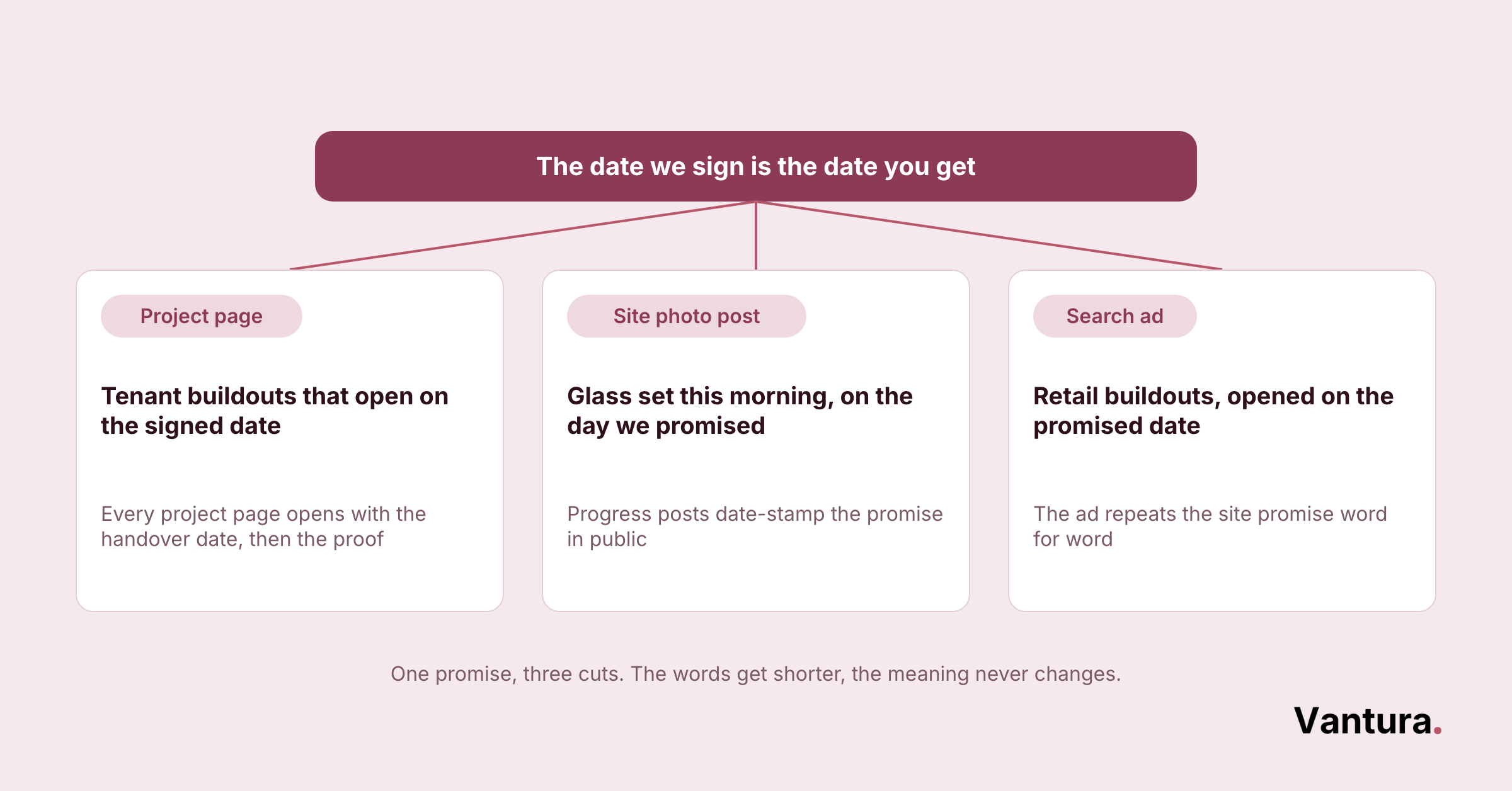
Your position only counts when buyers meet it in the wild, on your blog, your feed, and your ads. Construction marketing has moved online fast, and every channel now has to carry the same promise without a single weak link.
Content that carries the message
Every article, project page, and FAQ should reinforce your one angle. A schedule-certainty firm writes about planning, sequencing, and hitting dates, not generic building tips.
Positioning across social platforms
Show the work, since construction is visual and buyers trust what they can see. Progress photos, before-and-afters, and short site clips often beat a polished ad.
Short-form video carries its own weight here too. Instagram Reels pull 22 percent more interaction than standard video posts, according to Sprinklr, so a quick site walkthrough often earns more attention than a static photo.
Visual-first Pinterest ad campaigns can push finished-project imagery in front of homeowners who are still planning a build. Boards get saved and revisited for months, unlike a feed post.
Positioning in paid campaigns
Paid channels should repeat your position, not invent a new one for the sake of clicks. To build early awareness with a wider audience, native advertising can place your story next to industry reading without feeling like a hard sell.
Whatever the channel, the promise on the ad has to match the promise on the site. A mismatch there costs more trust than a weak ad ever would.
Keep in mind: A split position across channels quietly erodes trust. If your ads promise premium and your feed looks budget, buyers notice, and the mismatch costs more than a weaker single message ever would.
How Should a Construction Brand Handle Multiple Service Lines?
Handle multiple service lines with a clear structure, so one line doesn’t blur the others. Most firms do best with a single strong parent brand and simple sub-labels underneath.
- One brand, clear divisions, like commercial and residential
- Separate brands only when the buyers barely overlap
- Shared proof, like safety and reviews, across every line
Splitting into fully separate brands too early spreads your proof thin. Keep the trust in one place until a line is big enough to stand on its own.
Firms running crews across several markets face the same question as any franchise digital marketing setup, one brand promise, many local teams delivering it. Consistency at that scale takes real coordination.
How Does Employer Brand Positioning Help Construction Hiring?
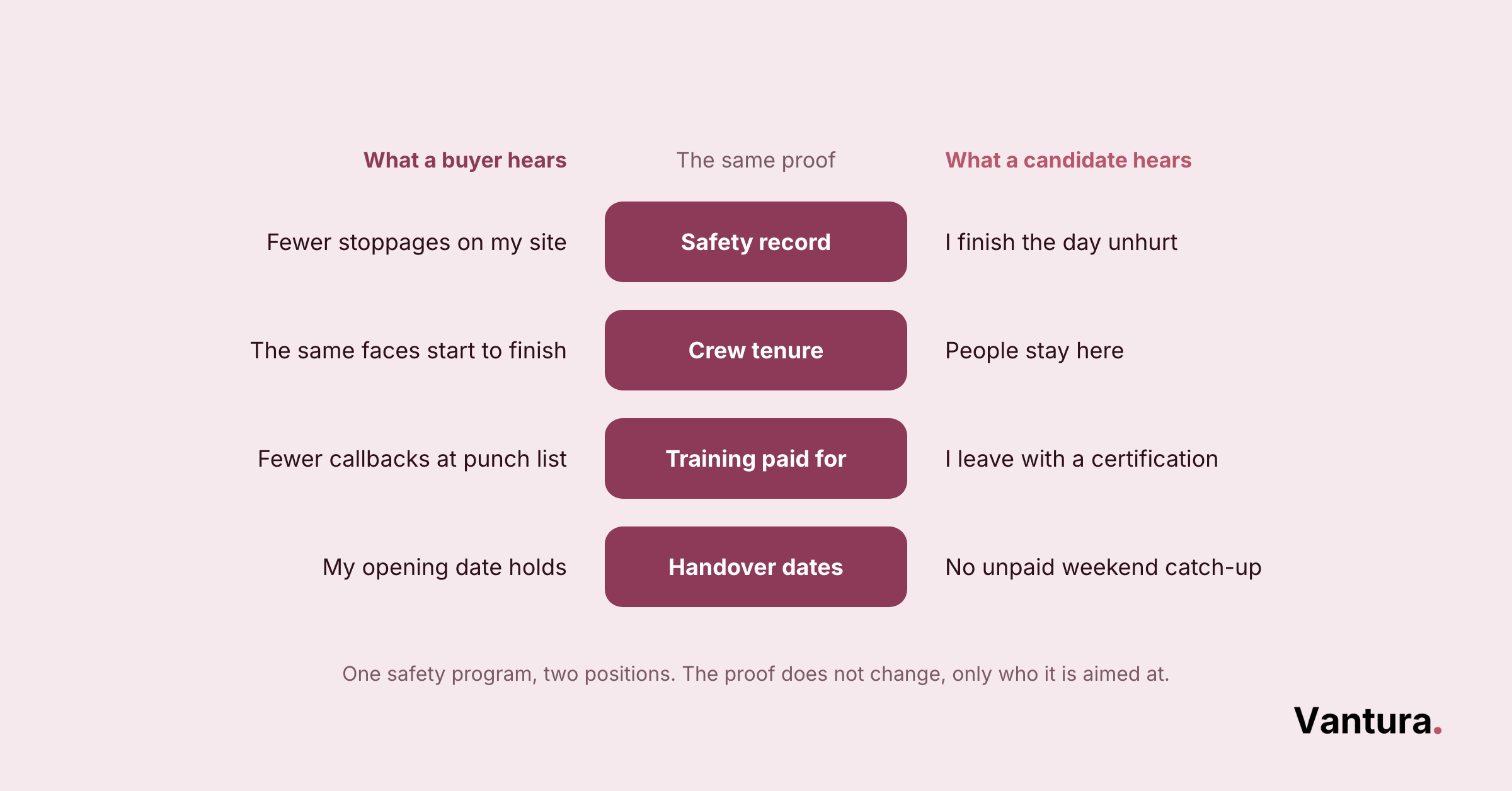
Employer brand positioning helps you win crews the same way it wins clients, by making your firm the obvious place to work. In a tight labor market, the position you hold with workers matters as much as the one you hold with buyers.
- Say what makes your site a good place to work
- Show real crews and real projects, not stock photos
- Back it with tenure, safety, and training
Smaller crews feel this most, and the fix overlaps a lot with everyday small business marketing. Treat hiring like a campaign, with a clear promise and steady proof.
How Do You Measure Construction Brand Positioning?
You measure positioning by watching the signals that show whether the right buyers see you the right way. No single number tells the whole story, so track a small set together.
| Signal | What it tells you | How we check it |
|---|---|---|
| Branded search volume | How many people look for you by name | Search console and analytics trends |
| Shortlist win rate | Whether your position closes bids | Proposal tracking over time |
| Referral share | How often your name gets repeated | Lead-source tagging |
| Review language | Which strengths clients name back | Review reads, quarter by quarter |
Watch the direction, not one snapshot. When branded searches and referrals climb together, your position is taking hold.
When Should You Reposition a Construction Brand?
Reposition when your work has outgrown your reputation, or when your position no longer wins the jobs you want. Markets shift, and a position that fit five projects ago can quietly hold you back.
A before and after from our own work
- Known as a general “we do it all” builder
- Competing on price against everyone
- Referrals slow and unpredictable
- Positioned around fast, clean tenant improvements
- Competing on schedule, not just cost
- Referrals from a clear, repeatable reputation
Positioning also evolves on its own as you take on bigger or different work. Firms scaling toward enterprise digital marketing territory should revisit it at least once a year.
Construction Brand Positioning Mistakes That Erode Trust
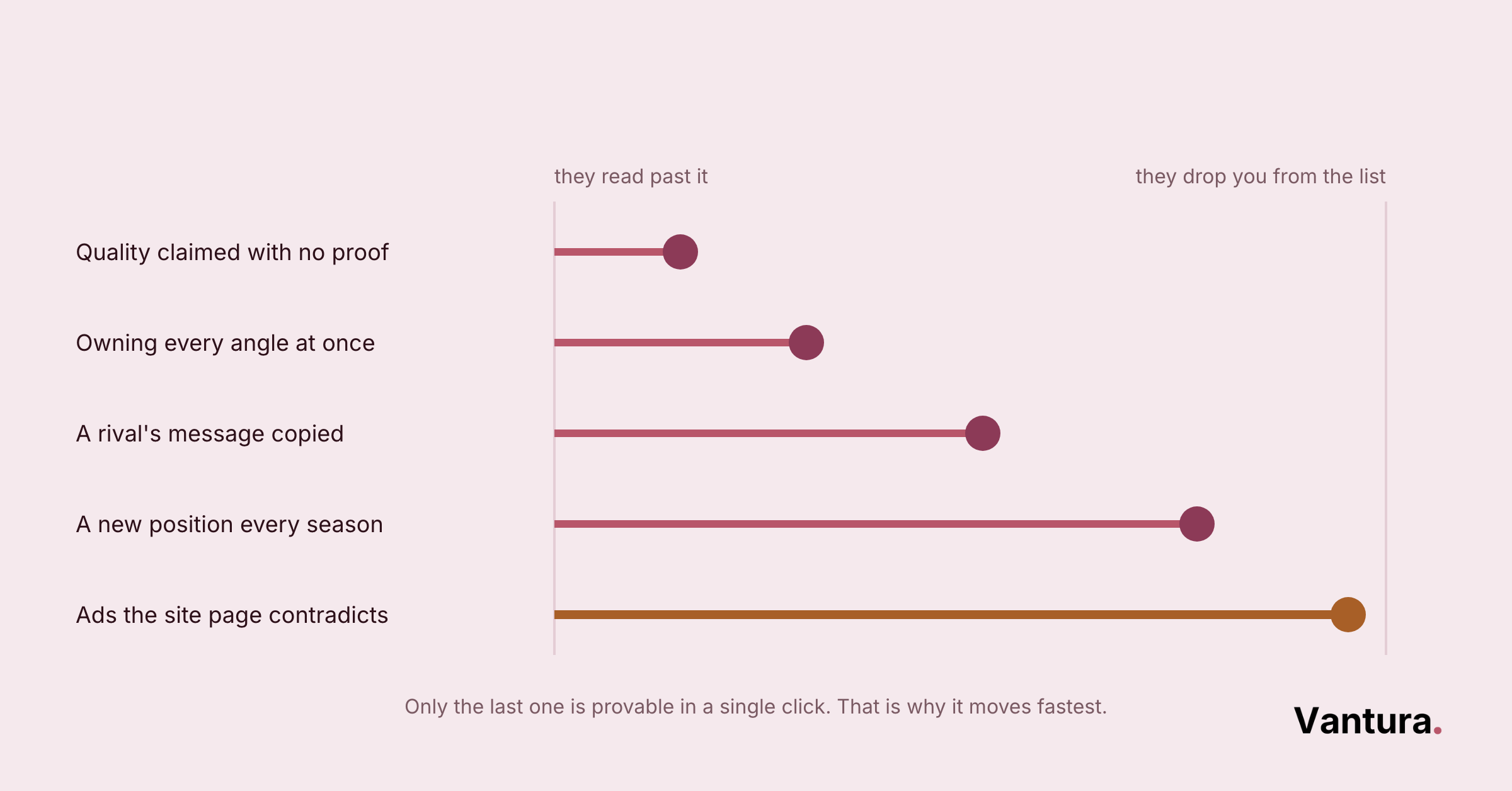
The fastest way to lose a position is to claim something your work doesn’t back up. Buyers forgive a narrow focus, but they don’t forgive a broken promise.
- Claiming quality and value with no proof behind either
- Trying to own every angle at once
- Saying one thing in ads and another on site
- Copying a rival’s message word for word
- Changing your position every season
As an independent agency with no vendor holding a stake in our advice, we steer clients toward the position they can defend. A promise you can keep beats one that only sounds good.
Firms stretched thin on staff sometimes lean on digital marketing outsourcing just to keep the message consistent while the project list stays long. Consistency matters more than volume here.
Bottom line: Construction brand positioning works when it’s specific, provable, and consistent. Pick one angle you truly win on, back it with real proof, and repeat it everywhere buyers and crews look.
Disclaimer: This article is for general information only and does not constitute professional, legal, or financial advice. Vantura Marketing makes no warranties about the completeness or accuracy of the content, and any action taken on it is at your own risk.