Construction Local SEO: Tactics That Drive Local Leads

Construction local SEO is the work of getting your contracting business found when nearby people search for the jobs you do. It lines up your Google Business Profile, local keywords, reviews, and citations so buyers in your area see you first. Done well, it turns map searches and phone-in-hand homeowners into booked work on your calendar.
Why contractors trust our local SEO guidance:
We’re a team of 28 specialists with more than 190 combined years in digital marketing, and we’ve delivered over 180 campaigns across 14 industries. Local search is a lane we run week in and week out.
Need help ranking in your service area?
We map where your leads actually come from, then build the pages, listings, and reviews that put you in front of local buyers. Get in touch and we’ll shape a local marketing strategy around your trade.
What Is Construction Local SEO?
Construction local SEO is how a contracting business gets found by people searching nearby for the work it does. It ties your Google listing, your website, and your reviews together so local buyers notice you before your competitors.
Think of it as the gap between showing up for a homeowner two towns over and showing up for the one standing in the house that needs work. That second search is the one that pays, and local SEO is how you win it.
Where Local SEO Fits in Your Marketing
Local SEO is one piece of a bigger plan, not the whole thing. It works best next to paid ads, email, and content, which is why we usually fold it into an integrated marketing plan rather than run it as a side project.
For a contractor, though, it’s often the piece with the fastest payback. A clean listing and a few strong reviews can move the phone in weeks, not quarters.
Worth knowing: Local search rewards proof over polish. A verified listing, honest reviews, and a matching address will outrank a prettier site that Google can’t tie to a real place.
How Does Local Search Work for Contractors?
Local search works by matching three things, how relevant you are to the query, how close you are to the searcher, and how credible your business looks online. Google blends those signals, then shows a map with a short list on top and regular links below.
The Map Pack and the Organic Results
That map with three listings is called the map pack, and it grabs most of the clicks on local searches. Below it sits the usual list of links, where your service pages can still rank.
The pattern holds across trades. A roofing crew and an HVAC marketing program chase the same map pack, just with different keywords.
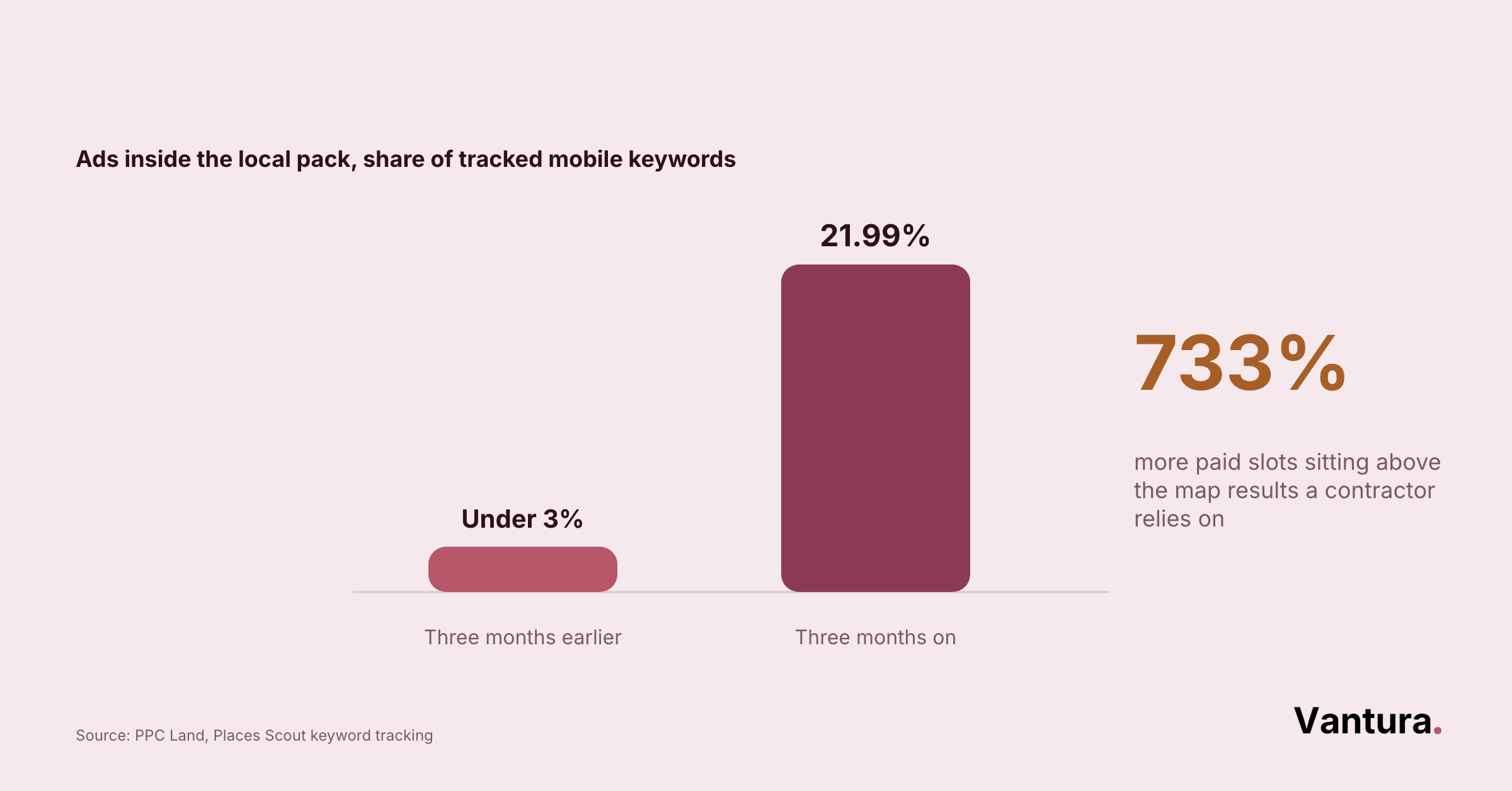
Local intent has exploded on phones. Google’s own search data shows mobile searches for businesses that are open right now near me have grown more than 900 percent, per Google.
Quick context: Proximity is dynamic. The same person gets different results at the job site than at home, so ranking across your whole service area matters more than owning one lucky spot.
How Do You Optimize a Construction Google Business Profile?
You optimize a construction Google Business Profile by claiming it, filling every field honestly, and keeping it active. The profile is the single biggest lever in local search, so it earns steady attention, not a one-time setup.
We treat it like a living page. On a recent build for a roofing company, updating the services list and adding real photos lifted calls within a month, which is why our roofing marketing work always starts here.
Construction Local SEO Ranking Factors
A handful of signals decide who lands in the map pack. None of them is a secret, yet most contractors only get two or three right.
The weighting shifts by market. In a crowded metro reviews carry more, while in a rural county proximity often wins, the same signals we tune for our small business marketing clients.
| Ranking signal | Why it moves the needle | How to strengthen it |
|---|---|---|
| Google Business Profile | Feeds the map pack directly | Verify it, complete every field, keep it active |
| Proximity to searcher | Google favors the closest fit | Publish real pages for each town you serve |
| Reviews | Signal trust and recency | Ask after every job and reply to each one |
| Citations and NAP | Confirm you are a real, local business | List identical details across directories |
| On-page relevance | Ties your pages to the query | Name the service and the location in your copy |
| Local links | Show community roots | Sponsor, partner, and join local groups |
What we’ve seen: In dense markets, reviews and proximity usually decide the map pack, and website quality breaks the near-ties. Fix the profile and reviews before you touch anything fancy.
How Do You Keep NAP and Citations Consistent?
You keep NAP consistent by writing your name, address, and phone the exact same way everywhere they appear. Then you build citations, which are listings on directories that repeat those details and back up your location.
Small mismatches do real damage. An old suite number or a stray tracking line can split your identity, a mess we untangle often for the plumbing marketing accounts we take over.
| Directory type | Where to list | What it does for local rank |
|---|---|---|
| Core search | Google Business Profile, Bing Places | Anchors your map presence |
| Data aggregators | Data Axle, Foursquare | Pushes consistent details across the web |
| Trade directories | Contractor and builder associations | Adds industry trust |
| Local guides | Chamber of commerce, city guides | Ties you to the area you work in |
| Review sites | Yelp, Angi, HomeAdvisor | Feeds reviews and citations at once |
| Social profiles | Facebook, LinkedIn, Instagram | Reinforces your name and location |
What Keywords and Pages Win Local Construction Searches?
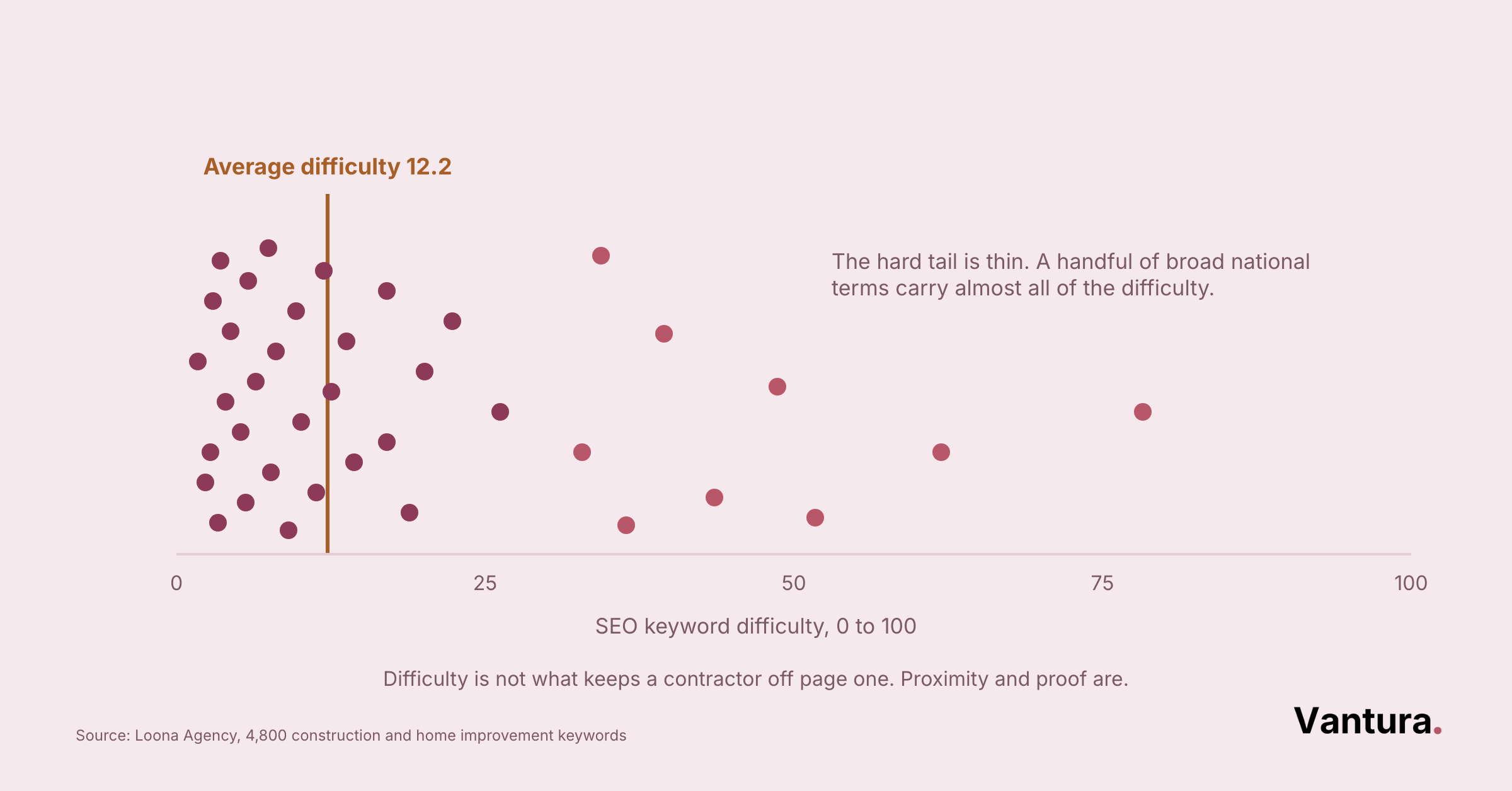
The keywords that win pair your trade with a place, like siding repair plus your city or town. People search close to how they talk, so plain service-plus-location phrases beat clever ones.
We map those phrases to pages that actually answer them. That’s the same keyword-to-page discipline behind our electrical contractor marketing, and it’s where most contractor sites fall short.
- Service plus city terms, like deck building in your town
- Emergency and same-day phrases people use in a hurry
- Question searches, like how much a new roof costs nearby
- Neighborhood and landmark names inside your area
Building Location Pages That Rank
If you serve several towns, give each one its own page with real detail. A thin page that just swaps the town name reads as spam, and Google treats it that way.
Write about local permits, common home styles, and jobs you’ve finished there. That local proof is what makes a page rank instead of just exist.
Field note: One strong page per town beats ten near-identical ones. We’d rather publish three honest location pages than a dozen that Google quietly ignores.
How Should Contractors Handle Online Reviews?
Contractors should treat reviews as a core ranking task, not a vanity score. Steady, recent reviews lift both your map pack spot and the odds a reader picks up the phone.
Buyers lean on them hard. Only 4 percent of people say they never read reviews, and 40 percent check at least two review sites before choosing a local business, according to BrightLocal.
A simple ask-after-the-job routine works. We built one for a pest control marketing client that doubled their review pace without a single incentive.
Keep in mind: Answer the bad reviews first. A calm, specific reply to a one-star rating reassures the next reader far more than a wall of five-star praise ever could.
Construction Local Link Building and Schema Markup
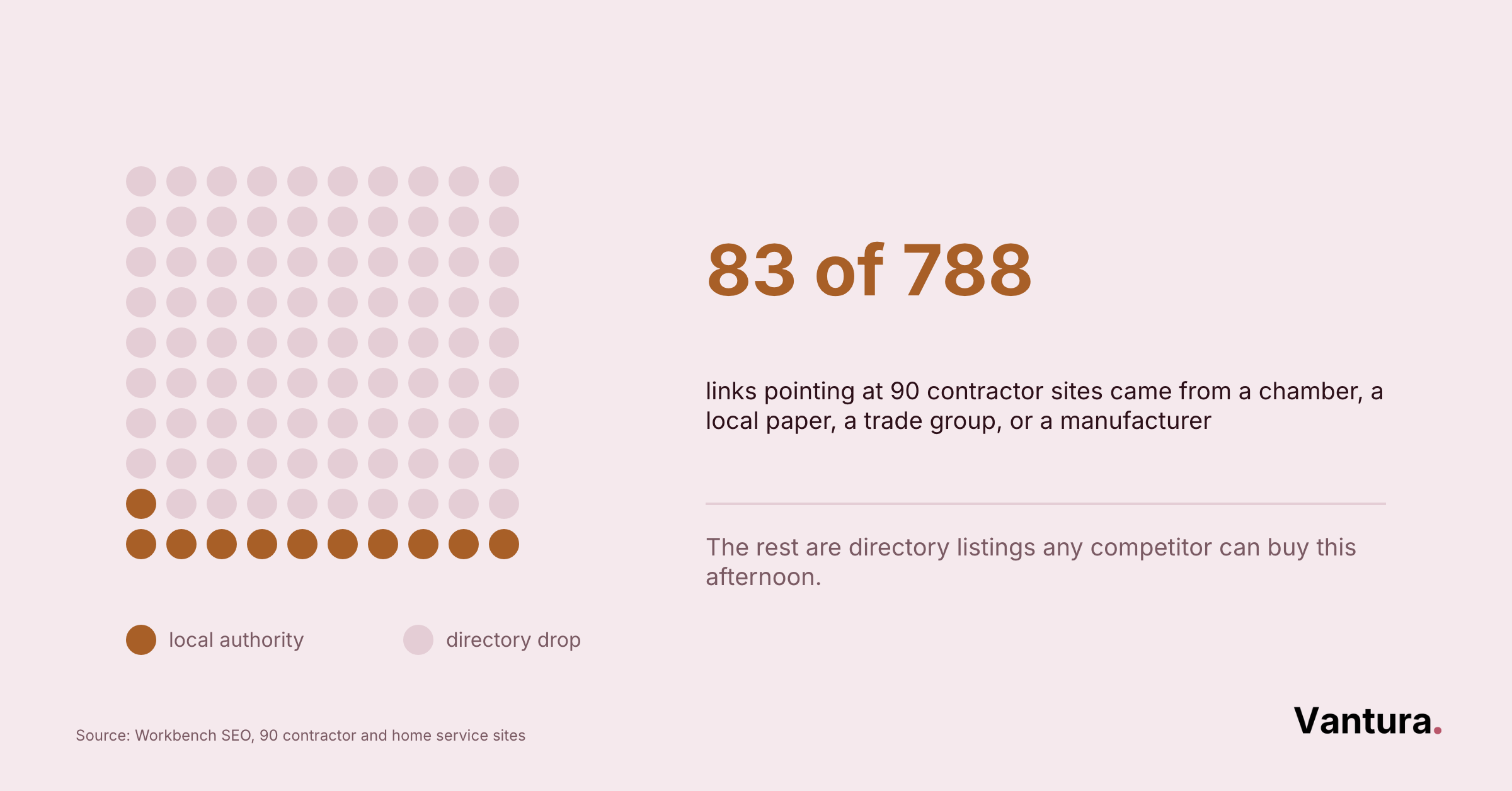
Two quieter tactics round out local SEO, earning local links and adding schema markup. Neither is flashy, but both tell Google your business is rooted in a real place.
Earning Local Links
Local links come from sponsoring a team, joining trade groups, and partnering with nearby businesses. A referral network with agents drives ours, much like the partner links behind our real estate marketing work.
Quality beats volume here. One link from a respected local builder outweighs a stack of random directory drops.
Adding Local Schema
Schema markup is a bit of code that spells out your name, area served, and services for search engines. It doesn’t change what visitors see, yet it helps Google read your page with less guessing.
LocalBusiness schema is the one that matters most for contractors. Add it once, keep it accurate, and it quietly supports every local query you chase.
How Do Mobile and Voice Search Change Local SEO?
Mobile and voice change local SEO by raising the bar on speed and plain language. Most local contractor searches happen on a phone, often by voice, so a slow site or stiff copy loses the lead.
Mobile Optimization for Local Search
A contractor site has to load fast and tap easily. If a homeowner has to pinch and zoom to find your number, they bounce to the next result.
Keep the phone number thumb-friendly and the forms short. When teams feel buried by all of this, our marketing consulting helps them fix the few things that move calls first.
Voice Search and Local Queries
Voice searches sound like questions, not keywords. Someone asks for a roofer near me who works weekends, so your pages should answer full, spoken questions in normal words.
That’s why plain headings and short answers help. The same copy that reads well out loud is the copy voice assistants like to read back.
One reminder: Speed is a local ranking factor and a trust cue at once. A three-second load feels fine to a homeowner and to Google, while a ten-second one loses both.
Construction Local SEO vs National SEO
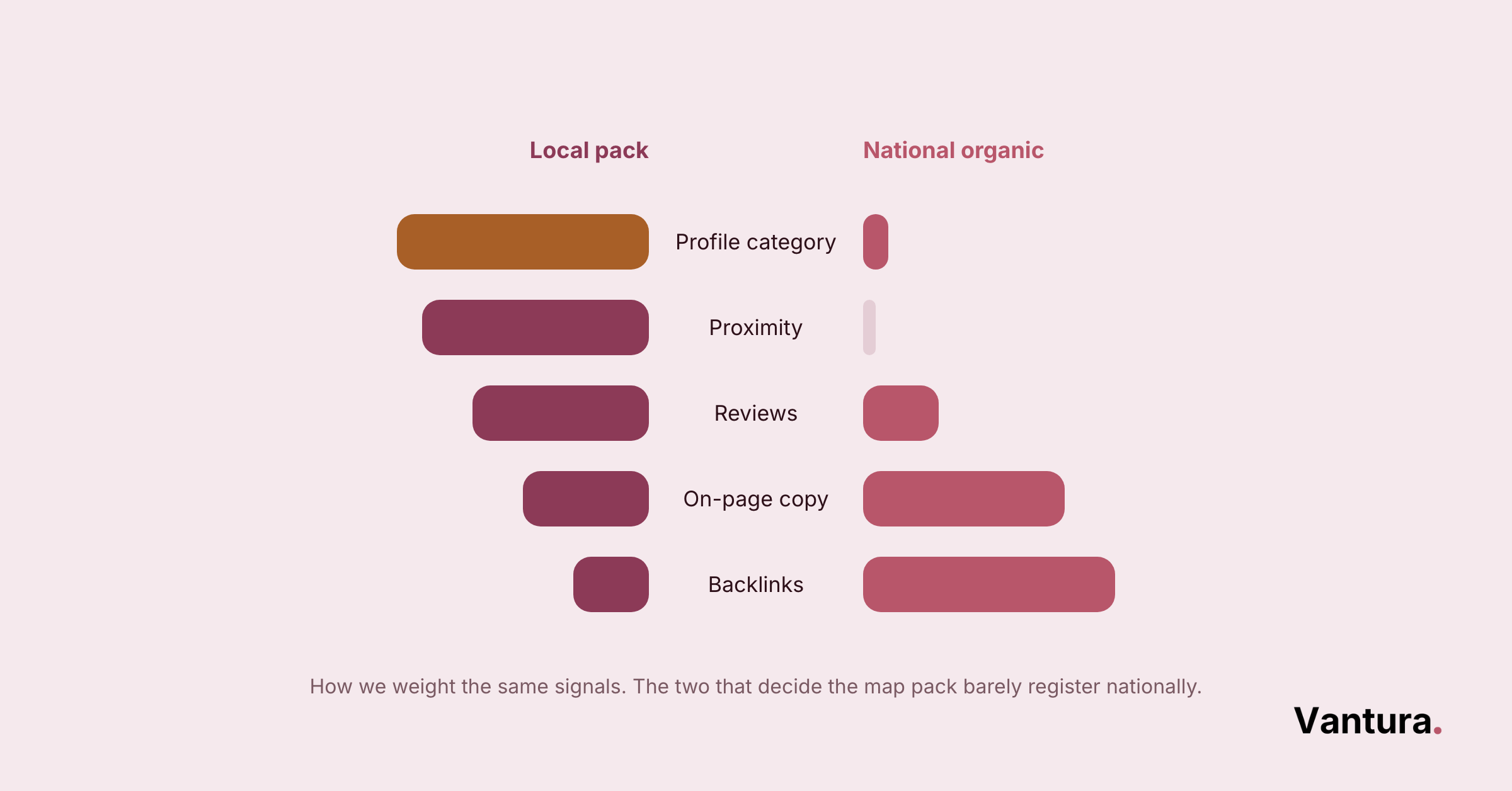
Local and national SEO share the basics but chase different goals. One wants to own a service area, the other wants to reach anyone, anywhere.
When Local Wins and When You Need Reach
For most contractors, local is the whole game. You can’t pour a foundation two states away, so ranking nationwide would just burn budget on clicks you can’t serve.
Focused on a service area. It leans on your Google profile, reviews, citations, and pages built around the towns you cover.
- Google Business Profile and map pack
- Reviews and local citations
- City and neighborhood pages
Focused on reach, not place. It leans on broad content, links, and authority to rank across many regions at once.
- Broad, high-volume keywords
- Large-scale content and links
- Brand authority over proximity
How Do You Track and Beat Local Competitors?
You track local SEO by watching your map pack rankings, calls, and form fills, then checking them against nearby rivals. Competitor gaps, like missing reviews or thin pages, show you where to push next.
Tools We Rely On
A few tools cover most of it, including Google Business Profile insights, a rank tracker, and call tracking. We usually start with a marketing audit to see which of those a contractor already has.
- Map and local rank trackers for your key towns
- Call and form tracking to tie rankings to real leads
- Review monitoring across the sites buyers use
- Competitor checks on listings, reviews, and pages
Bottom line: Track leads, not just rankings. A number-one map spot means little if the calls aren’t landing, so we always tie local SEO back to booked jobs.
Local SEO for Multiple Locations and Neighborhoods
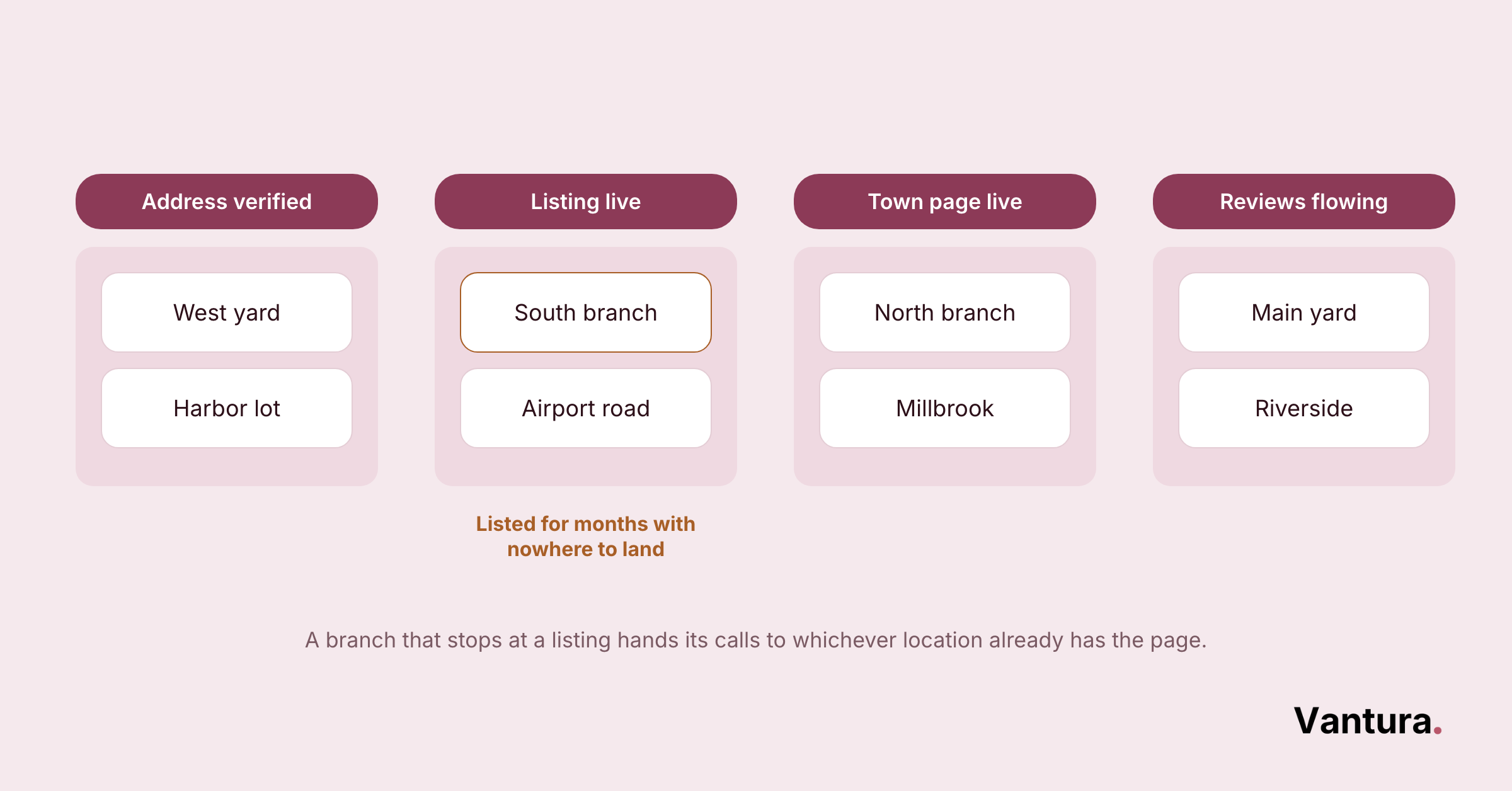
Multiple locations need a page and a profile for each real address, plus content tuned to each neighborhood you serve. Done right, it lets one brand rank in several towns at once.
This is where things get fiddly fast. We handle the same sprawl in franchise marketing, where every branch needs its own listing without cannibalizing the others.
Hyperlocal targeting takes it one step deeper. Naming specific neighborhoods, landmarks, and zip codes on the right pages helps you show up for the block, not just the city.
Keep each location honest and staffed. A listing at an address where no one works breaks Google’s rules and, worse, misleads the customer who drives there.
Disclaimer: This content is provided for general informational purposes only and does not constitute professional marketing, legal, or business advice. Results vary by market and effort, and Vantura Marketing makes no guarantee of specific outcomes.