Construction Content Marketing: Strategy & Tactics (2026)

Construction content marketing means publishing articles, project stories, videos, and guides that put contractors in front of buyers early. It works because buyers research a job online long before they call, and get the strategy right, and a small content library quietly turns everyday searches into booked projects.
Why Contractors Trust Our Content Work:
Our 28 specialists bring 190 plus combined years of marketing work across 14 industries. We’ve shipped content for 180 plus campaigns, so we know what earns a builder trust and what quietly gets skipped.
Need a Content Plan for Your Firm?
Get in touch and we’ll map a plan to your best jobs and margins through our industrial marketing support, not a generic blog schedule. You stay on the build while the pipeline fills.
What Is Construction Content Marketing?
Construction content marketing is creating and sharing useful content, articles, galleries, videos, and guides, that helps a contractor get found and chosen online. It earns attention instead of buying every click.
The idea is simple. You answer the questions a client already asks, so your firm is the obvious pick when the job turns real.
Most builders already have the raw material sitting on their phones. The job photos and site fixes rarely get posted.
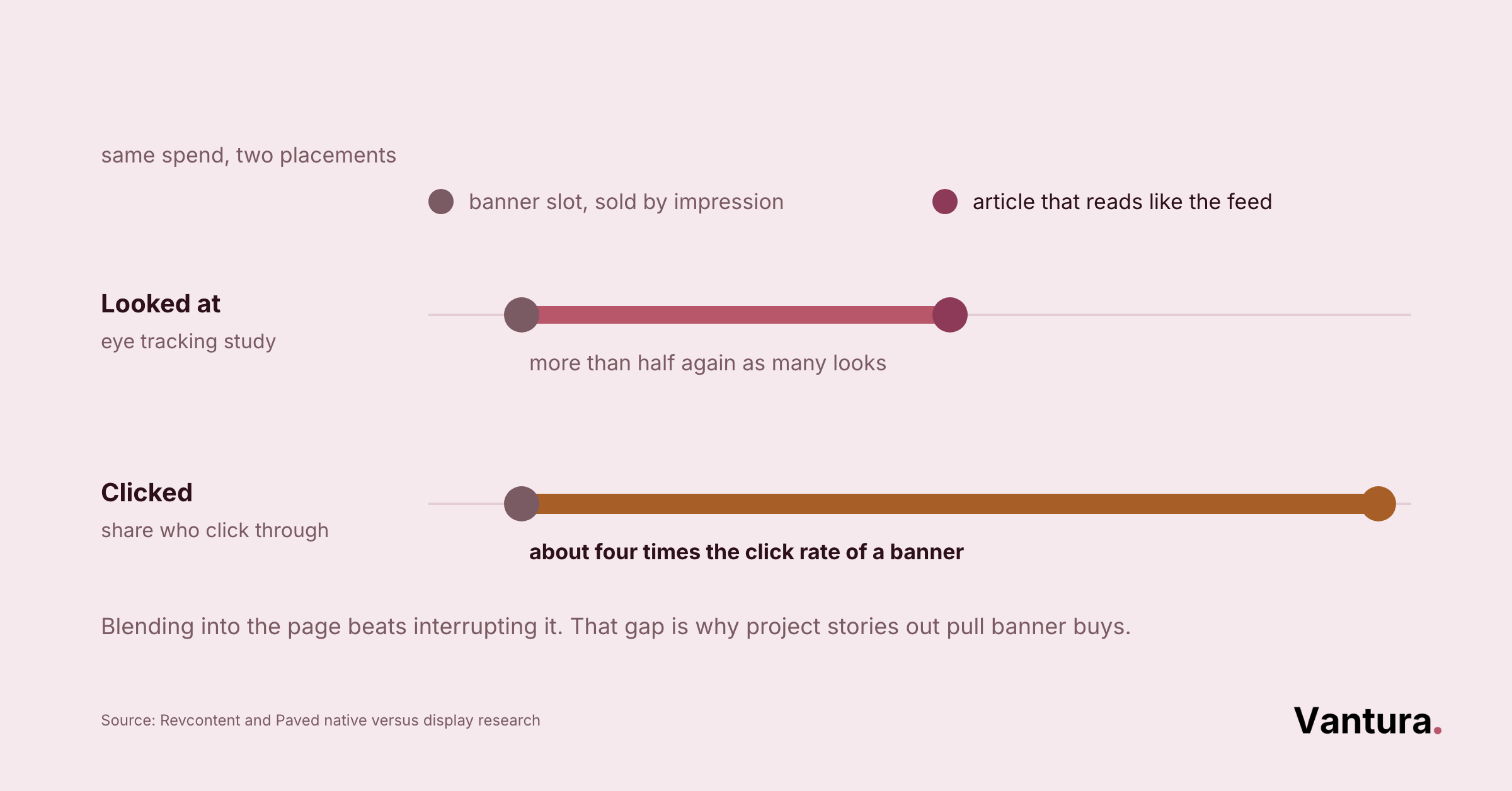
That gap costs jobs. Content that blends into a reader’s feed works harder than content that interrupts it, and per Revcontent, native placements earn 52% more views than standard banner ads.
Worth knowing: content marketing rarely pays off in week one. It compounds, so the guide you post this month can still bring in bid requests long after a paid ad would have gone quiet.
How Do You Build a Construction Content Strategy?
You build a construction content strategy by picking the jobs you want more of. List the questions those buyers ask, then match each question to a piece of content and a channel. Write it down, or it drifts.
Skipping the plan is the classic mistake. Firms post whatever comes to mind, then wonder why the blog brings no work.
We run the same sequence on every construction marketing strategy engagement, from a solo remodeler to a regional builder. It keeps a two-person crew and a fifty-person firm working off the same short plan.
| Phase | What you do | What you get |
|---|---|---|
| Pick targets | Choose the jobs and margins you want more of | A short list of priority services |
| Map questions | Write down what those buyers ask before hiring | A ready list of content topics |
| Match and make | Give each topic a format and a channel | A simple, workable content plan |
| Review | Check what earned calls each quarter | A tighter plan for the next round |
Step 1: Start With the Jobs You Want
Begin with margin, not volume. The best strategies push content toward the work a firm wants to repeat.
Step 2: Turn Buyer Questions Into Topics
List the real questions from sales calls and quote emails. Each one is a post, a video, or a short guide waiting to be made.
Step 3: Ship, Then Review
Publish on a schedule you can actually keep, even if that’s twice a month. In our experience, a steady twice-monthly cadence beats a burst of ten posts that stops by spring.
A burst-and-quit calendar. Ten posts in March, then silence once the crews get busy.
Two posts a month, every month, kept even through the busy season. This is the pace that compounds.
Types of Construction Content That Perform
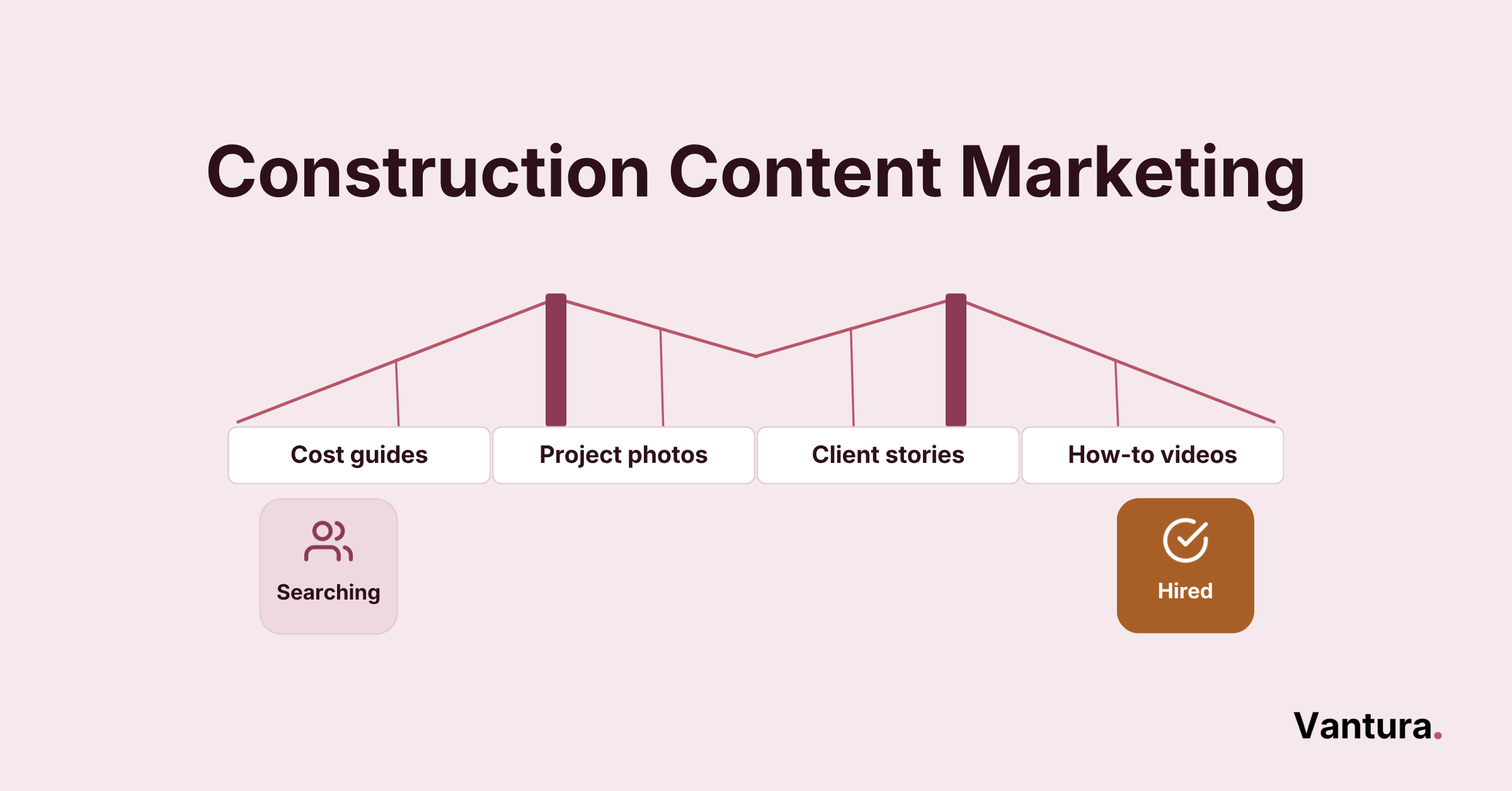
The content that performs for construction firms is practical and visual, project galleries, cost guides, process explainers, and short site videos. Buyers want proof and answers, not clever slogans.
Photos and video do the heavy lifting in this trade. A finished-project gallery often out-earns a dozen text posts, because it shows rather than tells.
For firms chasing commercial jobs, B2B construction content like spec sheets and safety records builds the most trust. It answers what a procurement team checks before it shortlists a bidder.
| Content type | Best for | Buyer stage |
|---|---|---|
| Project galleries | Proving quality | Deciding |
| Cost and pricing guides | Early research | Aware |
| How-to and process posts | Building trust | Considering |
| Site and drone video | Showing scale | Considering |
| Client story posts | Closing the deal | Deciding |
Matching Construction Content to the Buyer Journey
Not every piece should chase a sale. Early buyers want cost ranges and options, while late buyers want proof you’ve done their exact job.
The table above maps each format to a stage. In practice, most firms are heavy on bottom-of-funnel sales content and thin on the early guides that start the relationship.
- Cost and pricing guides
- Broad how-to explainers
- Project galleries in the exact category
- Client story posts with names attached
How Do You Write Construction Blog Content That Ranks?
You write ranking construction blog content by answering one real search question per page in plain words. Then build the page so search engines can read it. Blog writing and SEO are one job, not two.
Good posts sound like a foreman explaining a job, not a brochure. Plain language wins here, both with readers and with search.
Writing and Optimizing Ranking Posts
- Answer one clear question per post
- Use the words clients search for
- Add real photos from the job
- Put the main phrase in the title and first lines
- Link related posts and service pages
- Keep every page fast on a phone
Solo operators can absolutely do this in-house at first. When the blog outgrows spare evenings, marketing help for small contractors takes it off the owner’s plate.
Do Lead Magnets and Gated Content Work for Contractors?
Lead magnets work for contractors when the offer solves a real pre-project worry, like a cost checklist or a permit guide. Gate the genuinely useful stuff, and leave the basics open.
The trade-off is simple. A form filters out browsers, but it also scares off some good leads, so gate sparingly.
Offers That Pull Downloads
- A renovation cost calculator or checklist
- A material-selection guide
- A maintenance schedule for finished work
- A permit and timeline planner
We used to gate almost everything. After watching long forms kill downloads on a remodeler’s site, we now gate one strong asset per page and keep short guides open.
Turning Construction Projects Into Case Studies
You turn a project into a case study by telling it as a problem, a fix, and a result, backed by real photos and a client quote. One honest story beats a page of adjectives.
Every trade has these stories, whether it’s a roofing marketing win or a kitchen remodel that ran ahead of schedule. The format barely changes across specialties.
A Simple Case Study Shape
- The problem the client faced
- What your crew did, in plain terms
- The measurable result
- A photo and a short quote
Numbers make it land. Across our projects, a case study with a clear before-and-after figure tends to get read two to three times longer than a plain project post.
Thought Leadership and Brand Authority in Construction
Thought leadership sounds lofty, but for a contractor it just means sharing hard-won opinions. A short take on why a material fails, or when to walk from a bid, marks you as the expert.
Larger builders running several regions often formalize this inside enterprise marketing programs so every branch speaks with one voice. A consistent point of view is what turns a firm into a name people cite.
Formats That Build Authority
- Opinion posts on real trade debates
- Answers to the questions rivals dodge
- Talks, podcasts, and trade panels
Authority compounds slowly. It’s rarely one viral post, it’s the fiftieth useful answer that makes a buyer feel they already know you.
How Do You Distribute and Repurpose Construction Content?
You distribute construction content by pushing each piece across owned, earned, and paid channels, then repurposing it into new formats. A single project shoot can feed a blog post, three social clips, and an email.
1. Owned Channels
- Your website and blog
- An email list of past clients
- Google Business Profile posts
2. Earned Channels
These are the reviews, referrals, and shares you don’t pay for. They carry the most weight, because someone else vouched for you.
3. Paid Channels
Paid amplification puts your best content in front of new buyers fast. Running a paid content ad campaign can carry a cost guide to people right in the middle of their research.
Repurpose Once, Publish Everywhere
Repurposing is where the effort pays off twice. One project photoshoot becomes a gallery, a set of social pins, and a week of posts once you hand the repurposing off to a content partner.
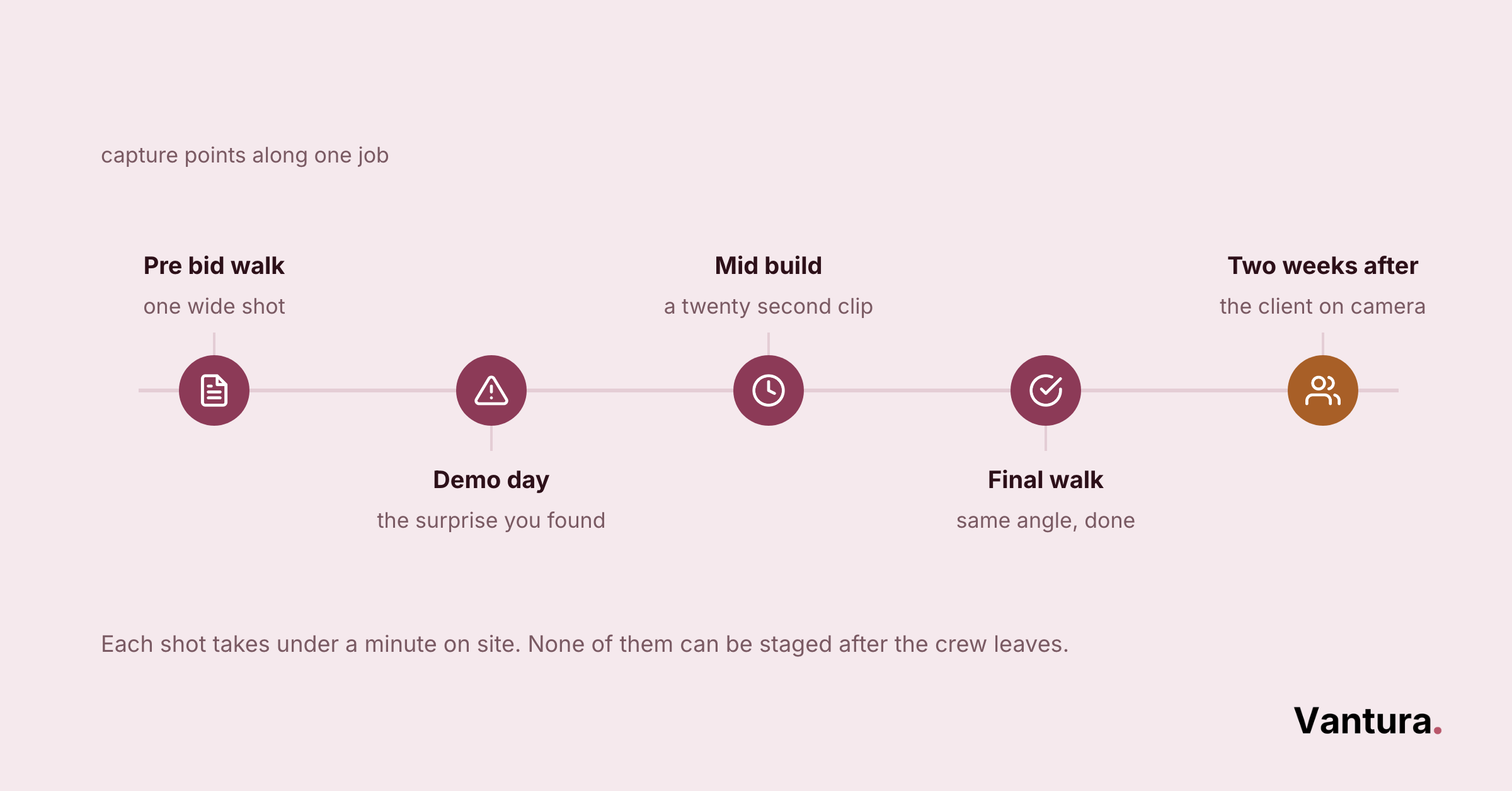
Time-saver: batch your content at the job site. One afternoon of photos and a two-minute phone video can supply a month of posts, which is often the only way a busy crew keeps publishing at all.
Building a Construction Content Calendar and Workflow
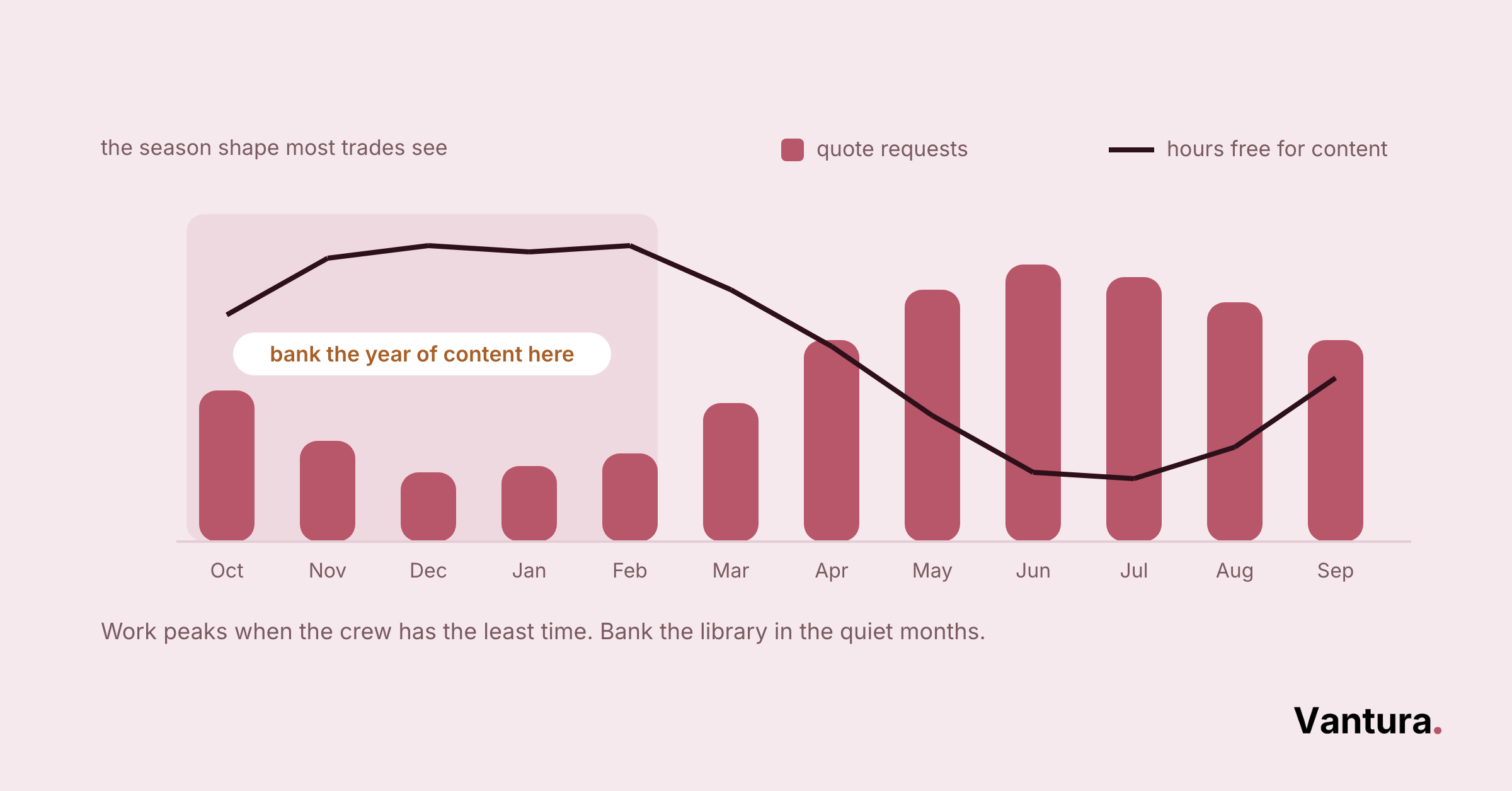
A construction content calendar maps what you publish, when, and who owns it. Even a one-page schedule keeps content alive once the busy season hits and everyone gets pulled onto job sites.
The calendar works best when it feeds one integrated content program rather than scattered posts. That way the blog, email, and social all point the same direction each month.
A Workflow That Survives Busy Season
- Pick a realistic cadence, even twice a month
- Assign one owner per piece
- Batch-shoot photos on site
- Keep a backlog for slow weeks
The trick is planning around the season, not against it. Bank content before spring, so a packed schedule on site doesn’t starve the pipeline next winter.
What Should a Construction Newsletter Say?
A construction newsletter should stay useful, not salesy, a finished project, a seasonal maintenance tip, or a quick answer to a common question. Past clients are your warmest list by far.
Your email list is an asset rivals can’t copy. A short monthly note keeps your name in front of the people who refer the most work.
Newsletter Ideas That Get Opened
- A recent project with photos
- A seasonal upkeep reminder
- One honest cost or material tip
- A client question, answered
Keep it short and human. In our experience, a plain three-paragraph note beats a designed template for most trades, since it reads like a person and not a flyer.
How Do You Write Construction Ad Copy That Converts?
Good construction ad copy names the job, the place, and the next step in plain words. The landing page then backs it with proof, a clear offer, and an easy way to ask for a quote.
Skip the hype. Phrases like award-winning mean little next to a photo, a price range, and a fast reply.
For big, considered projects, contractors can borrow conversion ideas from real estate marketing, where the decision is just as slow and proof-driven. Both need patience and evidence on the page.
Copy That Turns Clicks Into Quotes
- Lead with the exact service and city
- Show a real price range
- Make the quote button impossible to miss
How Do Content Marketing and SEO Work Together for Contractors?
Content marketing and SEO are not separate jobs for a contractor, they’re the same effort viewed from two angles. Your keyword research tells you what to write, and your content is what actually earns the ranking.
Internal links are the part firms skip most. Every new post should link back to a related service page or older post, so search engines and readers can find the next relevant page without hunting.
Treat your best posts as hubs. A strong guide on one job type, tied to our technical SEO work, can anchor a cluster of narrower posts underneath it.
Where SEO and Content Meet
- Keyword research sets the topic list
- Internal links connect related posts and service pages
- Old posts get refreshed, not left to fade
Refreshing old content is the quiet win most firms miss. A two-year-old post with an updated stat and a broken link fixed often climbs the rankings faster than a brand new page.
How Do You Measure Construction Content Marketing?
You measure construction content marketing by tracking the leads and calls it drives, not just the views. Traffic is a start, but booked quotes and won bids are the numbers an owner cares about.
Vanity metrics are the trap. A post with big traffic and zero quote requests is worse than a quiet page that books two jobs a month.
| Metric | What it tells you | How often to check |
|---|---|---|
| Quote requests | Whether content drives real demand | Monthly |
| Organic traffic | If you’re getting found at all | Monthly |
| Top landing pages | Which content earns the work | Quarterly |
| Cost per lead | If the channel earns its cost | Quarterly |
| Email replies | How warm your list stays | Monthly |
Tie every number back to revenue with a data-driven marketing habit. Across our projects, blog-sourced leads for trades usually cost far less than paid ones once a few posts rank, though it takes a season or two to show.
How Do You Use Reviews and User-Generated Content?
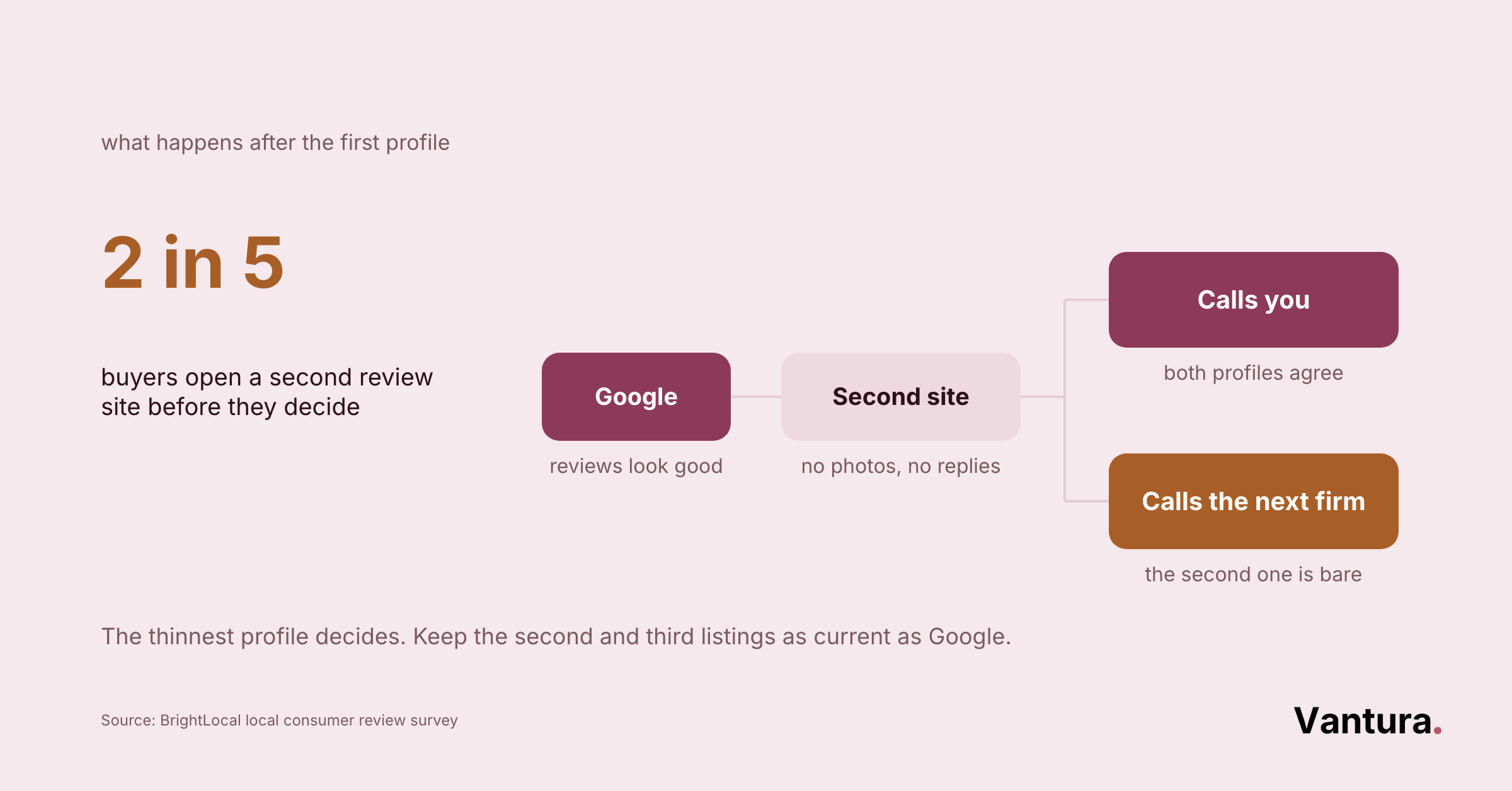
Reviews and user-generated content, client photos, testimonials, and social tags, carry more weight than anything a contractor writes about itself. Buyers believe other buyers far more than they believe your marketing.
Ask for it every time. A finished job is the natural moment to request a review and a photo the client is glad to share.
Beyond your own site, real proof travels further than any slogan. A review request costs nothing next to the trust a stack of them builds over a season.
Ways to Gather UGC
- A quick review request at project close
- A photo permission line in your contract
- A simple hashtag for tagged jobs
Which Construction Content Marketing Tools Help Most?
The most useful construction content marketing tools cover four jobs, planning, writing, publishing, and measuring. You don’t need an expensive stack, just one reliable option for each step.
We stay independent, with no vendor holding a stake in what we recommend, so the pick always fits the client. That usually means a mix of well-known platforms and niche, trade-specific tools.
The same simple stack that powers HVAC contractor marketing works for most trades, from a scheduling tool to a basic analytics dashboard. Start small, then add only what a real gap demands.
A Starter Stack
- A shared calendar for planning
- A phone and a simple editor for photos and video
- An email platform for the newsletter
- A free analytics tool for results
How Is AI Changing Construction Content Marketing?
AI is speeding up construction content marketing, drafting posts, sorting photos, and handling routine questions. But it can’t visit a site or vouch for a crew. The firms winning use it to move faster, not to replace real proof.
AI is a good first draft and a poor final one. It can outline a cost guide in seconds, yet the useful details still come from your own jobs.
Search is shifting too. Buyers now ask AI tools for a recommendation, which rewards firms with clear, genuinely helpful content over keyword-stuffed pages.
Keep in mind: AI can copy a tone, but it can’t copy your job history. The photos, numbers, and site stories from your own work are exactly what a model can’t invent, so that’s where your edge now sits.
Common Construction Content Marketing Mistakes to Avoid
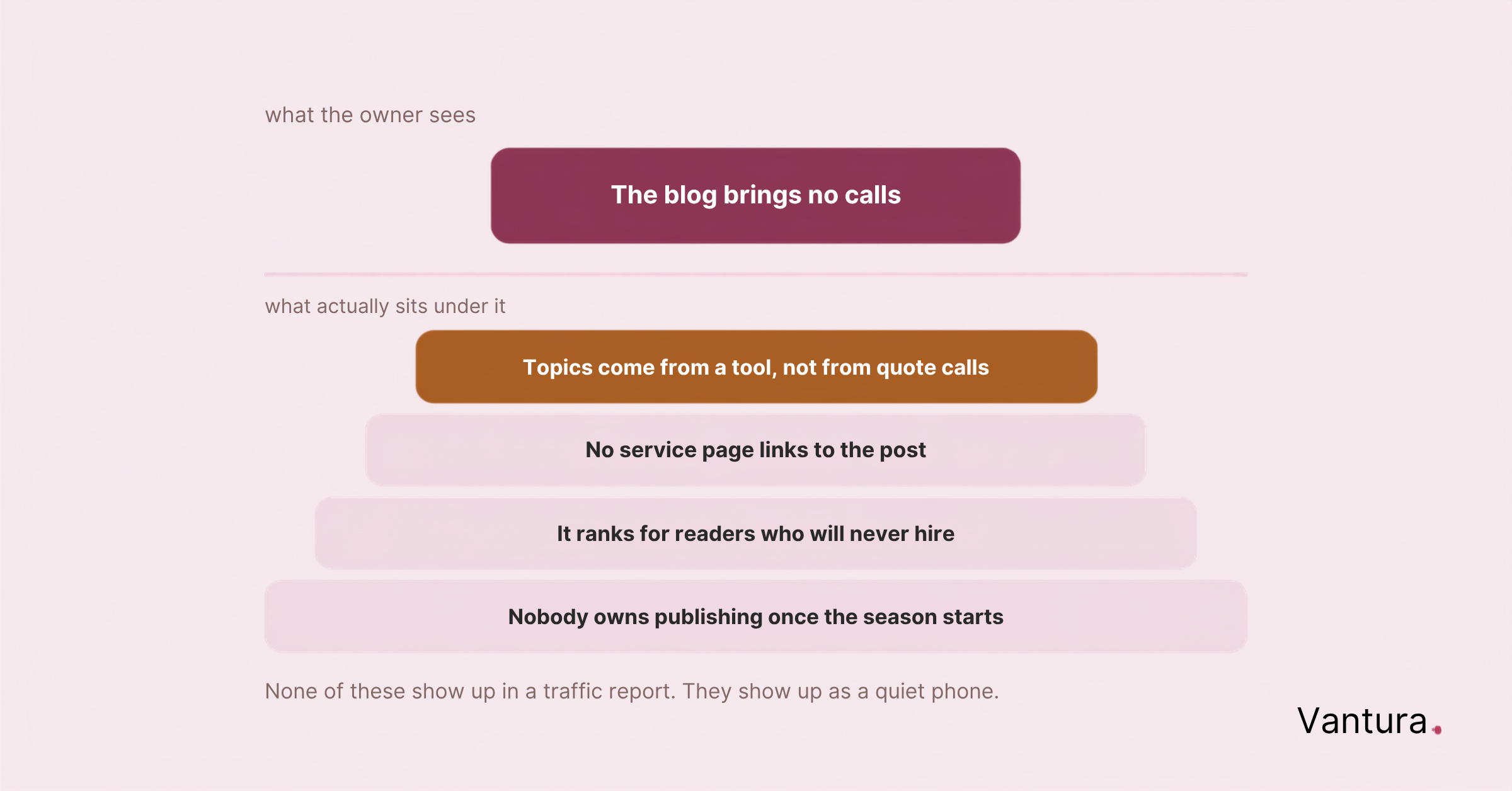
Most construction content efforts stall for the same handful of reasons. Spotting them early saves a year of posting into the void.
- Selling too soon: every post pushing for a quote
- No photos: plain text where proof should be
- Random posting: content with no plan or calendar
- Chasing traffic: views that never turn into work
- Quitting early: stopping before content compounds
The biggest one is impatience. We’ve watched solid blogs get abandoned a month before they would have started ranking, usually right when the busy season hit.
Bottom line: content marketing rewards the firm that keeps showing up. Pick a cadence you can hold through the busy season, lead with proof, and let the library build one honest post at a time.
Disclaimer: This guide is shared for general informational purposes only and is not a substitute for tailored marketing, legal, or financial advice. Results depend on your firm’s own market, resources, and follow-through, so no specific outcome is guaranteed. Vantura Marketing holds no ownership stake or vendor tie to any platform or brand named above, and each remains the property of its own owner.