Construction Facebook Ads: Strategy & Best Practices

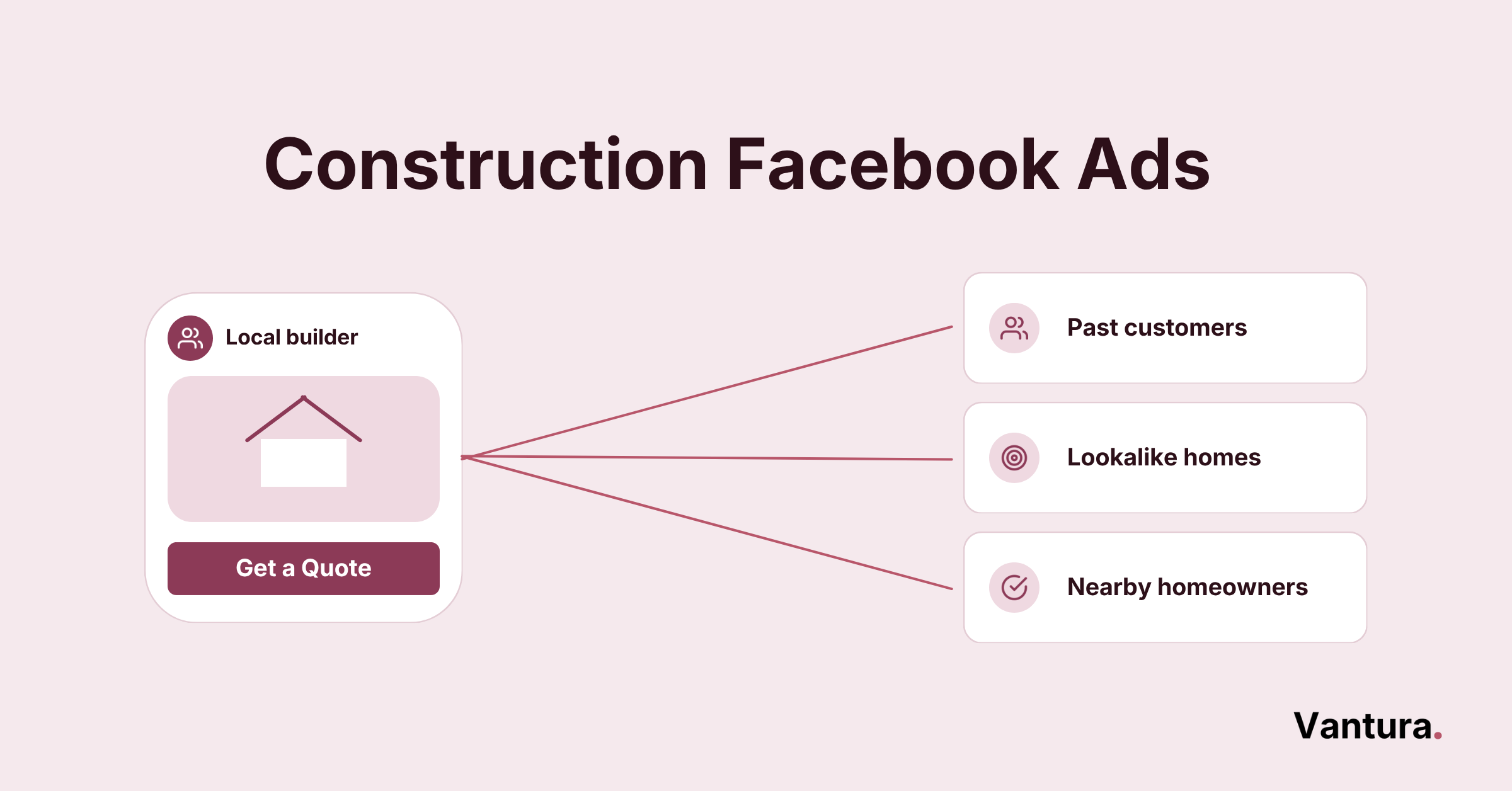
Construction Facebook ads are paid campaigns that put your projects, offers, and brand in front of homeowners and property managers while they scroll. They run across Facebook and Instagram through Meta’s ad tools, aimed at people in your service area who are likely to need a builder soon. Done well, they turn a modest monthly budget into a steady flow of qualified leads.
Why Builders Trust Our Facebook Ads Help:
We have run over 180 campaigns and tested 500-plus landing pages, so we understand what a contractor funnel needs. Across recent work, clients see about 4.2x more qualified leads within 90 days.
Get Help With Construction Facebook Ads:
If you would rather focus on the build than the ad account, get in touch with our team. We will shape a plan around your industrial digital marketing goals and local service area.
What Are Construction Facebook Ads, and Why Do They Work for Builders?
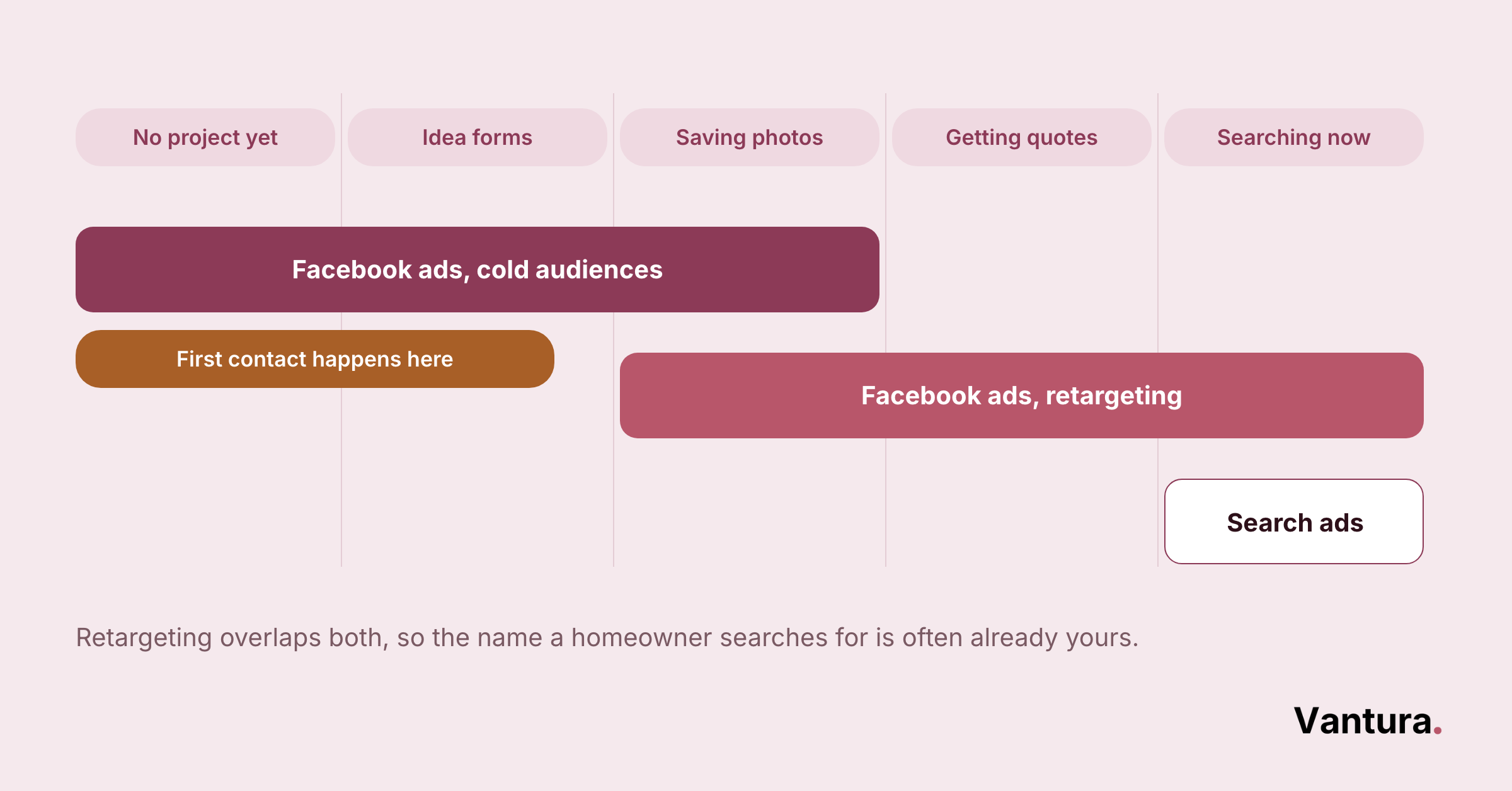
Construction Facebook ads work because they reach homeowners early, long before anyone types a project into a search bar. You can show a kitchen remodel or a new roof to people in your area who match the profile of your best past customers.
That head start matters in construction, where most jobs begin as a vague idea, not an urgent search. A well-placed ad plants the seed and keeps your name close when the homeowner is finally ready.
The wider shift helps too. Across the contractor accounts we manage, digital budgets keep climbing every year, and Facebook usually gets the first new dollar.
Among marketers who can name one top-performing channel, 27 percent point to organic search as their single best source, reports Ahrefs. That keeps SEO content the backbone of most plans, while Facebook catches homeowners before they ever type that search.
Because the audience overlaps with property buyers, a lot of what works here mirrors real estate marketing. The same photos that sell a home also sell the crew that built it.
How Facebook Advertising Reaches Local Homeowners
Facebook and Instagram sit inside Meta’s ad system, so one campaign can run across both. You pick who sees the ad, set a budget, and Meta shows it to the people most likely to act.
The targeting leans on interests, location, and behavior, not just guesswork. For a builder, that means you can focus a few miles around your yard instead of paying to reach a whole state.
Worth knowing: Facebook ads and Facebook posts are not the same thing. Posts reach a slice of your existing followers for free, while ads pay to reach new, targeted homeowners who have never heard of you. For most contractors, paid reach is where the leads really come from.
How Should You Structure a Construction Facebook Ad Campaign?
A Facebook ad campaign has three layers, and getting them right saves a lot of wasted spend. The campaign sets the goal, the ad set controls audience and budget, and the ad is the creative homeowners see.
Keep each layer simple when you start. One clear goal, one or two tight audiences, and a couple of strong ads beat a sprawling account every time.
This structure is the backbone of any paid digital marketing strategy, not just Facebook. Get the frame right and the creative has room to work.
Building the Campaign Step by Step
Here’s the order we follow on a new contractor account.
Step #1 Set the Objective
Pick leads or messages as the goal, not likes. Facebook optimizes toward whatever you choose, so the wrong goal quietly wastes budget.
Step #2 Define the Audience
Draw a radius around your service area and layer in homeowner details. A tight audience keeps your cost per lead down.
Step #3 Build the Creative
Use real job photos and a clear offer. Stock images and vague slogans get scrolled past.
Step #4 Set Budget and Launch
Start small, watch for a few days, then feed more into what works. A slow ramp beats a big gamble.
Which Facebook Ad Formats Work Best for Construction?
The strongest construction formats show off finished work and make the next step obvious. Single image ads, short video, carousels, and lead forms cover almost every contractor need.
- Single image: one clean before or after shot with a short offer.
- Video: a quick walk through of a finished project or a time lapse.
- Carousel: several photos that swipe through the stages of a build.
- Lead form: a tap to fill request that never leaves Facebook.
For most residential work, video and before and after photos pull the best response. In our experience, carousels do well for remodels where the transformation is the whole story.
| Format | Best use for contractors | Where it shows |
|---|---|---|
| Single image | Fast offers and promos | Feed and Stories |
| Short video | Showing craftsmanship | Feed, Reels, Stories |
| Carousel | Multi stage remodels | Feed |
| Lead form | Quick quote requests | Feed and Instagram |
Many of these formats carry straight over to other consumer work, which is why our B2C marketing services lean on the same playbook. A remodel and a retail promo sell in surprisingly similar ways.
Field tip: Film a short clip on your phone at the end of every job. A ten second walkthrough of clean, finished work often beats a polished studio video, because it looks real and homeowners trust real.
How Do You Target the Right Audience for Construction Facebook Ads?
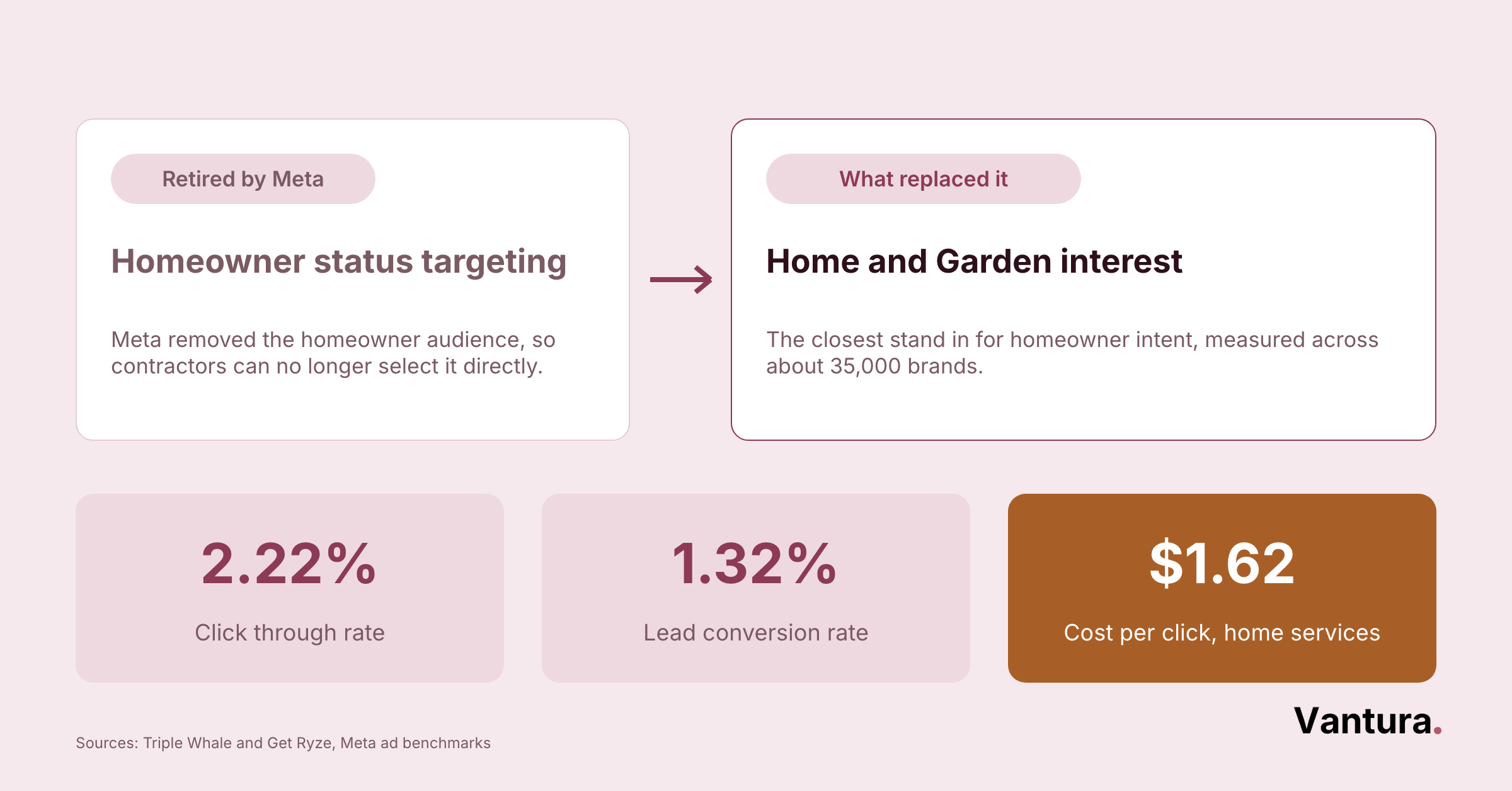
Good targeting starts with your map, not your message. Set a radius you actually serve, then narrow by homeowner status, property type, and the projects you want more of.
Cast too wide and you pay to reach renters and distant browsers. Stay tight and every dollar works harder.
Local Targeting That Matches Your Service Area
Draw your radius around drive time, not just miles, since crews lose money sitting in traffic. Pin the ad to the towns where you want more jobs.
The same local logic runs through our plumbing marketing work, where a five mile radius often beats a whole city. A homeowner clicks faster when the photo shows a house that looks like theirs.
Lookalike, Custom, and Retargeting Audiences
Once you have a customer list, upload it to build a custom audience. Facebook can then find a lookalike group that shares traits with your best past clients.
Retargeting is the other half. People who visited your site or watched your video already know you, so a gentle nudge brings many of them back.
This layered approach is a staple of our small business marketing help for trades. It lets a modest budget behave like a much bigger one.
- Who: homeowners who have never heard of you.
- Goal: introduce your work and build recognition.
- Creative: strong before and after proof.
- Who: past visitors, video viewers, and your customer list.
- Goal: turn interest into a booked quote.
- Creative: offers, reviews, and a clear next step.
Keep in mind: A cold homeowner and a warm one need different ads. Asking a stranger to book a quote rarely works, while asking someone who already watched your video often does. Match the message to how well they know you.
What Should You Budget for Construction Facebook Ads?
Most contractors can run a real test on a modest budget. In our experience, a monthly spend of about $1,500 to $2,200 is enough to learn what works in a single service area.
Cost per lead swings with your market and offer. Across our work with trades, we usually see it land somewhere between $25 and $45 for residential jobs, though high value remodels can run higher.
Let Facebook control bids at first with its lowest cost setting. A quick marketing audit of past spend often shows where budget leaked before Facebook even entered the picture.
Budget note: Don’t split a small budget across five audiences. With limited spend, Facebook needs enough signal to learn, so one or two audiences will almost always beat a scattered account. Concentrate first, then expand.
How Do You Write Construction Facebook Ad Copy That Converts?
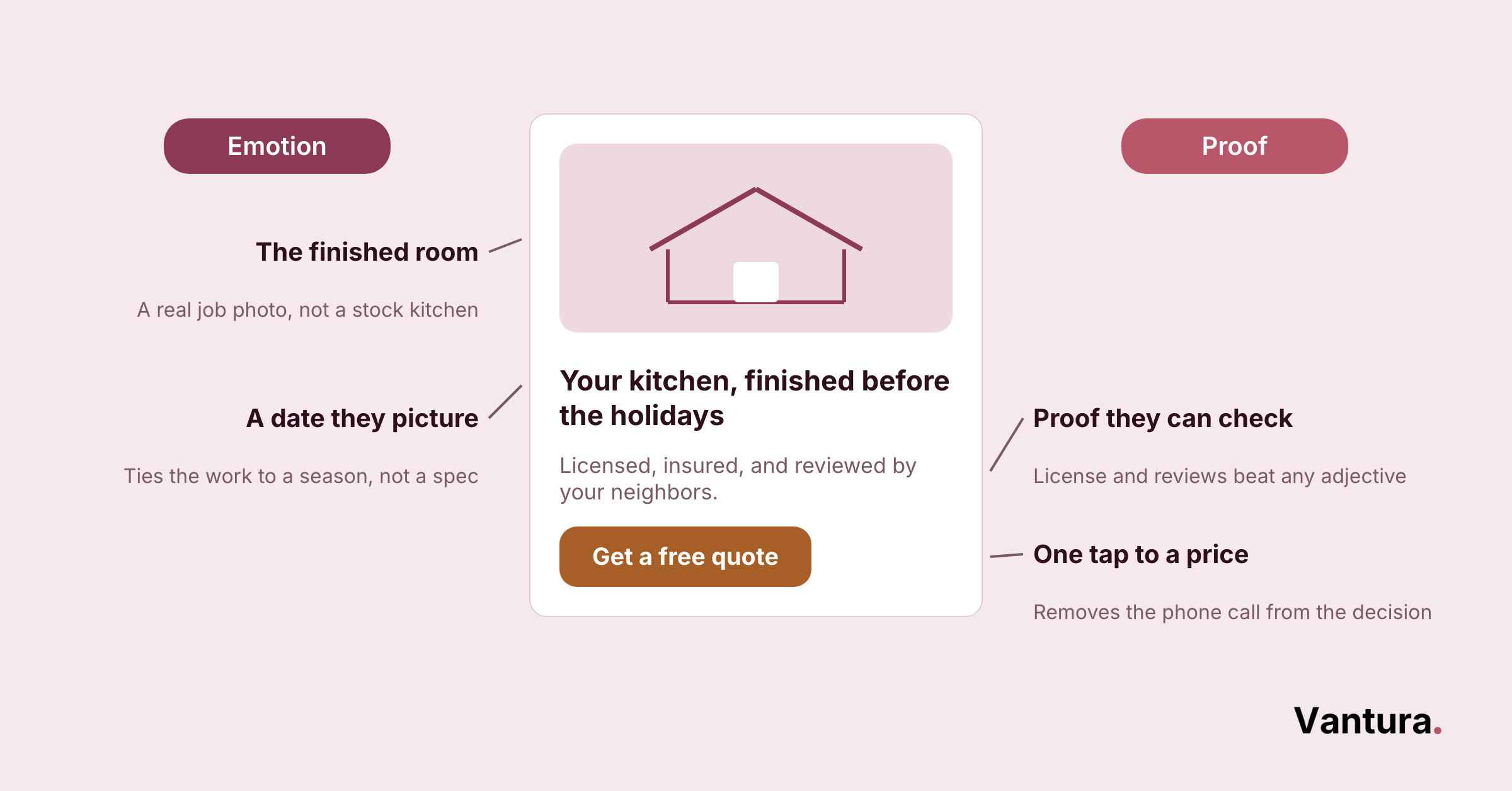
Strong construction copy is short, specific, and built around one clear offer. Lead with the result the homeowner wants, then tell them exactly what to do next.
Skip the jargon and the long company history. People scroll fast, so the first line has to earn the second.
When we handle this inside our marketing consulting engagements, the winning ad is usually the plainest one. Clarity almost always outsells cleverness.
Two Angles Every Ad Should Balance
The best contractor ads mix feeling with facts.
- Pride: show a home the owner would be proud of.
- Relief: promise a clean, on time job with no stress.
- Trust: real photos and a familiar local face.
- Proof: reviews, ratings, and years in business.
- Offer: a clear quote, warranty, or seasonal deal.
- Ease: one tap to ask for a price.
Copy tip: Write the way you talk on a first site visit. If a sentence sounds like a brochure, cut it, because homeowners trust a builder who sounds like a person, not a billboard.
Construction Facebook Lead Ads and Form Campaigns
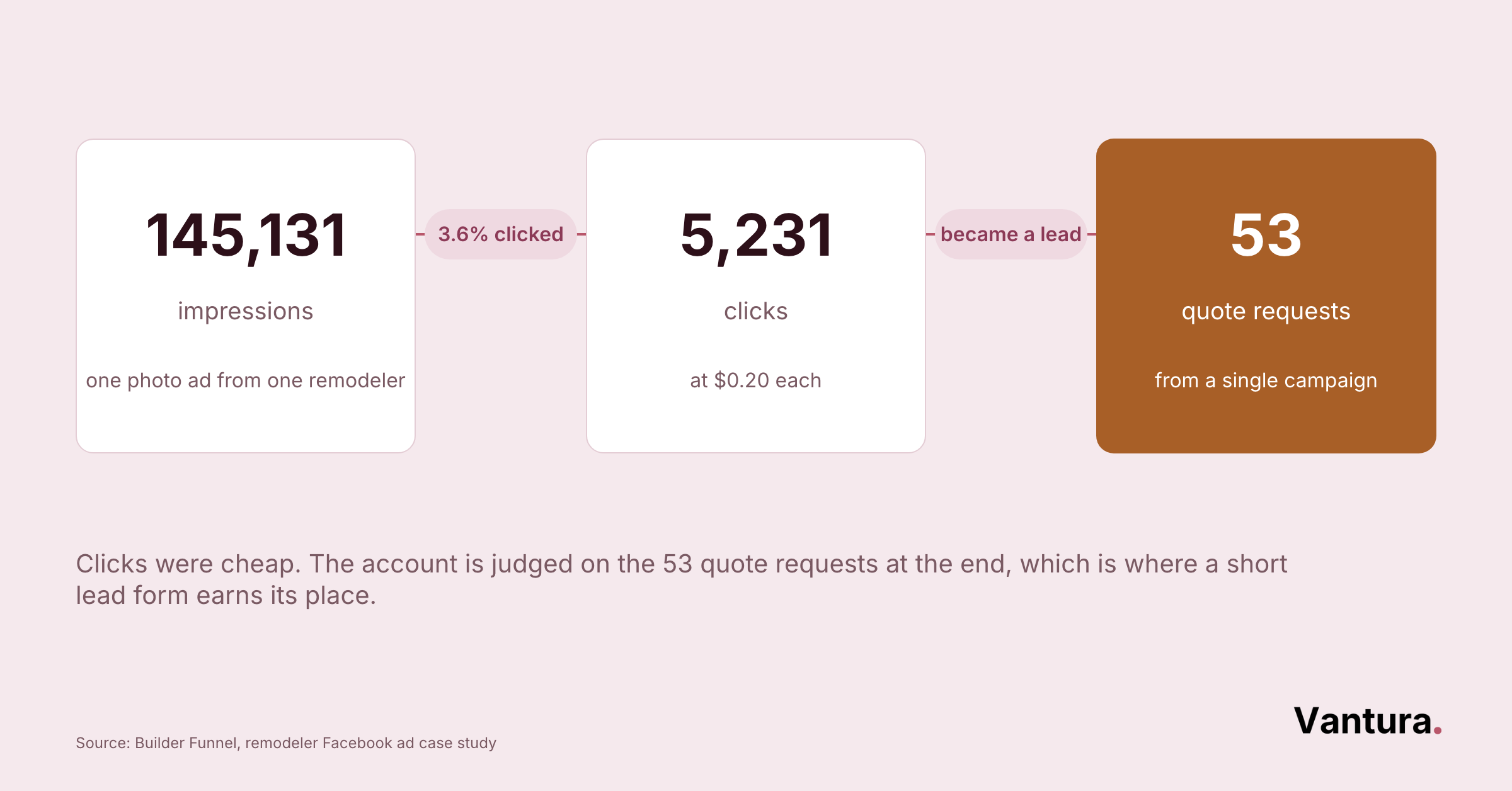
Lead ads let homeowners ask for a quote without leaving Facebook. The form opens instantly, pulls in their name and number, and sends it straight to you.
That speed is the whole point. In our experience, the faster you call a fresh lead back, the more of them turn into booked jobs.
For commercial builders, the same forms feed a longer sales cycle, which is where our B2B marketing approach takes over. A warehouse bid and a bathroom remodel need very different follow up.
Keep the form short. Three fields beat ten, since every extra question drops a few more people.
Setting Up the Meta Pixel and Conversion Tracking
The Meta pixel is a small piece of code on your website that tells Facebook what visitors do. Without it, you’re flying blind on which ads create leads.
Install it once, then define the actions that matter, like a form submit or a quote request. Facebook uses that data to find more people who take the same action.
Conversion tracking closes the loop between spend and jobs, and it’s the same backbone behind our integrated marketing work across channels. When it runs right, you see which ad, not just which campaign, brought in the call.
Setup note: Set up the pixel before you spend a dollar, not after. The data it gathers early is what teaches Facebook who your buyers are, and you can’t get those first weeks back once they’re gone.
How Do You Test and Optimize Construction Facebook Ads?
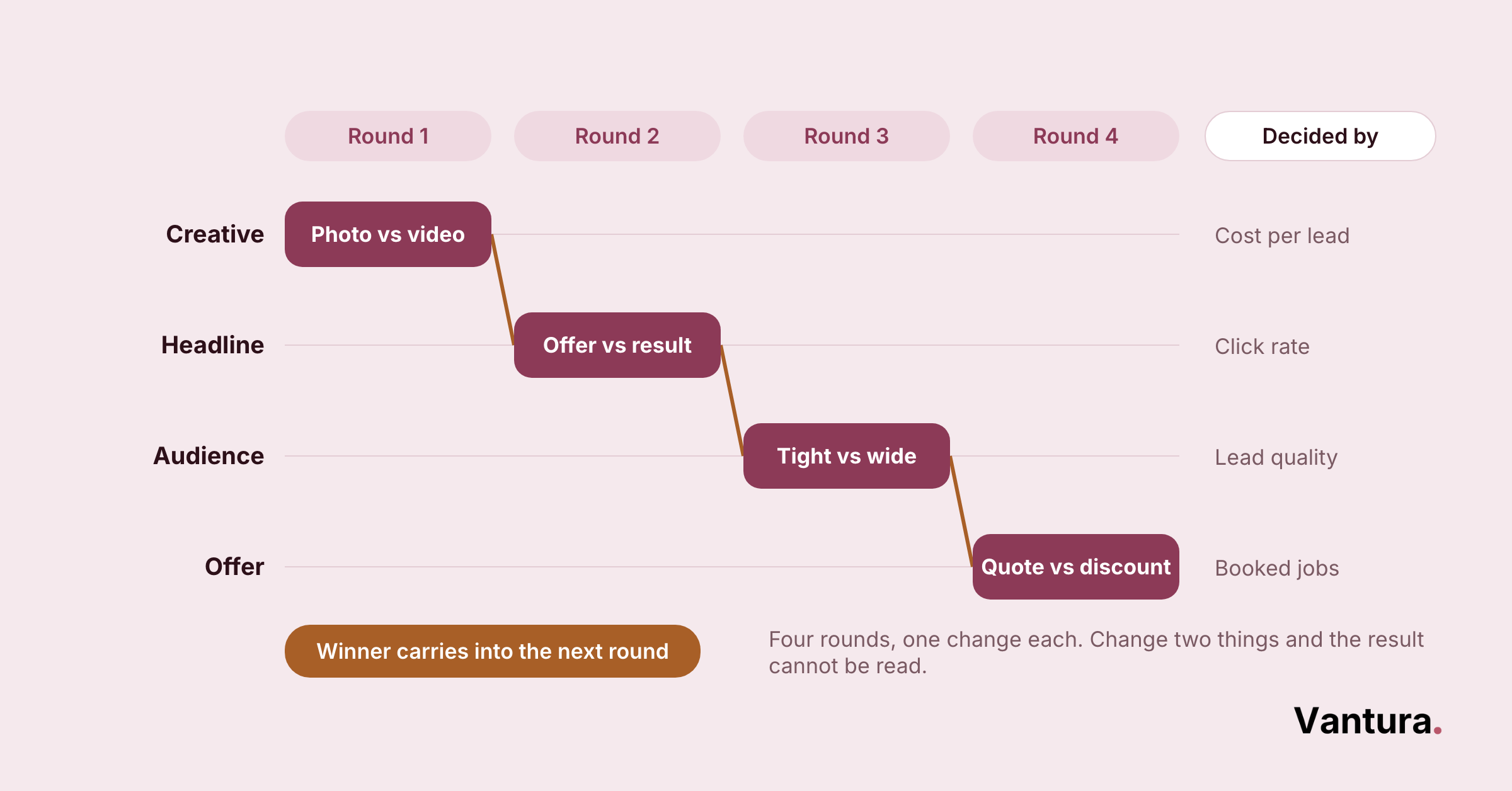
Testing means changing one thing at a time and letting the numbers decide. Try two headlines or two images, keep the winner, and retire the rest.
Give each test enough time and budget to be fair. Judging an ad after a day is like judging a job after the first hour.
- Creative: photo versus video, or one project versus another.
- Headline: offer led versus result led wording.
- Audience: a tight radius versus a wider one.
- Offer: free quote versus a seasonal discount.
Getting Comfortable Inside Ads Manager
Ads Manager is where every test, budget change, and result actually lives, so skipping past it for the mobile app notifications leaves you guessing. Learn the breakdown menu early, since splitting results by placement or age often explains a slow week faster than staring at the total number.
Save your best performing audiences once you find them, so you are not rebuilding the same radius and interests every time you launch a new ad set. A simple naming convention for campaigns and ad sets, built around the service and the month, saves real time once an account grows past a handful of tests.
Check the account weekly instead of daily, since daily numbers bounce and can push you into changes you will regret. A steady weekly review is what keeps several campaigns manageable once an account grows past a handful of ad sets.
Ads Manager is where you watch all of this. We keep the same rhythm across our electrician marketing accounts, where steady weekly checks beat constant tinkering.
Which Metrics Prove Your Construction Facebook Ads Are Working?
The metrics that matter tie back to jobs, not vanity. Cost per lead, lead quality, and booked revenue tell you far more than likes or reach ever will.
Watch a small set of numbers and read them in context, since marketing analytics only shapes about 53 percent of decisions industry wide, reports Gartner. A rising cost per lead is fine if those leads are closing bigger jobs.
In our roofing marketing accounts, one strong storm season can shift every number overnight. Context is what stops a good week from looking like a crisis.
| Metric | What it tells you | What we watch for |
|---|---|---|
| Cost per lead | What each inquiry costs | Sudden spikes or drops |
| Click through rate | How well the ad grabs attention | Weak creative if it dips |
| Lead to quote rate | Whether the leads are real | Poor targeting if it falls |
| Booked revenue | The number that pays the bills | The true test of the account |
Quick check: If you only track one number, track cost per booked job, not cost per lead. Cheap leads that never turn into work are the most expensive kind, and that single view keeps you honest.
Construction Facebook Ads vs Instagram Ads
Facebook and Instagram run through the same ad system, so you rarely pick just one. The real question is where your audience spends time and which format fits your work.
Facebook skews a bit older and leans on detail and reviews. Instagram is more visual and younger, which suits striking before and after shots.
| Consideration | ||
|---|---|---|
| Audience | Broad, skews older | Visual, skews younger |
| Best content | Reviews, offers, lead forms | Photos, Reels, transformations |
| Homeowner intent | Strong for local services | Strong for inspiration |
| Contractor fit | Most residential jobs | Design led remodels |
We often split budget across both inside our HVAC marketing accounts, then let results decide the share. There’s no need to guess when the data will tell you.
How Do You Scale Construction Facebook Ads and Stay Compliant?
Scaling works best in small, steady steps, not big jumps. Raise budget on your best ad sets slowly, and keep fresh creative ready so you never lean on one tired ad.
Growing too fast resets Facebook’s learning and spikes your costs. Patience here protects the results you already earned.
Keeping Ads Within Facebook’s Rules
Facebook is strict about claims, some before and after images, and anything that feels personal. Construction is usually safe, but sloppy wording can still trip a rejection.
Avoid promises you cannot keep and language that singles people out. Clear, honest ads clear review faster and stay live longer.
Matching Ads to the Right Landing Page
An ad is only half the job, since the page it points to has to keep the promise. If the ad offers a free roof inspection, that page should open on exactly that, not your home page.
Mismatched pages waste clicks you already paid for. A tight match between ad and page is one of the cheapest wins in the whole account.
Common Construction Facebook Ad Mistakes to Avoid
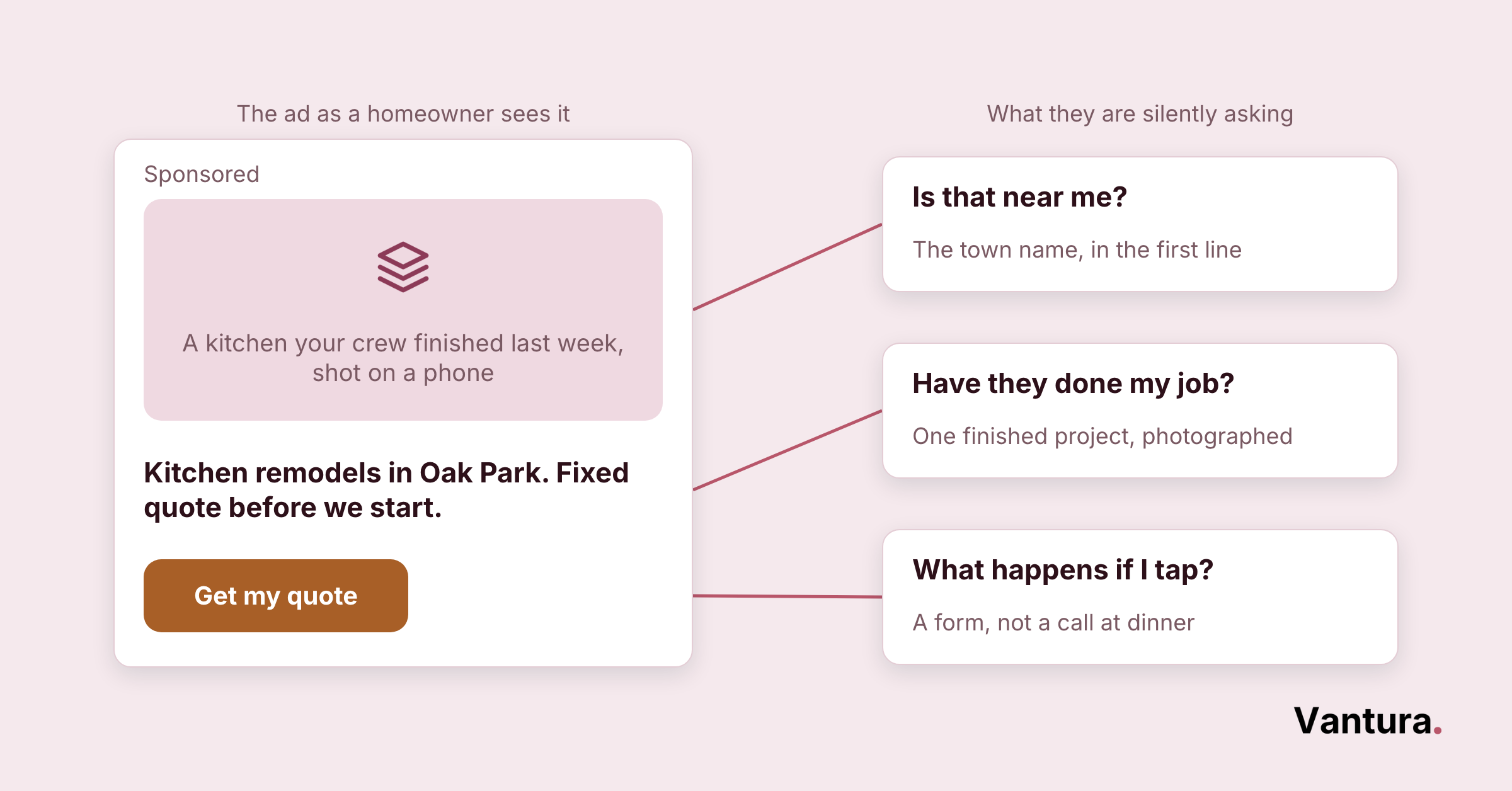
Most failed contractor campaigns share the same handful of errors. Fix these and you’re ahead of most builders running ads in your town.
- Boosting posts: the boost button spends money that Ads Manager would use better.
- Vague offers: ads with no clear next step get scrolled past.
- Wide targeting: reaching a whole state burns budget on the wrong people.
- Stock photos: homeowners can spot a stock image, so real job shots win.
- No follow up: a lead you never call back was money thrown away.
The thread through all of these is patience and focus. Pick one goal, one tight audience, and real photos, then give it time to work.
Disclaimer: This article is for general informational purposes only and does not constitute marketing, legal, or financial advice. Results vary by market, budget, and execution, and Vantura Marketing makes no guarantees of specific outcomes.