Construction Digital Marketing KPIs to Track in 2026

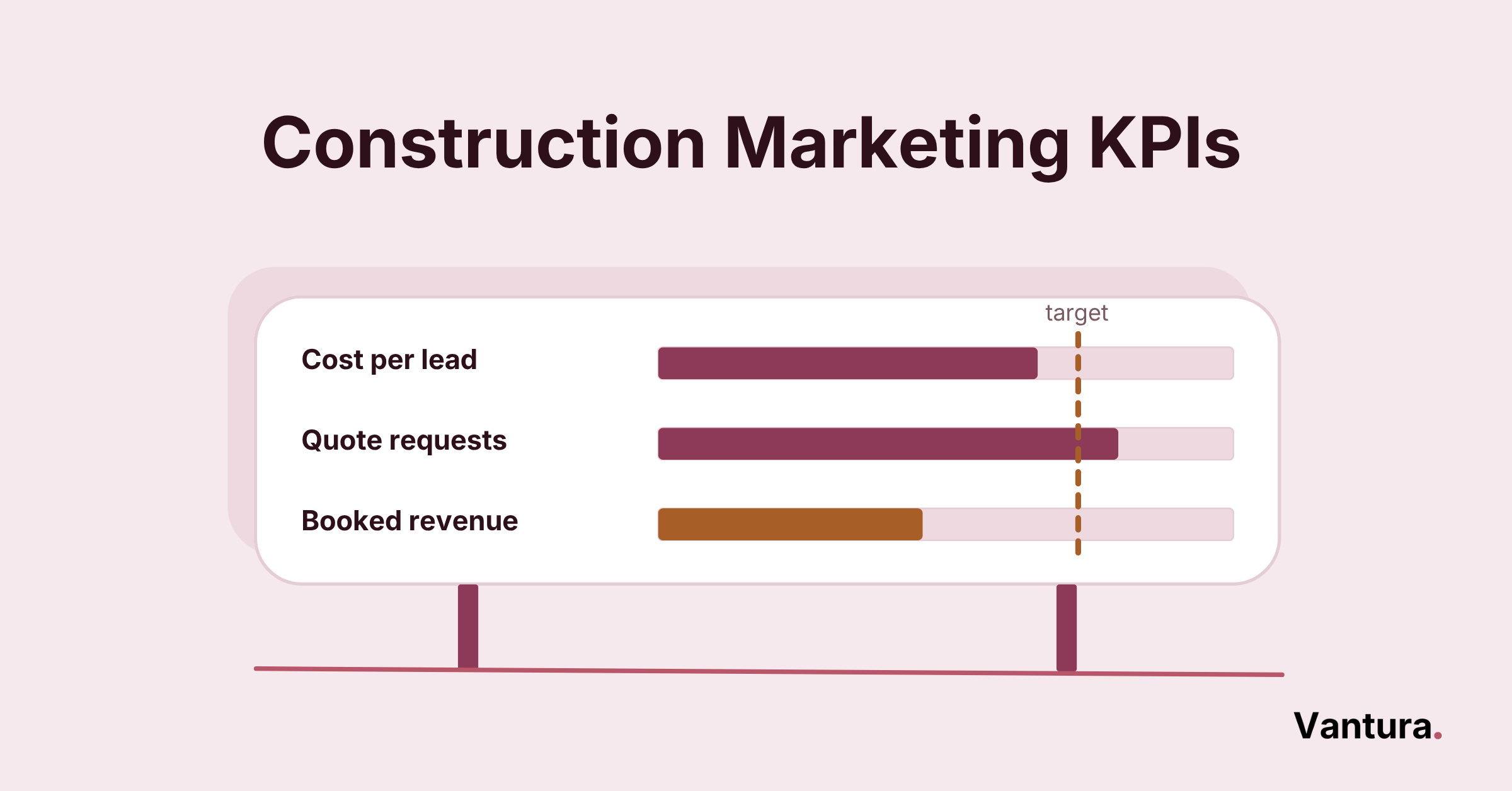
Construction digital marketing KPIs are the few measurable results that show whether your online marketing wins real projects, not just clicks, from qualified leads and cost per lead to organic rankings and return on ad spend. Most contractors track dozens of numbers, yet only a handful truly predict revenue. The trick is picking the metrics tied to booked work and watching them closely.
Why contractors trust our KPI guidance:
We have run over 750 A/B tests and delivered more than 180 campaigns, so we know which numbers move revenue. Across those projects, clients see a 4.2x average lift in qualified leads within 90 days.
Need help tracking the right KPIs?
If your reports feel busy but unclear, a digital marketing audit can show which metrics matter for your firm, and we will help you tie them to steady, booked work.
What Are Construction Digital Marketing KPIs?
Construction digital marketing KPIs are the small set of numbers that prove whether your marketing brings in real jobs, not just website visits. They track things like qualified leads, cost per lead, and the revenue tied to each channel.
The strongest ones connect straight to money in the bank. Everything else is background noise you can safely glance at and move on.
Most contractors we meet drown in dashboards, yet they still cannot say what is working. That gap is more common than you would think.
Constant Contact found that about 73% of small businesses are not confident their marketing strategy is working, and construction firms are no exception. A short, honest KPI set is how you close that confidence gap.
Construction KPIs vs Metrics vs Goals
People swap these three words around, but they are not the same thing. A quick way to keep them straight is to line them up side by side.
| Term | What It Means | Construction Example |
|---|---|---|
| Goal | The business outcome you want | Book 20 more remodels this quarter |
| Metric | Any number you can measure | Website sessions, email opens, ad clicks |
| KPI | The metric that proves progress toward the goal | Qualified quote requests per month |
| Target | The number that marks success on a KPI | 35 quote requests by month end |
Worth knowing: A metric only becomes a KPI when it is tied to a goal. You can track sessions all day, but until more sessions reliably predict more signed contracts, it stays a metric and never earns a spot on your scoreboard.
How Do You Choose the Right KPIs for Construction Marketing?
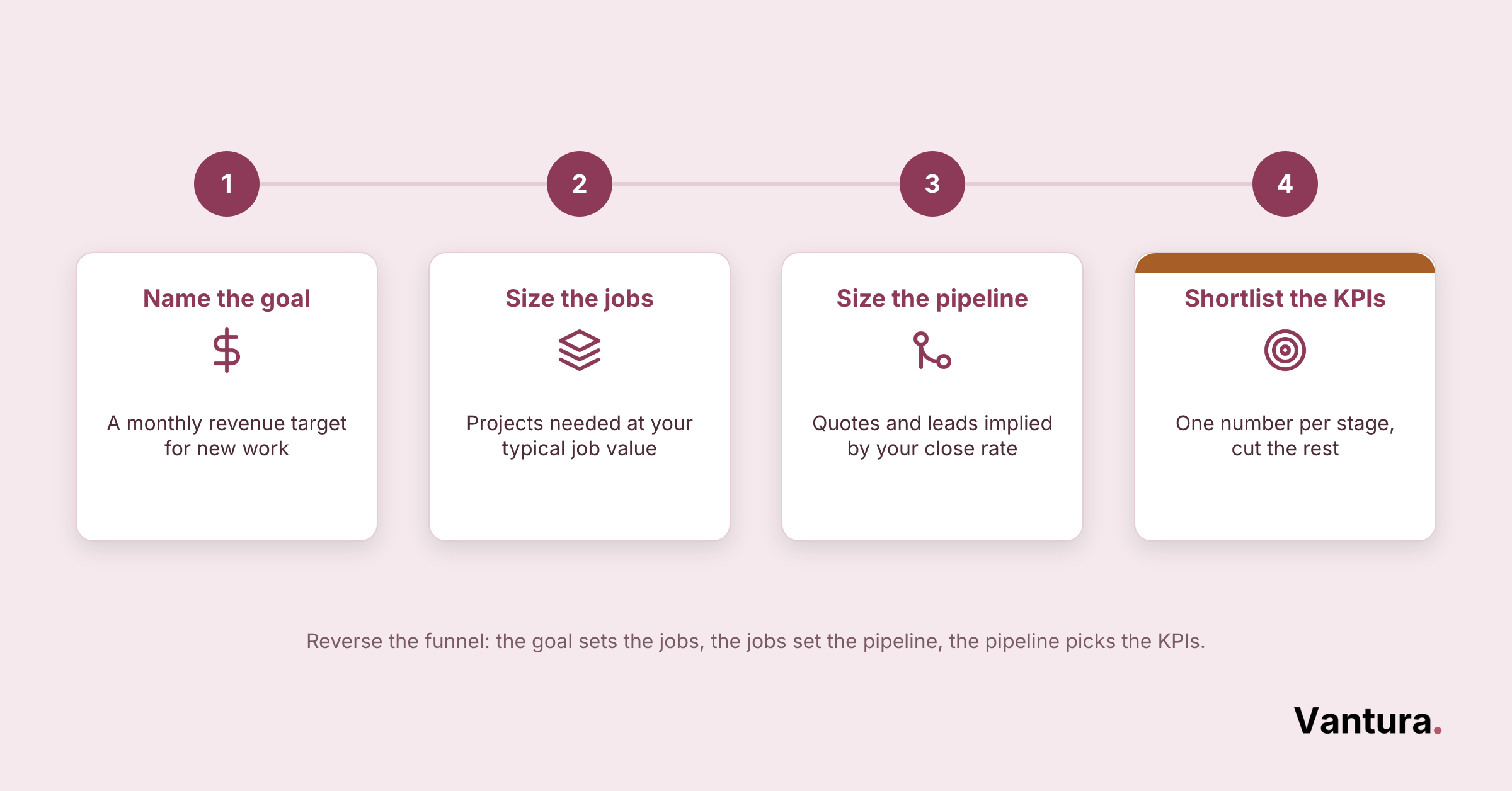
Choose construction marketing KPIs by starting from your revenue goal and working backward to the few numbers that predict it. Pick metrics you can measure reliably, tie each one to a decision, and cap the list so your dashboard stays readable.
If shortlisting feels overwhelming, our marketing consulting team can help you narrow a messy report down to the handful of numbers worth watching. We do this at the start of nearly every engagement.
- Start with the money goal. Name the revenue or job count you want this quarter before you look at any metric.
- Map the buyer journey. Sketch how a client goes from first search to signed contract, stage by stage.
- Pick one KPI per stage. Choose a single number that best shows movement through each step.
- Check that each number is trustworthy. Drop any metric your tools cannot measure cleanly and consistently.
- Set a baseline. Record where each KPI sits today so you can tell real change from noise.
- Trim the list. If a KPI will not change a decision, cut it and keep the dashboard short.
Which Website and Lead KPIs Matter Most for Contractors?
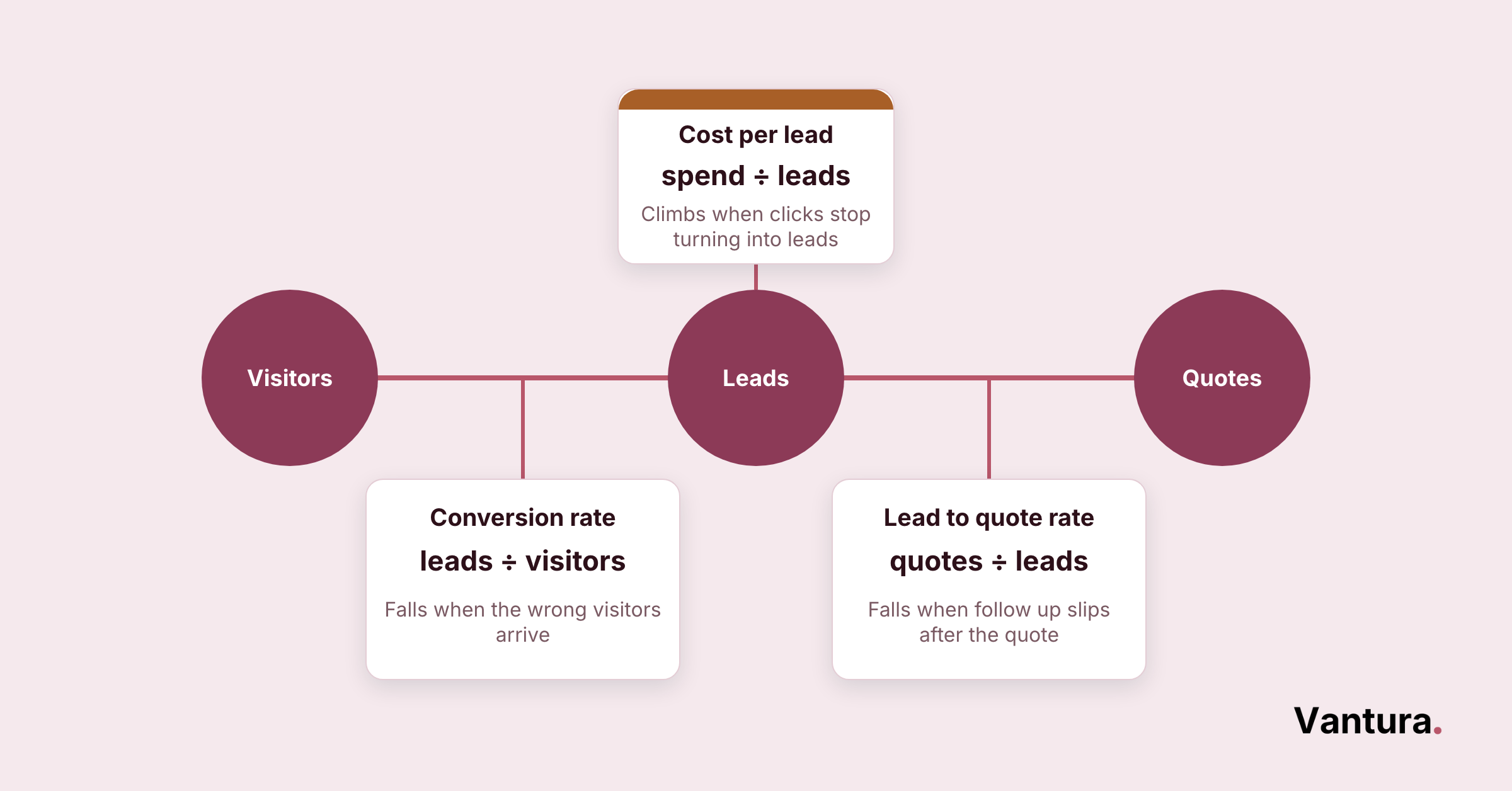
For most contractors, the website and lead KPIs that matter most are traffic quality, conversion rate, cost per lead, and lead-to-quote rate. Together these four tell you if the right people find you and then raise their hand.
Website Traffic and Engagement KPIs
Traffic numbers are where most contractors start, and that is fine as long as you look past the headline count. Where visitors come from usually says more than how many show up.
- Traffic by source: how much comes from search, ads, social, and referrals
- Engaged sessions: visits where someone reads or clicks something
- Top landing pages: which service pages pull the most attention
- Device split: how mobile and desktop visitors behave differently
We fold these into integrated campaigns so paid and organic traffic feed one shared scoreboard instead of two rival reports. That way a spike in one channel does not hide a slump in another.
Lead Generation and Conversion KPIs
This is where marketing starts to pay for itself. Conversion rate, cost per lead, and lead-to-quote rate turn raw traffic into a pipeline you can plan around.
Across our construction campaigns, a healthy site turns about 3 to 4 percent of visitors into leads, and the best get a little higher. Smaller crews often win here first, which is why small business marketing leans hard on conversion before spending more on traffic.
Field note: A contractor site with great traffic but few calls almost always has a form or phone problem, not a traffic problem. Fix the path from click to call before you buy a single extra click.
How Do You Measure Construction SEO, PPC, and Social KPIs?
Measure each channel by the numbers that show booked work, not vanity reach. SEO lives on rankings and organic leads, paid media on cost per lead and return, and social on engagement that turns into real conversations.
SEO KPIs and Organic Performance
Organic search rewards patience, so its KPIs are slower and steadier. Watch keyword rankings, organic leads, and calls from your Google Business Profile rather than raw impressions.
Local Visibility Signals
Local pack position and review volume matter far more than national rank for a company that serves one region. A roofing company that climbs into the map pack will feel it in booked jobs long before a broad ranking ever moves.
PPC and Paid Media KPIs
Paid media is where a loose KPI gets expensive fast. Cost per lead, conversion rate, and return on ad spend keep spend honest, while quality score quietly lowers your costs when you tend to it.
In our experience, cost per lead for contractors usually lands between 120 and 180 dollars, higher for competitive commercial work. Paid media now stretches well past search too, so channels like Reddit ads deserve the same cost discipline you give Google.
Social Media Marketing KPIs
Social is easy to measure badly. Follower counts feel good, but engagement rate and leads from social tell you whether anyone is listening.
Visual trades do well on image-first platforms, so Pinterest ads can be worth tracking beside your feed engagement and saved posts. Campaign after campaign, the comments and direct messages predict booked jobs better than likes ever do.
| Channel | KPI to Watch | What Good Looks Like |
|---|---|---|
| Organic search | Organic leads and map pack rank | Steady month-over-month lead growth |
| Paid search | Cost per lead and return on ad spend | Cost per lead below your average job margin |
| Social | Engagement and leads from social | Comments and messages that turn into quotes |
| Retargeting | Return visits and assisted conversions | Lower overall cost per booked job |
Construction Email and Content Marketing KPIs
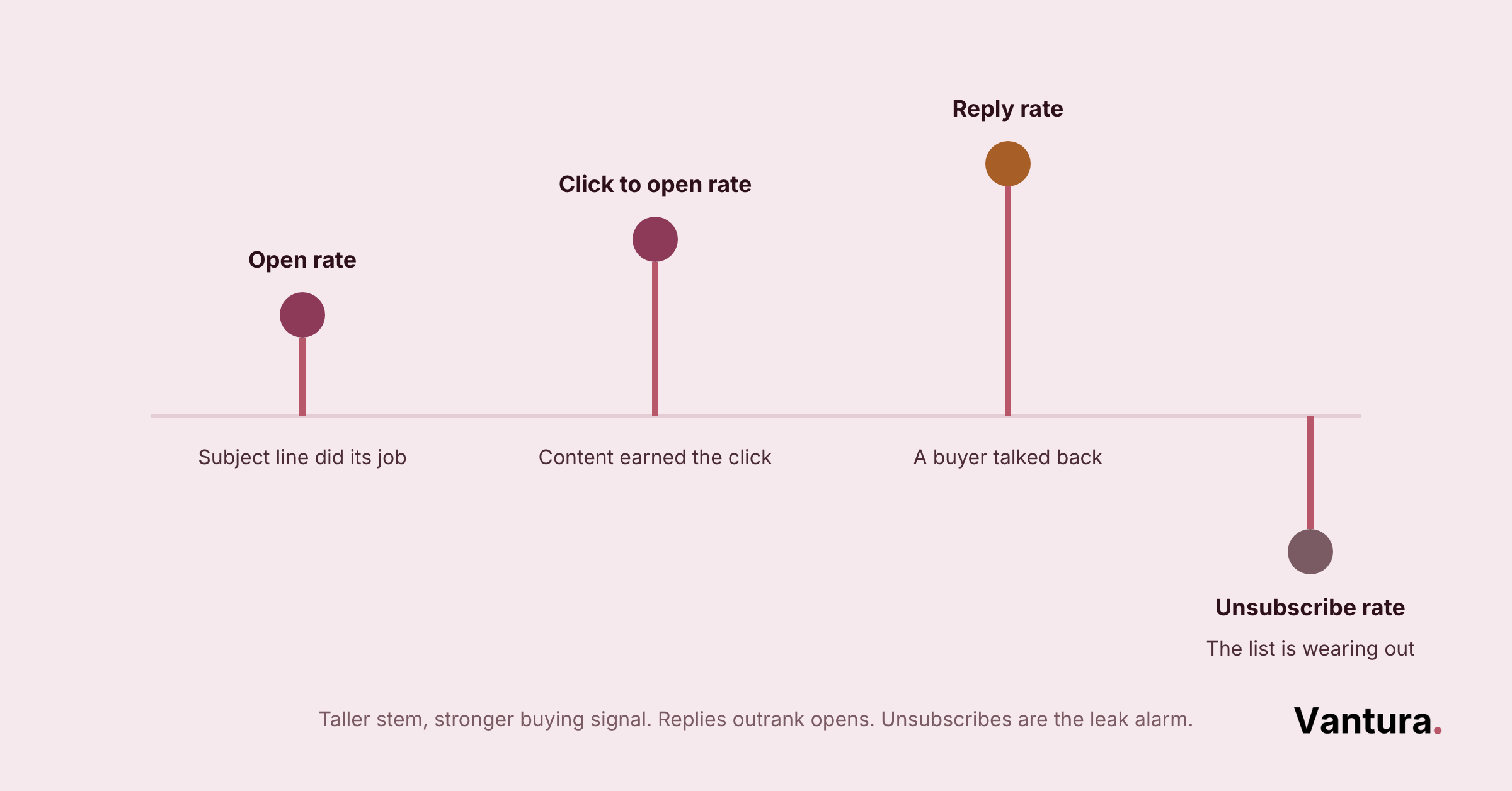
Email and content are the slow-burn channels that hold a pipeline together between projects. Their KPIs reward consistency over quick wins.
Email Marketing KPIs and Benchmarks
Open rate gets all the attention, but click-to-open rate and reply rate tell you if the message actually landed. Watch unsubscribe rate too, since a rising one is an early warning.
Deliverability and List Health
Across our contractor lists, reply rates sit around 2 to 3 percent on a well-kept list, and they collapse the moment deliverability slips. Many firms hand this to outsourced marketing support so someone watches bounce rates and spam flags every week instead of once a quarter.
Content Marketing Performance KPIs
Content pays off in assists more than direct sales, so measure it that way. Track organic traffic to each post, time on page, and how often content touches a lead before they request a quote.
What stands out over the years is that a single strong project guide can feed leads for a long time. One good case study often outperforms ten thin blog posts, so we watch depth of coverage rather than volume.
What Do CAC and Customer Lifetime Value Tell Construction Firms?
Customer acquisition cost and lifetime value tell you whether a marketing channel makes or loses money over the full relationship. CAC is what you pay to win a client, and lifetime value is what that client is worth across every job they ever book with you.
| Metric | How to Calculate | Why It Matters |
|---|---|---|
| Customer acquisition cost | Total marketing spend divided by new clients won | Shows the true price of each new project relationship |
| Customer lifetime value | Average job value times repeat jobs per client | Reveals how much you can afford to spend to win work |
| Value to cost ratio | Lifetime value divided by acquisition cost | Flags channels that quietly lose money |
| Payback period | Months until a client repays their acquisition cost | Protects cash flow between large projects |
Across our projects, a healthy payback period sits around 4 to 6 months for most residential work. Commercial jobs run longer, but the value they carry usually earns back the wait. Getting these numbers right usually comes down to a solid marketing strategy, not chasing a new channel every quarter.
Rule of thumb: If it costs more to win a client than that client will ever pay you, the channel loses money no matter how good the leads look on paper. We like to see lifetime value at least three times the cost to acquire.
How Do Marketing KPIs Connect to Construction Sales?
Marketing KPIs connect to sales through a shared definition of a good lead and the rates that move one down the pipeline. Lead-to-quote rate, quote-to-close rate, and sales cycle length are where marketing and the sales team finally speak the same language.
Construction selling is B2B lead pipelines at heart, with committees, site visits, and long cycles. Without shared definitions, marketing celebrates leads that sales quietly throws away.
From our work with contractors, lead-to-quote often runs around 30 to 40 percent, and quote-to-close lands near 25 to 35 percent. The leads almost always stall at the quote follow-up, so that is the number we push clients to guard.
Construction Digital Brand Awareness KPIs
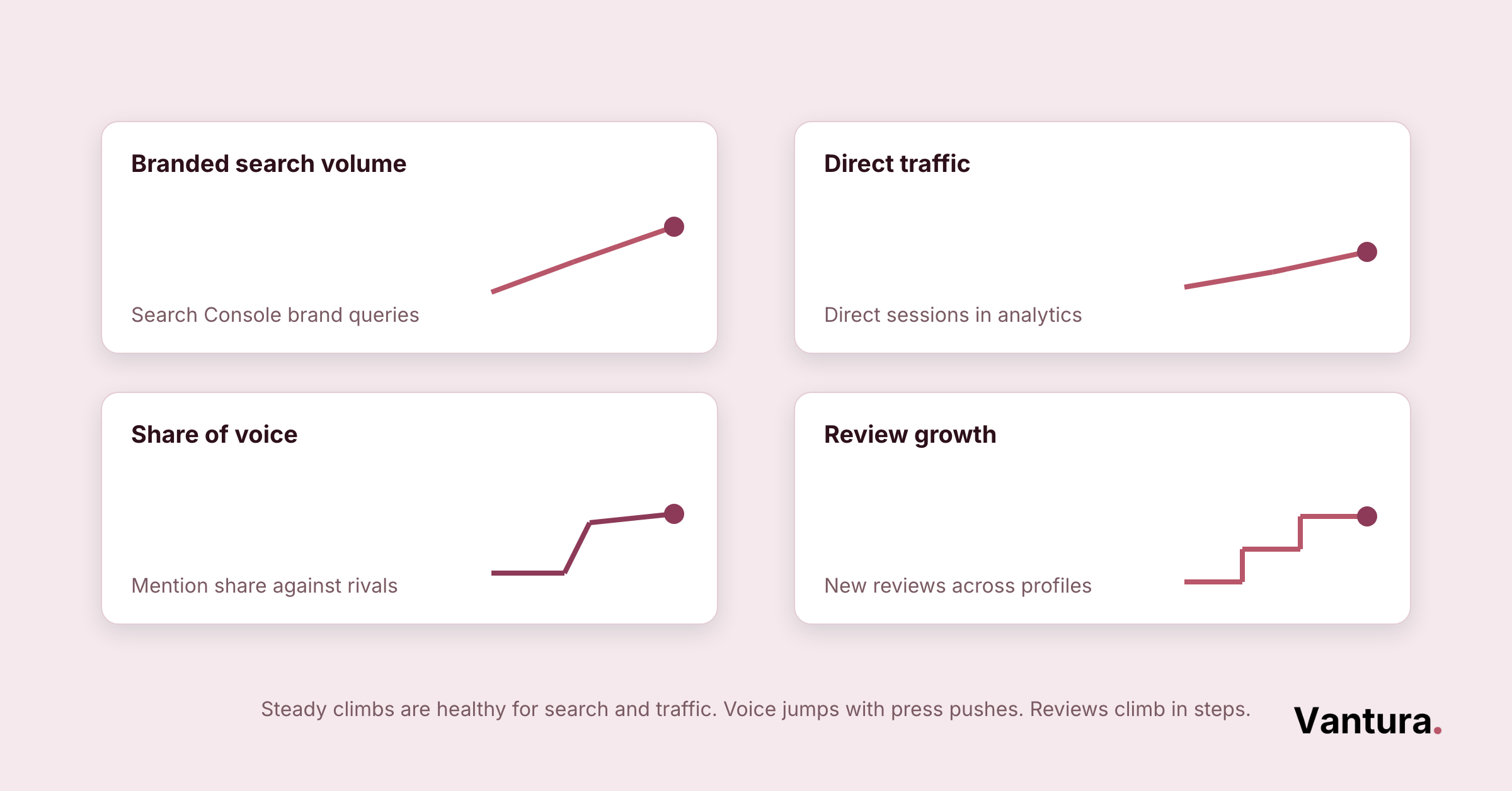
Brand awareness KPIs measure how well buyers recognize and remember you before they ever need a bid. Branded search volume, direct traffic, share of voice, and review growth are the honest signals here.
Awareness matters because buyers check you out long before they call, and it matters for hiring too. In our experience, a strong online presence pulls in younger job candidates almost as reliably as it pulls in customers, so a firm’s digital footprint does double duty as recruiting content and sales content.
This holds whether you serve homeowners or chase industrial and commercial marketing bids. Time and again, the firms with strong branded search close warmer, faster deals because the trust is already there.
How Do You Set Construction Marketing KPI Targets?
Set construction marketing KPI targets from your own baseline, a realistic growth rate, and a firm deadline. Targets pulled from thin air either crush morale or get ignored, so ground each one in a number you have hit before.
- Measure your baseline for at least one full cycle.
- Add a realistic growth rate, not a hopeful one.
- Attach a date so the target has teeth.
Targets differ by trade, so an HVAC contractor chasing summer demand sets very different monthly goals than a general contractor bidding a few large annual projects. We used to hand every client the same growth target, and after enough missed quarters we do the opposite now.
Keep in mind: A target with no deadline is just a wish. Tie every KPI goal to a date and a specific number, then review it before the next quarter starts so nothing drifts.
How Do You Build a Construction Marketing KPI Dashboard?
Build a construction marketing KPI dashboard on one screen, grouped by funnel stage, pulling from a single source of truth. The goal is a view you can read in thirty seconds and trust without double-checking.
Keep it simple and automate the data so nobody rebuilds it by hand each Monday. Bigger firms running many locations lean on enterprise marketing dashboards that roll every branch into one clean view.
Reporting Frequency and Updates
Not every KPI needs the same rhythm. Paid campaigns want a weekly look, while brand and SEO trends only make sense over months.
- Daily: a quick glance at active ad spend and lead flow
- Weekly: paid performance and cost per lead by channel
- Monthly: full funnel review against targets
- Quarterly: a deeper audit of what to keep or cut
Leading vs Lagging Construction Marketing KPIs
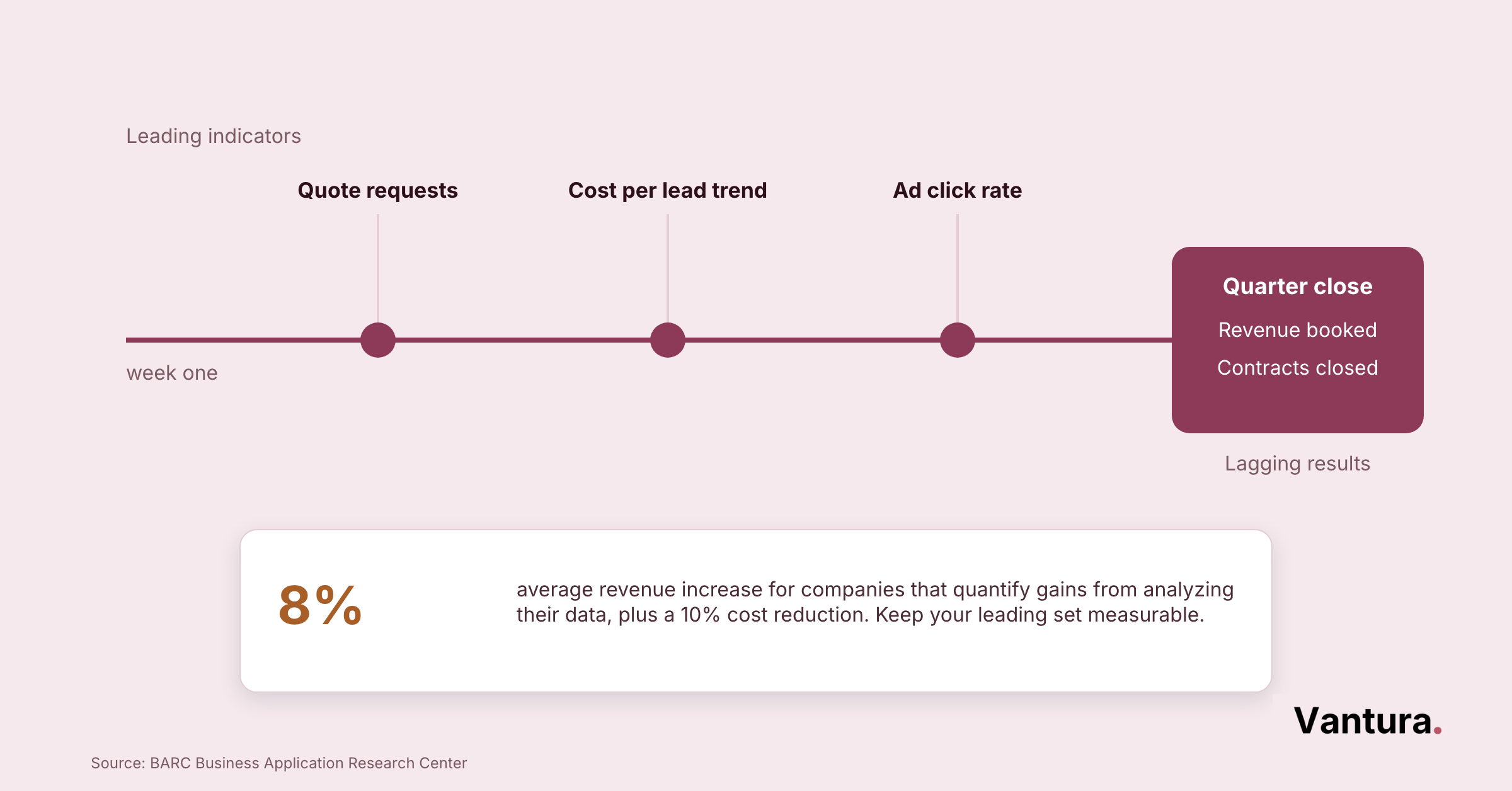
Leading KPIs predict results, while lagging KPIs confirm them after the fact. You need both, but the leading ones give you time to fix a problem before it hits revenue.
How the Two Compare
- Cost per lead trend
- Quote requests this week
- Ad click-through rate
- Pipeline value in progress
- Revenue booked
- Contracts closed
- Cost per acquisition
- Return on ad spend
When Should You Adjust Your Construction Marketing KPIs?
Adjust your construction marketing KPIs when the business changes, the season turns, or a metric stops driving decisions. A KPI you never act on has already retired, so let it go.
Watch for a few clear triggers. A new service line, a busy season, or a fresh channel all shift which numbers matter.
The honest signal is boredom in the report. When a KPI never sparks a conversation or a change, swap it for one that does before your dashboard turns into wallpaper.
What Are the Most Common Construction KPI Tracking Mistakes?
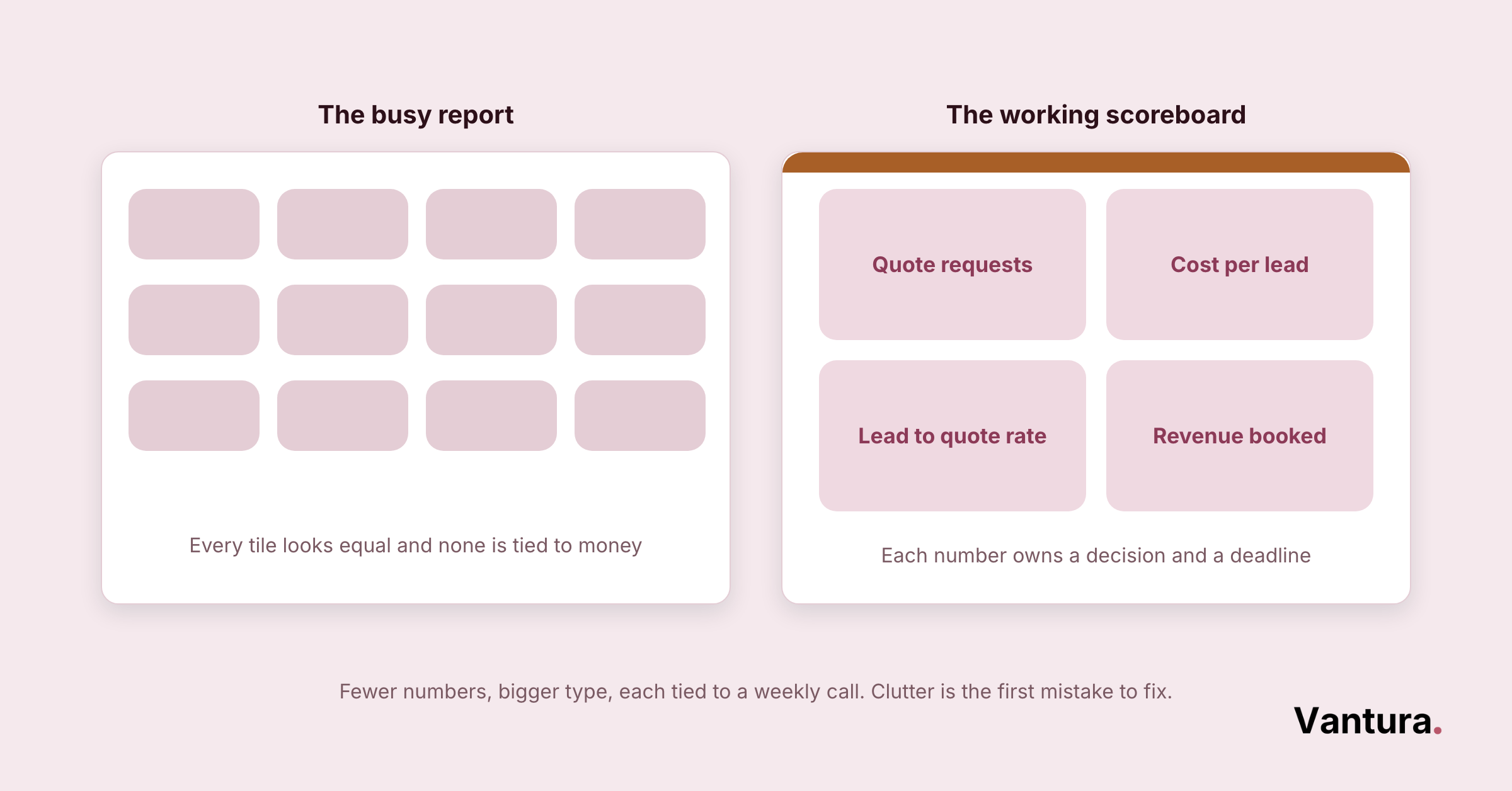
The most common construction KPI tracking mistakes come down to chasing vanity numbers and tracking far too many things. Both leave you busy but no wiser about what books work.
- Vanity metrics: counting followers and impressions instead of leads
- Too many KPIs: a dashboard so crowded nobody reads it
- No baseline: no way to tell real change from noise
- Ignoring attribution: guessing which channel earned the lead
- Set and forget: never revisiting targets as the market moves
We have watched contractors track twenty numbers and still miss the one that mattered. Fewer, sharper KPIs almost always beat a wall of charts.
Bottom line: The best construction KPI set is short, tied to revenue, and reviewed on a schedule. Track less, act more, and keep only the numbers that change what you do next.
Disclaimer: This article is for general informational purposes only and does not constitute professional marketing, financial, or legal advice. Vantura Marketing makes no guarantees about specific results, since outcomes vary by market, budget, and execution.